Belief, not benefits bonanza, drives active engagement with loyalty programs – but it’s a formula of motivation, ability and practical prompting that secures more consumer bucks

Kieran Collins, strategy director, Honeycomb Strategy

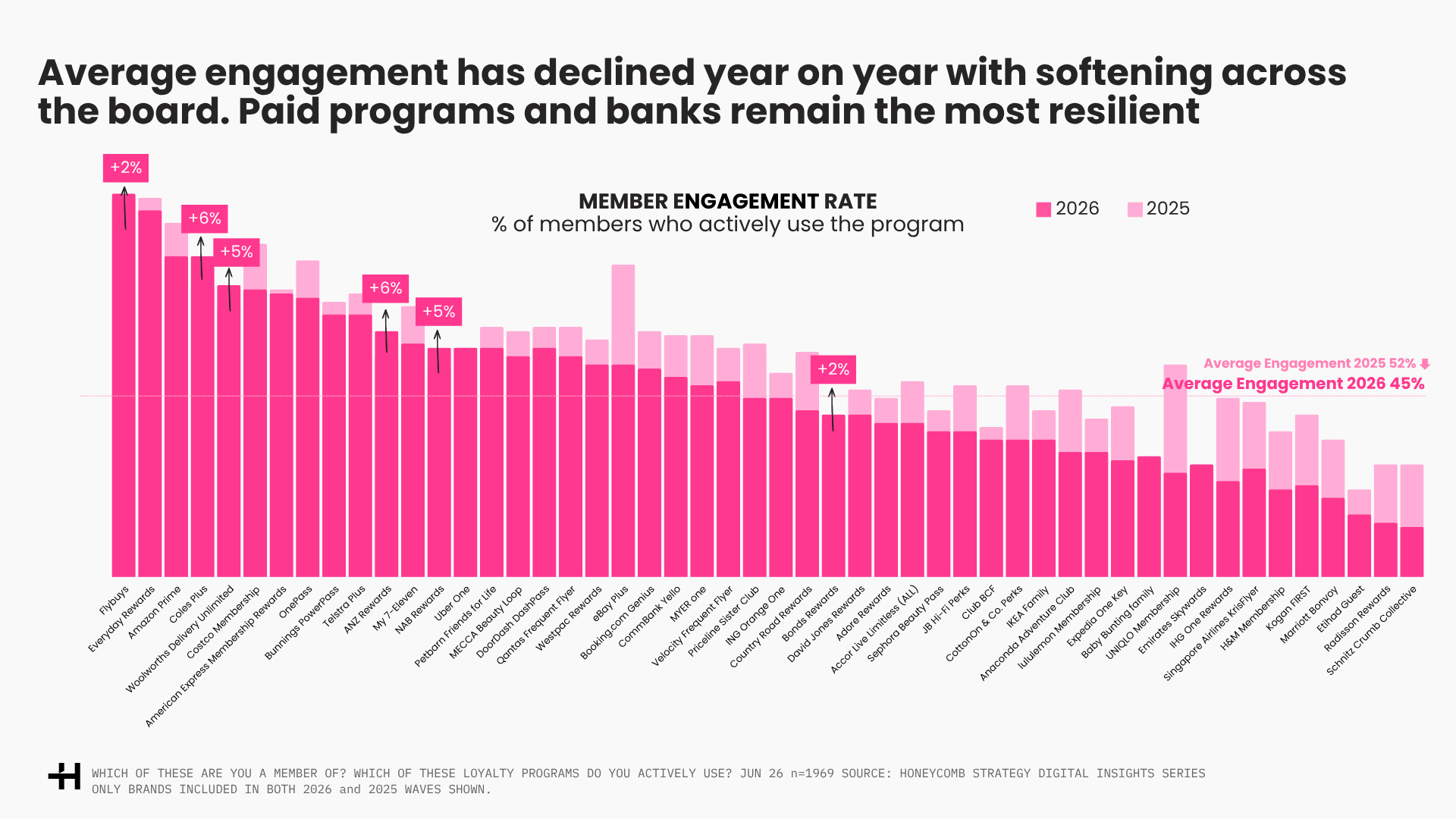
Active engagement in loyalty programs is diminishing, but integrated and paid programs offering participation, led by Amazon Prime and Coles Plus, is on the up, according to the latest Science of Loyalty research from behavioural science agency, Honeycomb Strategy. The extensive analysis across 60 of Australia’s retail, travel, telco, banking and finance and paid programs, also reaffirms that when you can get consumers to engage more, they’ll spend more. The quandary for brands and retailers is that traditional ways of evaluating a program’s chances of success – how many benefits you can stack up against the competitive set, or offering immediate payback – don’t directly correlate to active engagement. Instead, it’s instinctive human behaviours – and most notably, the rise in self-identification with loyalty programs and the brands offering them – that are laddering up to more engagement especially across younger demos, and therefore, more share of the consumer’s wallet. And the winners here? Flybuys, Mecca, AMEX, McDonald’s, Bunnings and Amazon Prime.
Frequency of use still clearly plays a dominant role in Australia’s loyalty program rankings. According to a new and extensive loyalty program study by the team at Honeycomb Strategy, Flybuys remains Australia’s top retail program, followed by Everyday Rewards.
But if you’re looking to secure engagement and therefore more share of wallet in a consumer base that’s shrinking both the volume of programs they’re signed up for, as well as those they’ve actively engaging with, it’s not about just getting your benefits in order. It’s critical you’re also tapping into the human behaviours compelling consumers to choose the shrinking pool of programs they align with, while making it as easy as possible for them to interact, earn and redeem their rewards.
‘The Science of Loyalty’ study, conducted by Honeycomb Strategy, is the second annual report to come out of the market research and behavioural science agency and aims to provide an extensive study of what’s driving loyalty program engagement.
Sixty of Australia's leading loyalty programs were included across retail (including Myer, Flybuys, Bunnings, Rebel Active, Everyday rewards), travel (Qantas Frequent Flyer, Virgin Velocity, Accor Live Limitless, IHG One Rewards), telco and finance (CommBank Yello, American Express Membership Rewards, Telstra Plus) and paid (Kogan First, Amazon Prime, Uber One, Costco). Measures of success focused on membership rate, saliency, active engagement and impact on spend.
Rounding out the top retail ranks after Flybuys and Everyday Rewards were McDonald’s MyMacca’s Rewards, Bunnings PowerPass and Dan Murphy’s My Dan’s. In travel, Qantas topped the list for respondents, followed by Velocity, Booking.com Genius, Accor Live Limitless, Singapore Airlines KrisFlyer and Emirates Skywards.
Amazon Prime was the highest ranking paid loyalty program, followed by Coles Plus, OnePass, Woolworths Delivery Unlimited and Costco Membership. Across average engagement and outside the supermarkets and paid offerings, other categories that held up well included the banks (ANZ Rewards, NAB Rewards).
While the leaderboard is a little different, the study identifies the same loyalty leaders as Adam Posner's For Love or Money study released earlier this year.
Engagement, participation numbers down, paid and integrated programs up
Honeycomb found respondents averaged four loyalty programs, down from five last year. Active engagement rates came in at 45 per cent, also down from 52 per cent last year, signalling average engagement also declined year-on-year. Millennials and Gen X showed the highest levels of membership, while older generations tended to concentrate membership to fewer programs.
“Something the research shows quite strongly is there's a diminishing amount of active engagement within programs we've seen versus last year,” Honeycomb Strategy’s strategy director, Kieran Collin, told Mi3. “I think it's reflective of society as a whole. There are so many inputs happening at the moment. There's so many different directions you can be pulled in, which is why consumers are very much narrowing in and leaning on a few specific programs for themselves.”
It’s potentially why integrated loyalty programs (think Wesfarmers OnePass, or the deals struck between Qantas and financial services companies and retailers such as ANZ and David Jones), are chalking up engagement increases – consumers get multiple brand benefits in one. Collins said it’s such an interesting element, the agency is now in the midst of creating a own second chapter of loyalty all around integrated programs.
But meanwhile, one of Honeycomb’s big findings this year is that there is no direct correlation between the types of benefits offered and the success of the program in driving engagement or spend. Nor does layering in more benefits equal better engagement or increased spend. Top benefit choices group into nine buckets, with the five most common being member-only discounts (90 per cent of programs), points-based rewards (65 per cent), tiered membership levels (44 per cent), free shipping (35 per cent) and anniversary rewards (34 per cent).
“More traditional ways of evaluating the program would be focused on how well it does in terms of offering more benefits that are equal or more likely to win. But more doesn’t necessarily equal better. Similarly, specific benefit types don’t necessarily equal instant success either,” argued Collins.
Instead, Honeycomb argued the programs people most value have one thing in common: They give customers something meaningful back for the effort they put in. And it pays off: According to report findings, the top quartile of programs see more than a quarter of members actively shifting their spend behaviour as a result.
Notably, many on that list were paid programs – Coles Plus, Woolworths Delivery Unlimited, Amazon Prime and Costco Membership. Collins agreed this does tie into the idea of value exchange. “If you have already committed a certain amount of monetary value into the program itself, your perceived value of what you’re going to get out of it is more,” he said.
There’s also a frequency bent to many others in this top quartile – Bunnings Powerpass, Flybuys, eBay plus, ANZ Rewards, Onepass, Uber One and American Express Membership Rewards all made for a strong showing.
We are finding the ‘buy who we are’ becoming more and more prevalent, as well as in other research we’ve done. In self-funded research earlier on the year all around sponsorships, that came out really strongly there, and again specifically with the younger generations. One of my hypothesis is the world is moving a bit more towards disconnect. Being able to find ways to create a bit of a community resonates – Mecca does that really well with the beauty boxes it shares through the program. So it’s an interesting difference that came up between the two [younger versus older] generations.
The human truths driving consumer loyalty program behaviour
But for Honeycomb Strategy, the clincher is when programs are “working with human behaviour and not against it”.
“The core of how we approach things is around human behaviour and behavioural science, so we wanted to see how that was at play within what we’re seeing in the world of loyalty, then understand how that’s having an impact on the winning programs and how they’re leveraging how humans behaviour to win among consumers,” said Collins.
Honeycomb applied its 16 ‘Human truths’ framework, rolled out over the last year, to understand the motivators behind active engagement in loyalty programs. The agency has formulated these behavioural science insight buckets as a way of gaining a practical understanding of consumer behaviour across different environments, buying behaviours, categories and interactions.
“We see them appear in multiple different areas that we look at and across different industries because they speak to how humans behave,” Collins explained.
Across all of top performing loyalty programs in terms of active engagement, four Human Truths were dominant per Honeycomb: ‘We want it now’; ‘We buy who we are’, ‘We hate losing more than we love winning’; and ‘we spend in mental buckets’.
For instance, ‘we want it now’ is about human preference towards smaller rewards now over a bigger reward later on, or what is known as ‘present bias’. A winning example of this per the report is the McDonald’s MyMacca’s Rewards program, which leverages low reward thresholds so benefits are regularly divvied out. As a result, 65 per cent of members said they actively favour McDonald’s as a result of the loyalty program.
“We saw very much how being part of MyMacca’s offered consumers some kind of reward they can instantly get that’s smaller, and how that’s very much better than giving them a larger reward further down the line,” Collins commented.
Mecca’s identifiable winning formula
Beauty retailer, Mecca meanwhile, was the striking example Honeycomb highlighted of its second Human Truth, ‘we buy who we are’, or identity-based motivation. It’s a trend that jumped out to Collins, who reported it becoming increasingly prevalent across loyalty programs and their levels of active engagement. And it’s a behaviour younger generations surveyed exhibiting more frequently than older generations.
“This ties into how, as a consumer, your core values are your beliefs, and the way you self-identify,” Collins said. “That comes through strongly and you can see that within the loyalty programs you're a member of … that’s really positively impacted those programs in the loyalty world. And it’s something we’ve seen in other market research we’ve done as well.”
Mecca’s Beauty Loop program recorded 54 per cent active engagement, higher than competitors such as Adore Rewards (39 per cent) and Sephora Beauty pass (35 per cent). A key reward feature of Mecca’s program is the ability for members to receive their own gift box curated by tier. Per Honeycomb’s report, it works because it turns the conversation from ‘look what I bought’ to ‘look what we got’, while Mecca’s shared language, experiences and recognition via the ‘Beauty Loop’ insiders structure also centre in identity-based rewards.
“We are finding the ‘buy who we are’ becoming more and more prevalent, as well as in other research we’ve done,” Collins commented. “In self-funded research earlier on the year all around sponsorships, that came out really strongly there, and again specifically with the younger generations. One of my hypothesis is the world is moving a bit more towards disconnect. Being able to find ways to create a bit of a community resonates – Mecca does that really well with the beauty boxes it shares through the program. So it’s an interesting difference that came up between the two [younger versus older] generations.”
Mecca chief loyalty officer, Sarah Kearney, described Beauty Loop as built around a meaningful value exchange: members receiving tangible rewards, products and experiences, designed to feel genuine and personal.
"Beauty Loop has always been more than rewards: it's one of the ways we show our customers how much they mean to Mecca," she said. "From a thoughtfully curated Beauty Loop Box that helps our community discover something new, to events, experiences and rewards that feel made for them, we want every part of Beauty Loop to feel thoughtful, inspiring and distinctly Mecca … We'll keep listening to our customers, learning what they love and finding new ways to make Beauty Loop more meaningful to them."
Another example Honeycomb highlighted was American Express Rewards, which it argued reinforces self-identity through member-only access activations, including at key sporting events, as well as points redemption in luxury and premium places including airlines, hotels, tech, dining and homewares. As a result, 69 per cent of members actively favour using AMEX because of the loyalty program, and 26 per cent said they exclusively use AMEX instead of competitors.
The third ‘Human Truth’ driving loyalty program engagement is what Honeycomb called ‘we hate losing more than we love winning’, otherwise described as loss aversion and prospect theory. The idea is consumers fear losing out more sharply than earning the equivalent gain. Contributing to the power of this in loyalty programs are benefits such as expiring points balances without continued engagement, or benefits that step up sharply.
Qantas Frequent Flyer was the example here, and Honeycomb said it leveraged the ‘discomfort’ of what stands to be lost to keep customers actively engaged. As a result, 62 per cent of members actively favour flying with Qantas as a result of the program, and 18 per cent exclusively use Qantas instead of competitors.
The fourth dominant behavioural science principle underpinning loyalty programs is ‘we spend in mental buckets’. This is the idea we treat money differently depending on which mental budget it’s coming from. Telstra Plus was the example used as consumers separate the telco bill from point redemption. Honeycomb’s report found 64 per cent of members actively favour using Telstra as a result of the loyalty program, and 23 per cent exclusively use Telstra instead of competitors as a result.
Loyalty engagement formula
But even with these growing motivators, loyalty program operators can’t forget about ensuring programs are easy to engage with, or how they prompt consumers to engage.
Honeycomb has come up with a formula for how it believes loyalty programs achieve active engagement: Motivation x ability x prompt = active engagement.
The first and arguably the one most prioritised in market, is the motivation and ensuring program benefits that will motivate consumers to engage. The second, however is the ability to engage – an element anchored in reducing friction and providing consumers with the path of least resistance. That could be by reducing friction in terms of participation, or in how they earn and redeem rewards. Honeycomb pointed to Flybuys as the masterclass in this, making it easy to redeem rewards through a simple 2000 points equalling $10 off, and an automatic prompt once the dollars are ready to be used at the checkout. As a consequence, 79 per cent of members actively favouring shopping where they can use the loyalty program.
By contrast, common friction points include high earn thresholds, opaque earning rules, hidden exclusions, redemption delays, checkout identification, login barriers or multi-step sign in.
Thirdly, programs need to prompt engagement. Honeycomb pointed to consistency, timely communications and placements, specific questions and statements in communications about how to redeem a reward and benefits being stated upfront are critical here.
“Motivation is something programs and brands tend to focus a lot on, while slightly disregarding or forgetting about the other elements, such as ability to engage, and prompts that tie into that aspect as well,” Collins commented. “For example, how easy is it for someone to use the program and how often are they reminded?
“All this ties into how humans behave.”