Why a ‘frequency of 1’ works – and why it isn’t nearly enough
It’s one of advertising’s most entrenched heuristics: A frequency of one is enough. But performance at low levels of activity can be incredibly misleading. Drawing on Adgile’s proprietary data across Australia’s largest TV advertisers, director of customer insights, Stu Carr shows how low weekly frequency often appears effective – not because frequency no longer matters, but because prior accumulation has been doing the heavy lifting. As budgets shift from linear TV to streaming, that accumulation has quietly eroded. The result is a growing effectiveness gap and a need to move beyond fixed rules toward practical, evidence-based frequency frameworks designed for modern streaming environments.
Every AFL and NRL off-season tells the same story.
When Round 1 rolls around, some athletes appear sharp, conditioned and ready. Others look underdone. The difference is rarely talent. It’s what happened in the weeks and months before anyone was watching.
Brands are no different. Mental availability isn’t built in bursts, it’s earned through continuity, reinforced through repetition and lost gradually when activity stops. Advertising works the same way: What looks effortless at the point of impact is often the result of accumulated effort over time.
This is why performance at low levels of activity can be misleading. Apparent efficiency is often the dividend of prior investment, not evidence that little effort is required. Readiness is rarely created in the moment – it’s the outcome of work done long before it’s measured.
A streaming problem hiding in plain sight
At the start of 2026, Adgile conducted a pulse-check analysis of more than 800 Australian brands active across both linear TV and streaming in 2024 and 2025. We examined how year-on-year shifts between linear and streaming correlated with changes in business outcomes, using web visitation as a proxy.
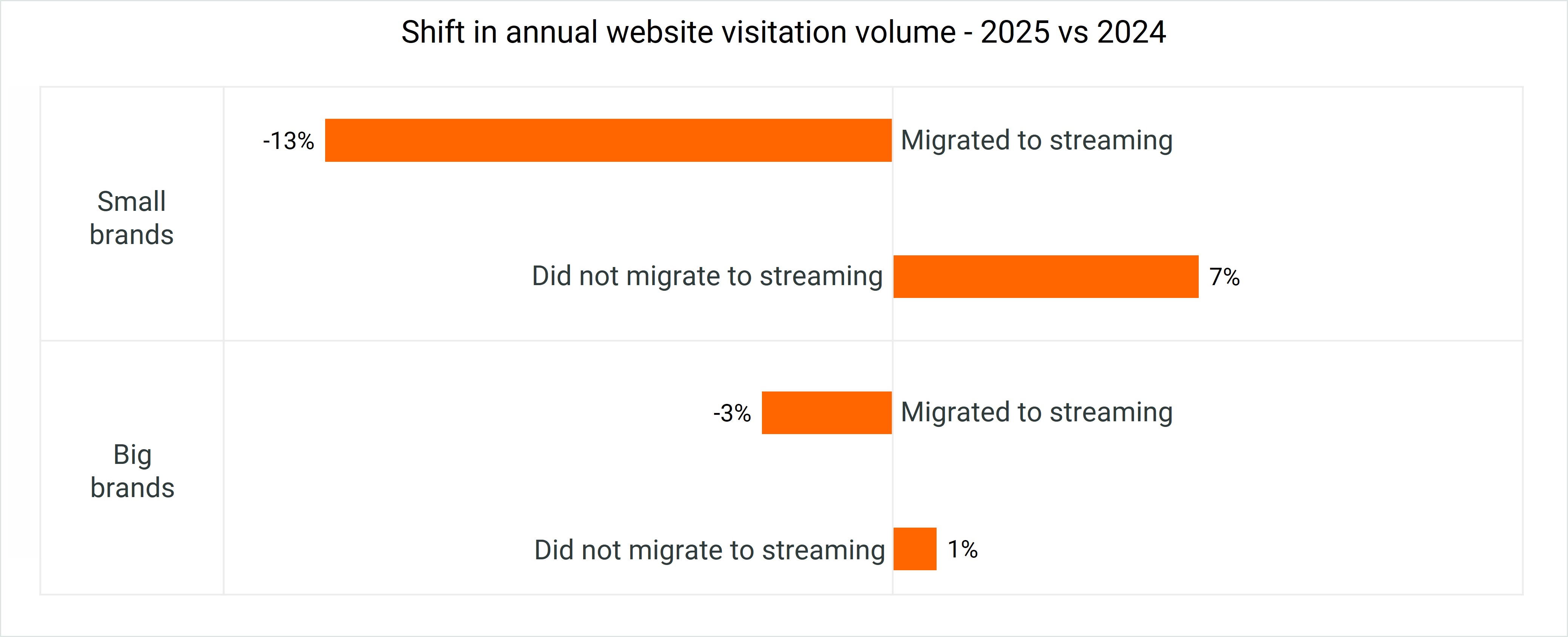
Restricting the analysis to brands with less than a 10 per cent change in total video impressions, a clear pattern emerged. Among the smallest half of brands in category, more than a quarter shifted over 15 per cent of impressions from linear TV to streaming and were associated with an average -13 per cent decline in web visitation. Smaller brands that maintained or increased their linear weighting saw an average +8 per cent increase.
The same directional pattern appeared among the largest brands, though less pronounced due to base or scale effects. The third of big brands that materially shifted from linear to streaming saw a -3 per cent decline in visitation, while those that held their linear presence recorded +1 per cent growth.
This is not a causal claim. But with frequency activated very differently on streaming than on linear TV – while each brand’s creative mix remains largely consistent between platforms – it raises a critical question: In our effort to modernise screens plans, have we inadvertently removed the very exposure dynamics that made linear TV work in the first place?
When reach became shorthand for ‘less frequency’
The idea that low frequency ‘works’ did not emerge as a rule. It emerged as shorthand.
In the late 1980s and 1990s, Erwin Ephron’s recency planning shifted focus from repetition to timing, arguing that advertising works best when it reaches buyers close to purchase occasions. This favoured broad reach and continuity over heavy bursts within short purchase windows. Ephron was not dismissing frequency; he was replacing the rigid ‘3+’ rule with a context-dependent view.
John Philip Jones reinforced this in the early 1990s with his ‘once is enough’ observation, describing the strong marginal effect of a single exposure shortly before purchase. He also stressed that effective frequency varies by task, brand strength and message and that repetition beyond one exposure is not inherently wasteful – but the caveats were often lost.
In the 2000s, Ehrenberg-Bass research added empirical weight, showing response curves are often convex, with the first exposure delivering the greatest immediate effect. Importantly, the authors cautioned this pattern is not universal and varies by context.
By then, the slogan “one is enough” stuck because it was easier to plan than ‘enough over time’.
What this means is the industry didn’t decide that frequency doesn’t matter – it simplified reach theory until frequency became the assumed casualty.
How streaming infrastructure turned shorthand into a rule
Streaming transformed theory into enforcement.
In linear TV, frequency accumulation has always been a by-product of scale. As reach grows, repetition builds among heavier viewers. Some of this was labelled waste, but it was rarely controlled with precision.
On streaming platforms, while frequency can still inadvertently accumulate due to limits in suppressing delivery over time, frequency capping exists to make distribution more controllable. Frequency could now be flattened deliberately, platform by platform. In a fragmented ecosystem without a unified view, capping became one of the few practical controls available.
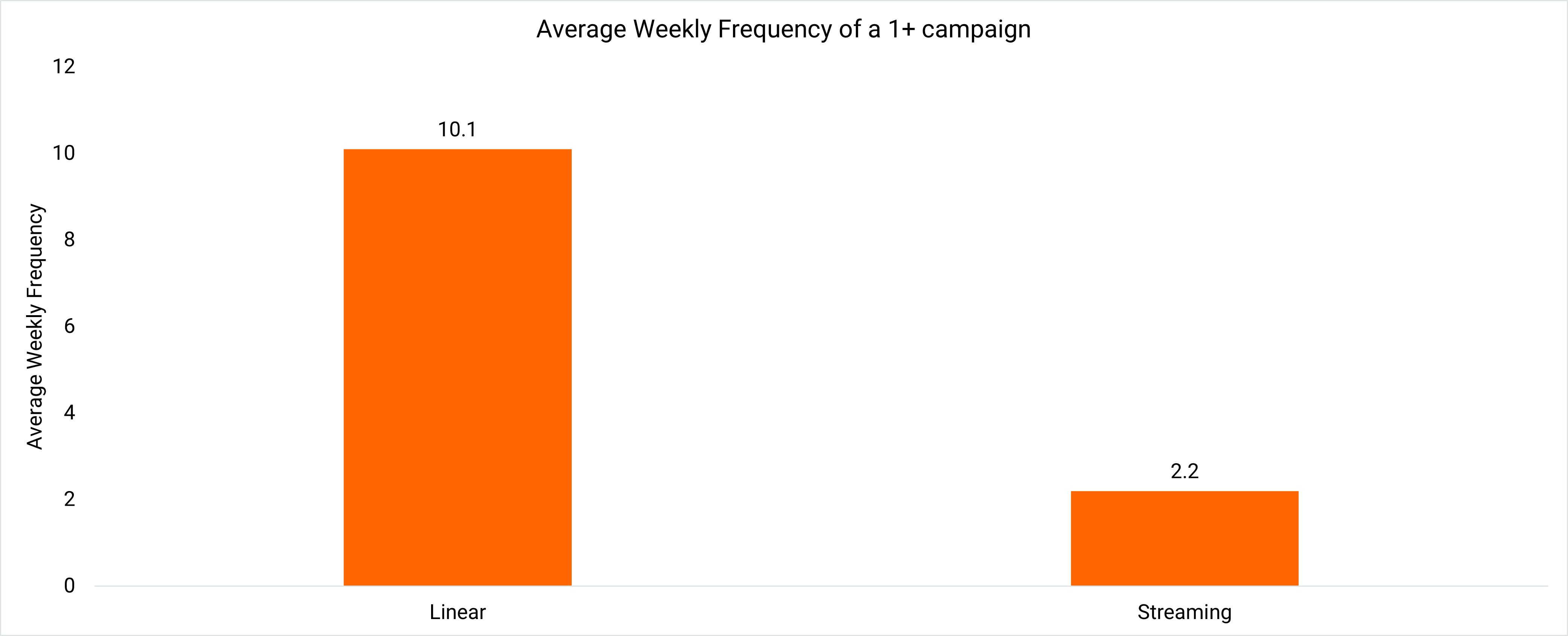
But a familiar translation followed: If linear delivers X+ frequency, streaming should be capped at X. What felt disciplined often resulted in materially lower average frequency on streaming – even at comparable spend:
Why a frequency of one is so easy to ‘prove’
Measurement completes the picture.
Diminishing returns curves make low frequency look efficient, particularly when effectiveness is assessed over short windows. The first exposure often appears to deliver the highest return per impression. Higher frequencies flatten quickly.
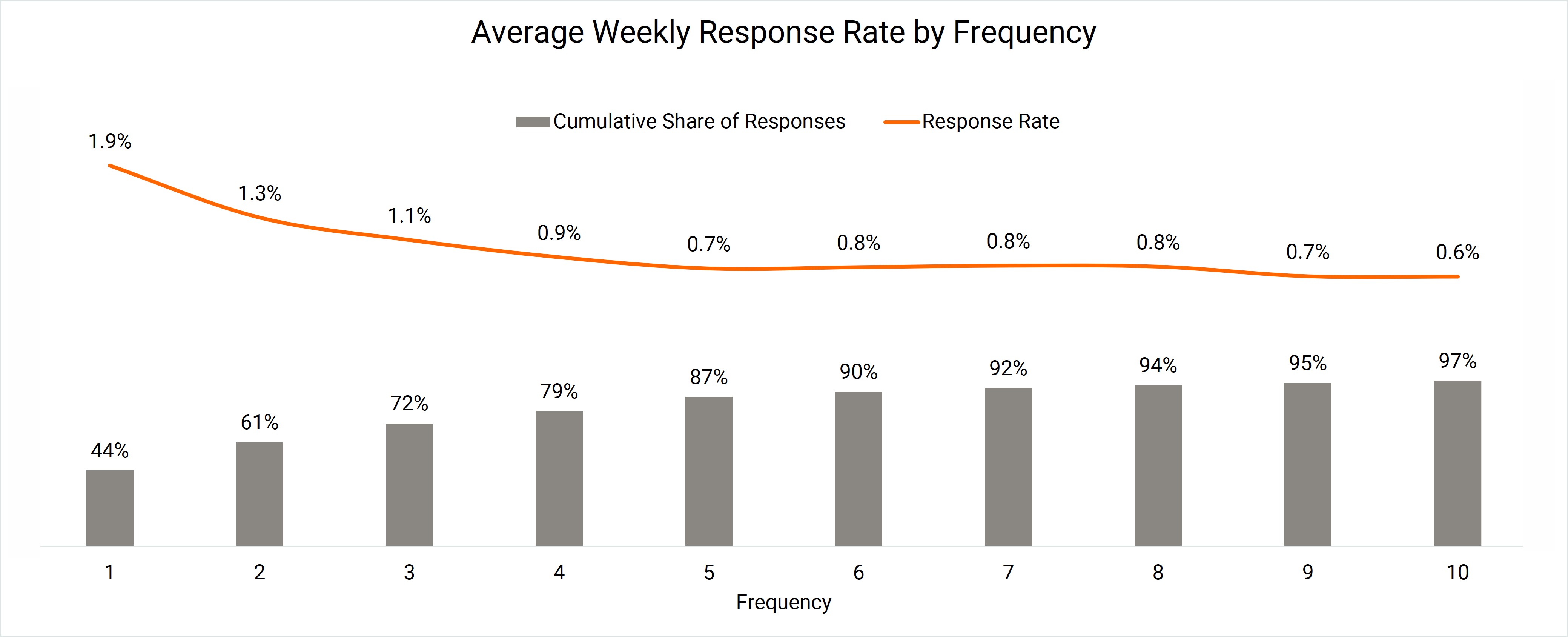
But this is a timestamp issue, not a truth about effectiveness.
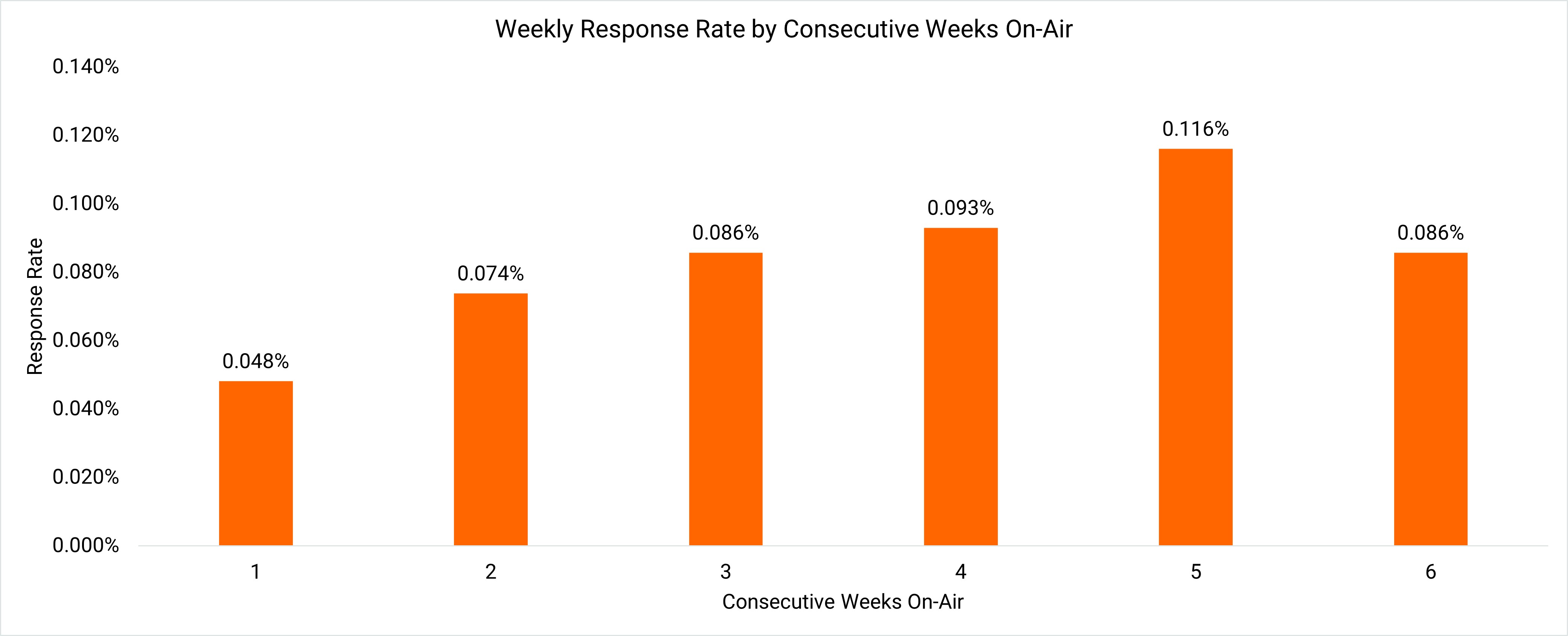
Low apparent weekly frequency often reflects accumulated exposure from prior weeks or campaigns. A ‘frequency of one’ today may sit on top of extensive prior conditioning. The effects of prior conditioning are evident in the following analysis, which shows incremental gains in viewer responsiveness across consecutive weeks on air:
Conversely, higher frequencies often shine during rebuild phases, such as after dark periods or when the cumulative effects of new brand platforms or “campaigns” are assessed via traditional brand lift studies.
This is why opposing views on optimal frequency are often not contradictory. They describe different points in the same system, observing different tasks at different moments and time scales.
What looks like a frequency debate is often the same system being observed from different perspectives.
The real role of frequency – and when more is required
Advertising’s primary role is to build mental availability, ensuring a brand comes to mind when buying situations arise. Frequency exists because competitors exist and memory fades.
Frequency plays three related roles:
- Building memory structures among out-of-market buyers
- Refreshing memory structures to maintain readiness
- Reducing friction among in-market buyers, bridging mental and physical availability.
These roles imply different frequency requirements. New brand platforms, challenger brands and periods following inactivity require building memory structured via higher frequency. Established brands, familiar creative and maintenance phases can perform well at lower levels.
Below is a real example of a brand replacing an established platform with a new one. In the final weeks of the outgoing platform, effective weekly frequency sat at three to four. During the launch of the new platform, effective weekly frequency rose to between five and seven – not because the rules changed, but because the task did.
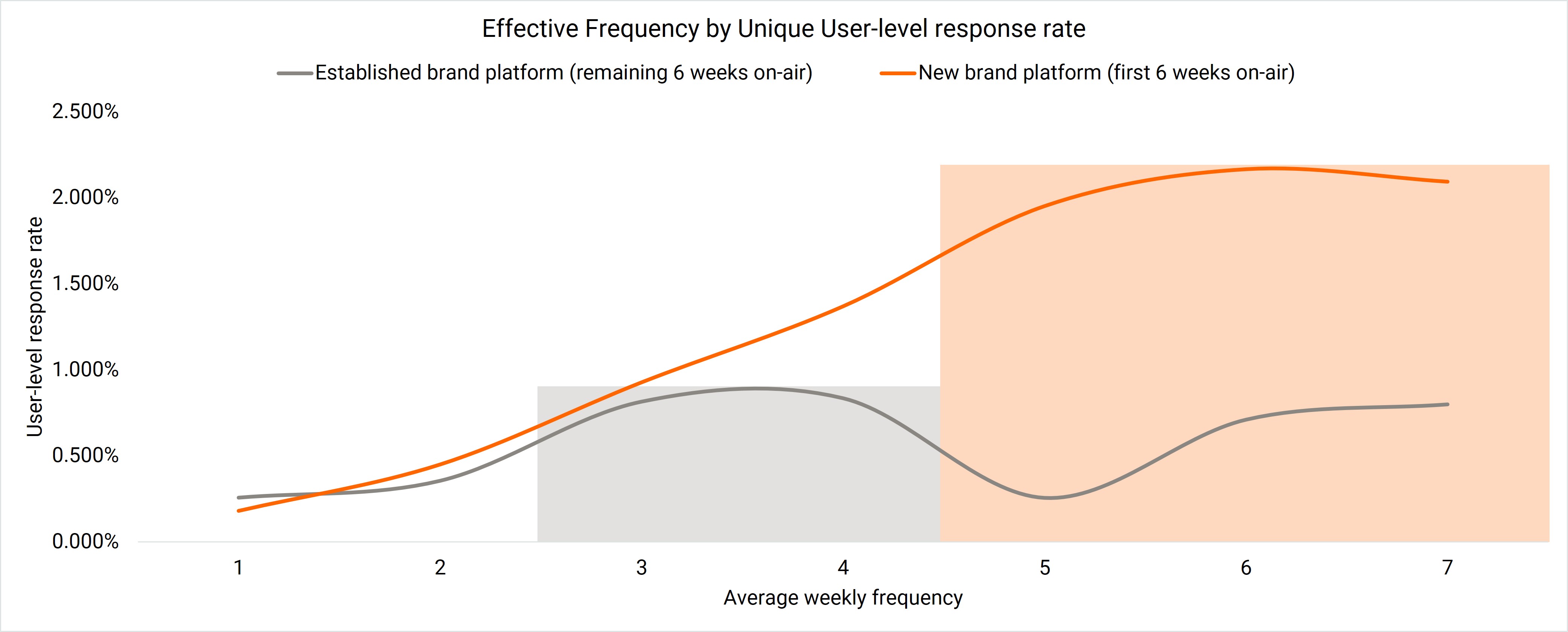
This is why frequency guidance must be conditional, not reduced to a single universal rule.
Frequency requirements change with context – not ideology.
Frequency accumulates, then stabilises, then decays
Frequency behaves like an asset.
With continuity, exposure accumulates and effectiveness stabilises. Once sufficient conditioning exists, lower refresh frequency can sustain performance. When activity stops, effects don’t vanish immediately, but they do decay over time.
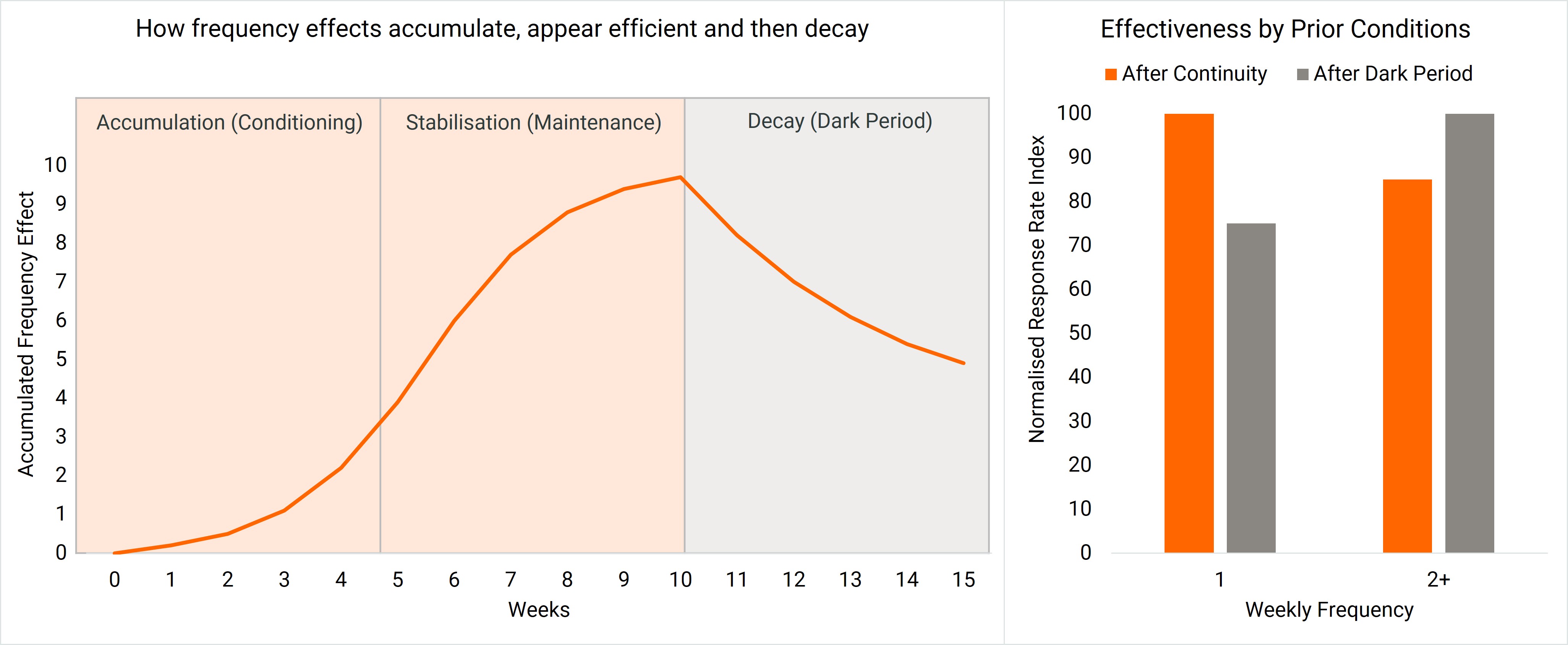
This explains why low frequency can work – and why it eventually stops working if not supported. It also explains why rebuilding after dark periods requires more effort than maintaining momentum.
Low frequency performs best after accumulation – not in its absence.
Frequency is a system, not a single metric
Frequency operates across strategy, planning, activation and control – not as a number, but as a connected discipline.
At a strategic level, frequency is about effect. Person-level analysis helps identify the exposure ranges at which advertising can plausibly do its job for an individual, depending on task, brand strength and message.
At a planning level, frequency becomes a question of trade-offs. Aggregate modelling determines how far those individual-level effects can be pursued across a population before the next unit of frequency is less valuable than alternative uses of budget.
Both require tailored analysis; both are necessary. Focusing only on effectiveness creates unaffordable ideals and over-concentration. Focusing only on efficiency risks under-exposure – confusing “cheap” with “effective”.
Then comes activation. Environment becomes the multiplier of frequency. Attention, clutter, context and competitive proximity determine whether exposures reinforce memory or dissipate – especially in fragmented streaming environments.
Finally, control matters. Real-time monitoring of frequency distribution helps manage risk – identifying excess concentration, binge-driven delivery or ineffective repetition – without chasing false optimisation.
Frequency creates value when intent, delivery and control are aligned – not when a single number is optimised in isolation.
What marketers should rethink
The takeaway is not that frequency rules are wrong – it’s that fixed rules are no longer sufficient.
As screen plans continue to fragment, marketers need guidance that is practical, conditional and executable. Frequency must be planned sustainably and activated deliberately, particularly in streaming, where frequency is no longer an emergent by-product of scale, but a deliberately constrained input.
This doesn’t mean maximising frequency everywhere. Just as elite athletes don’t train at peak intensity year-round, brands must know when to build, when to maintain and when to rebuild – and how to deliver frequency effectively when it matters.
A frequency of one can work. But it works best when it sits on top of prior effort. When that foundation erodes, relying on the same rule leaves brands underprepared.
For marketers navigating the shift to streaming, the challenge isn’t choosing between reach or frequency: It’s developing sustainable, actionable frequency frameworks that reflect how modern video actually works.