
Upfronts: CX before soccer: SBS-Ehrenberg-Samba-Insighten studies find lower adloads build brand, now mapping TV v streamers v YouTube; Fifa World Cup goes BVOD-first
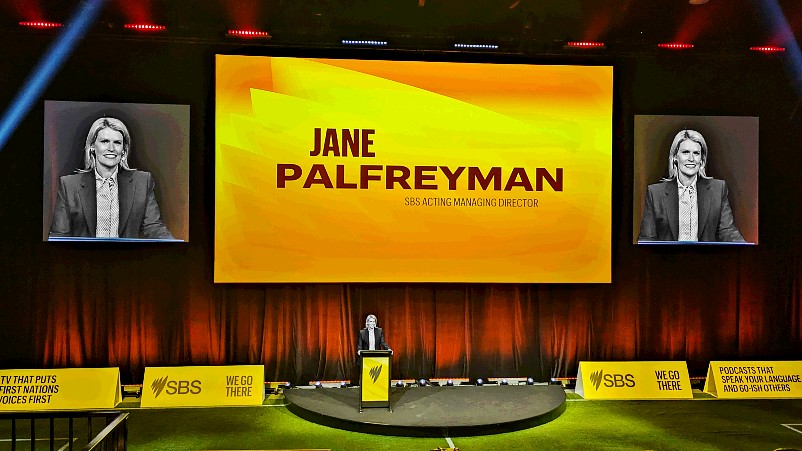
Jane Palfreyman at SBS Upfronts 2025
SBS data suggests cutting adloads to five minutes per hour massively boosts brand recall. Working with Samba and Insighten, plus updated Ehrenberg-Bass Institute research, the firm now aims to map how TV, streaming and YouTube compare on that basis. Meanwhile, it's going all-in on BVOD over free-to-air for the 2026 Fifa World Cup. Senior media buyers representing billions of dollars in ad spend suggested the broadcaster kicked some big goals at the first of this year's TV upfronts.
SBS is betting on at least a 25 per cent swing of the viewing mix from linear to digital for its exclusive FIFA World Cup 2026 coverage as it gears up for what the part-public broadcaster is expecting to be the biggest audience and advertiser year in its 51-year history.
With the 2022 FIFA World Cup tournament proving the tipping point for engagement hitting 50/50 between linear and on-demand – the 3am final reportedly had an even split between linear and streaming – SBS took its top-tier partnership opportunities for the forthcoming FIFA World Cup 2026 to market with an SBS On Demand-first proposition and an investment ratio that put digital to linear at three to one.
As revealed in the football themed spectacle of this year’s SBS Upfronts, seven tier-one broadcast partners have now signed on: Hyundai, McDonald’s, Rexona, Hisense, Bet365, Commonwealth Bank and Youi.
But football wasn’t the only thing SBS was looking to kick goals on. It’s also made a deliberate foray into better connecting the dots between media campaign delivery and business outcomes. Having worked to cement its position for premium, cost-effective incremental reach in the media plan over recent years, the broadcaster shifted the dialogue this year to demonstrating impact through the language of client-side effectiveness.
One example was a case study with the South Australia Tourism Commission (SATC) and a summer 23-24 campaign highlighting the Festival State as a top holiday destination to viewers in NSW and Victoria. The work, which involved Azira and Merkle measuring precise footfall attribution to 342 locations, directly connected campaign viewership on SBS On Demand with a 42 per cent uplift in foot traffic to South Australian tourist locations and 12,300 verified visits.
“For the first time, they [SATC] could measure cost per incremental visitor – and prove exceptional return on ad spend with SBS,” SBS media national sales manager of digital and TV, Keiran Beasley, told attendees.
'Lower adloads build brand'
In addition, SBS announced new market-first research commissioned from Samba and Insighten to showcase fresh insights into how ad loads compare in live TV environments across all free-to-air commercial players and demonstrate the effectiveness of its lower five-minute ad thresholds per hour. According to the data, Australians are exposed to an average of up to 16 minutes on ads per hour on some networks. Against this, SBS-commissioned research found its low-clutter environment delivered between 32 per cent and 47 per cent better recall than FTA competitors.
SBS also referenced an updated research study by Ehrenberg-Bass Institute and the Beyond:30 Study initiative, which reinforced the power of shorter and fewer advertising breaks and demonstrated a clear connection between lower ad load and better recall. SBS previously worked with Ehrenberg-Bass in 2018 on research to show the effectiveness of low-clutter environments and this is the evolution of that journey, said Beasley.
Most significantly, SBS said it plans to expand the research early next year to include all ad-supported streaming services plus YouTube in an attempt to line-up a view across total TV environments. How to make sure ad load research reflects not just linear but live streaming, then the total TV space, was another important step to take. Samba and Insighten are critical to accessing the data to measure such ad loads.
“This will enable agencies and clients to better understand clutter across the total TV ecosystem,” said Beasley. “It’s a bold thing to do, it’s ambitious and there is a lot of nuance to how we do that – we know not all SVODs are the same, and there are nuances around YouTube and how people consume that content. So there's a lot of work that we still need to do with our partners to make sure that that has rigour and gives us robust results,” he said. “But we feel it's a story we need to be able to share with people to make sure that conversation is alive and well.
“In a world where attention is scarce, smart marketers ensure their message stands out – and is not lost in the noise – and drives measurable results. We know SBS offers a premium audience and world-class ad environment. Now, we’re also working hard to prove the ROI.”
Samba.TV VP APAC, Yasmin Sanders, said the research was vital in bringing much-requested transparency to the sector, particularly in streaming, as well as insights based on the real experience of viewers. Insighten director, Gagan Batra, said the “novel use” of Samba data requires “forensic examination of the data to model the viewing experience”. “However we are now in a great position to expand the analysis to the full range of BVOD and SVOD services,” he added.
Meanwhile, SBS’s automated TV trading platform, SBS Connect, is in final beta testing and will be available in coming months.
“In 2026, it’s time to look beyond the cheapest CPMs and superficial metrics,” Beasley told attendees.
“If there's one takeaway, it’s that reminder not all reach is created equal. It's just for brands to keep that in mind when they're making their decisions on media. Brands have lots of choices – more choices today than they did yesterday. How do you make sure you're in the consideration set, and that they are considering the return on investment there? That's what we ultimately want to make sure that they are considering that,” he added to Mi3.
In a world where attention is scarce, smart marketers ensure their message stands out – and is not lost in the noise – and drives measurable results. We know SBS offers a premium audience and world-class ad environment. Now, we’re also working hard to prove the ROI.
Common currency woes
News of ad loads and cut-through data across the ecosystem piqued the interest of UM chief strategy and growth officer, Raj Gupta, who told Mi3 the side-by-side ad load / ad recall testing SBS is suggesting it’s going to do across the whole spectrum of ‘TV’ is unprecedented.
“I’ve never seen a side-by-side comparison that actually breaks it down to media partner, as opposed to a broad-based BVOD or streaming numbers, to sit there now and compare Netflix to Amazon Prime and other BVODs without actually realising Amazon are running their ad loads so differently to how the BVODs are,” he said. “We have to work on averages a lot as a response.”
For Gupta, how SBS and partners actually do the research, plus whether the impact of creative is factored into this, will be critical here. “I’ve seen out-of-home perform really well and perform really badly – and that is not an issue with the channel, it’s an issue with the creative. Again, if you’re testing things in a fair and equitable way, the results will be very good. But how are you going to get that point across all those platforms?” he asked.
Gupta also agreed SBS’s move on ad load research signalled a challenge to the broader TV ecosystem and its ongoing divergence on measurement systems.
“As someone sitting on the planning side of the business, the more I can get to a common currency to evaluate something, the better,” he said. “The decisions we are making right now on an SVOD, BVOD level are either coming out of model data for those clients, or they’re coming out of aggregated data, whether it be attention data we have built into our planning tools, or something like the Analytic Partners Genome research, which doesn’t break things down to the level. So how people make decisions between Netflix, Amazon Prime, Disney when it comes onboard [with ads]? I’m wondering whether people are making total screen decisions then sub-segmenting that. Because again, different attention is paid to different screens.
“That data [SBS ad load research] is the type of data that’s going to allow you to make a better decision to not equate all CPMs the same way.”
As someone sitting on the planning side of the business, the more I can get to a common currency to evaluate something, the better.
Upfronts lowdown: Content, culture, connected TV
Overall, digital-first shone proudly through this year’s SBS Upfronts, as SBS On Demand’s 13 million logged in user-base becomes the flagship entry point into how it’s engaging both with audiences and advertisers. Yet again, dialogue was peppered with references to SBS being part of the wider, global TV mix including linear, BVOD, SVOD and YouTube.
SBS equally kept to the brand script by putting its unique content slate for all Australians in the limelight.
“You won’t find this combination – bold content, cultural leadership and commercial clarity – anywhere else in Australian media,” suggested SBS acting MD and chief marketing and commercial officer, Jane Palfreyman. “While others play it safe, we go there with courage, trust, heart and yes, sometimes a little bit of nudity.”
The tentpole item taking centre stage content-wise was inevitably the forthcoming FIFA World Cup 2026 tournament in June-July 2026. SBS has committed to showing all 104 matches live (up from 64 in 2022) in the multi-country event (US, Mexico and Canada) – some 550 hours of coverage. SBS will also have a dedicated hub, a FIFA Fast news channel and a Socceroos show from team camp plus mini matches and replays. It’s also the friendliest kick-off times for Aussie viewers since the World Cup in Korea in 2002.
In preparation for the digital onslaught, SBS is introducing fast forward, rewind and pause capability onto the SBS On Demand platform in time for all live matches.
“In 2026, there will be no bigger event than the FIFA World Cup 2026 and SBS will be the only place Australian audiences can watch what will be an incredible competition,” said Palfreyman, adding further partnership opportunities are still on the offer.
Palfreyman also emphasised expectations of a “halo effect” from these sporting rights. “What we have seen with the World Cup is that it’s a huge opportunity for the network – both with viewing into the World Cup alone, but also exposing new and light audiences to our broader suite of content on SBS On Demand and linear.”
Beasley told Mi3 it’s putting together tailored approaches for several tier-one FIFA partners. “There isn’t a one-size-fits-all approach or consistency of request, even from those big partners for an event on the scale of the World Cup,” he commented. “Some seek association, for others it’s brand building, and others will have more of a performance lens and business outcomes they’re looking to drive over that particular time of the year. They’re very varied and different requests in terms of how they will prove the effectiveness of this and we’re working with them on how we build those measurement platforms to help them deliver on that.”
Initiative head of investment, IAG, Suzanne Mellon, said sport as a media property was bucking the trend in an otherwise declining linear TV spend market. So she wasn’t surprised to see all the tier-one spots snapped up.
“With FIFA it’s so compelling, because the ad load is low, but also because in the partnerships, the category exclusivity is at 70 per cent. Other FTA networks offer their sporting partnerships 50 per cent,” she noted.
“But the other thing they showed is the 2022 FIFA was the tipping point for digital – there was a 50/50 split between linear and streaming. But the digital audiences this time are expected to well outshine linear,” Mellon continued, citing about two-thirds of investment going to digital, versus one third in linear. The new on-demand functionality will therefore be a great addition here to the user experience, she said. If Nine’s 500,000+ new logged-in users to their base during the 2024 Olympic Games is any guide, SBS is also set to gain a new set of logged-in users to its 13 million data base off the back of FIFA World Cup 2026.
Mellon also noted the timeliness of SBS bringing ad load and cut-through data to light as the conversation in the industry shifts from pure reach to attentive reach. “It’s quite a strong position for them, but it did look like bias to market,” she said. “It would have been better for an independent body to do it, because it is a good story.”
Nevertheless, Mellon emphasised the strength of SBS’s audience, especially in the 40-plus category. “Surely people are putting SBS on their media plans not just for diversity but for their mainstay plans.”
Top bins
WPP Media GM of investment partnerships, Claire Butterworth, felt SBS’s content mix was a great reflection of modern Australia and Upfronts felt authentic to its brand narrative.
“I thought it was a very confident presentation – SBS has balanced what advertisers are looking for. They have a lot of premium content, which is certainly what is driving a lot of demand within the TV ecosystem at the moment,” she said. “It’s key cultural moments, which is where we see a lot of advertisers wanting to move to as it allows them to extend the conversation through other channels as well including things like social. Being part of that zeitgeist moment is where a lot of brands want to behave, and in a brand-safe environment as well. And brands are still advertising in major sport – there’s a huge amount of demand for it.”
For Butterworth, the outcomes-based play can help SBS further its premium narrative with certain advertisers. “If you’re looking for brand-safe environments that are going to be driving mass engaged audiences, then yes. But each business is so specific in what their requirements are, SBS can’t be a one-size-fits-all. But the way they put their proposition across to the marketing world is very strong,” she continued.
Butterworth also saw the push by SBS on ad cut through as a new data point aiding its total TV proposition in market. Over recent years, SBS has consistently hammered home the message it’s not just competing against local FTA or the traditional broadcaster base, but a global, multi-layered TV ecosystem. “SBS needs to form part of the criteria selection and as they said, they have the audience, the brand-safe reach and content that attracts that diverse audience.”
The other thing they showed is the 2022 FIFA World Cup was the tipping point for digital – there was a 50/50 split between linear and streaming. But the digital audiences this time are expected to well outshine linear.
The data play
For advertisers, plenty of mod con elements now expected to feature at a modern media upfronts were also on the runsheet. More data sources, and more unified data usage to better target and drive engagement over pure reach was one.
SBS unveiled Data Lab, a new unified offering bringing together its partnerships into one offering. That partner list includes Experian, Smrtr, Adobe, Snowflake, InfoSum, LiveRamp and Unified ID. SBS also revealed its sign on another partner, DataCo, to brings commerce data into streaming media for incremental campaign measurement and actionable insights. The primary data source in DataCo is ANZ transaction data.
“SBS Data Lab brings together years of data-led innovation under one roof, making it easier to reach SBS’s broad and diverse audiences across our digital ecosystem with personalised campaigns,” said SBS acting director of media sales, Lee Callagher.
In addition, SBS highlighted several cases of successfully activating privacy-safe clean rooms including Adobe Real-Time CDP Collaboration, Snowflake and InfoSum. It also flagged its first-mover position on activating LiveRamp ATS Direct and Universal ID 2.0 across connected TVs.
Callagher told Mi3 in a separate interview it works in a similar way to a market mix model (MMM), using a stitched cross-media identifier to prove attribution and efficacy of campaigns.
“Those lead us down the path of helping clients to prove their campaigns have resulted in attribution is some way shape or form,” she explained. “With DataCo, what we’re trying to do is prove a customer or audience member on SBS exposed to a campaign actually purchased. With what we’ve done with DataCo and any other advertising partner we have partnered with in the same capacity is that it’s a mirror copy with MMMs. While we didn’t build it with that in mind, it’s definitely something we could look at integrating with in the future.”
What all broadcasters are trying to achieve is to prove ROI and outcomes for clients “so they understand their money is being put to the right place”, Callagher added.
Transmission emissions mission
Sustainability has been another of SBS’s progressive plays and this year was no different. The latest initiative is SBS Brief Green, both an umbrella branding and new sustainability toolkit for marketers that includes support for designing a brand’s media plan to reduce advertising emissions while retaining media outcomes. It’s based around the Ad Net Zero framework and utilises a partnership with Scope3 to ensure campaigns booked though SBS Brief Green are measured for emission.
Content is complementing the new toolkit, and there’s a new SBS On Demand sustainability hub on the platform curating documentaries, landscapes and sustainability made drama in one place.
Under legislation starting from 1 July 2024, Australia’s largest companies by law had to begin disclosing their direct, Scope 1 and Scope 2 emissions. From 1 July 2025, this starts extending to Scope 3 indirect emissions, which are expected to account for up to 98 per cent of a company’s total emissions.
SBS extended to Scope 3 emissions reporting last year, and has also had its carbon reduction targets validated by the Science Based Targets initiative earlier this year. As work has gone on internally to get the house in order on Scope 1, 2 and 3 emissions – starting with program, The Cook Up with Adam Liaw – the company has been expanding efforts to help advertisers also get on-board and better manage their media planning with sustainability in mind.
As well as the new productisation of emissions-effective media planning, SBS announced the winner of its sustainability challenge, NRMA, and confirmed it’s kicking off another year of the competition. The challenge launched in February last year offers up $500,000 in advertising for the most impactful creative highlighting better environmental practices for consumers. And there’s a new Sustainability Report too, showcasing what SBS is doing.
“Supplier emissions make up a large proportion of businesses’ footprints – and media has a responsibility here too. This is an issue that is increasingly coming to the fore for all business leaders, particularly in our sector,” Palfreyman said.
You won’t find this combination – bold content, cultural leadership and commercial clarity – anywhere else in Australian media. While others play it safe, we go there with courage, trust, heart and yes, sometimes a little bit of nudity.
Ad opt-out goes national
Another string to SBS’s responsible media bow is conversion of its advertising opt-out trial into full-blown production. The beta trial, which kicked off in early 2024, allows customers to choose to exclude three categories of advertising: Alcohol, gambling and QSR.
SBS has seen a 45 per cent decrease in complaints around wagering since the opt-out came into being, Palfreyman said. By November 2024, about 1,300 people had chosen to opt-out within the beta trial, with 90 per cent of these opting out of gambling ads. It’s since understood the figure has risen to a couple of thousand, mostly skewing towards wagering.
Notably, two of SBS’s new tier-one FIFA World Cup 26 partners – Bet365 and McDonald’s – sit in categories users can choose to curb advertising from. But Palfreyman pointed out opt-out is improving the quality of campaign reach and spend for a client.
“It was a win for the consumer, but importantly, it was also a win for the advertiser who was not paying to reach consumers who weren’t interested in that category of advertising, because we are taking those audiences out of the mix who probably weren't going to respond to the advertising anyway,” she said.
“The opt-out gives audiences further benefit by providing greater control over the ads they see as well. The advertiser benefits by not paying to reach people who have no interest in their product. This is responsible advertising at its best.”
Indigenous consumption rises, brands return
SBS also provided an update on the now four-year-old NITV and First Nations Media initiative, Beyond 3%, to increase the level of coverage and market engagement with First Nation content after finding just 0.3 per cent of content referenced the 3.8 per cent of Australians who identify as First Nations.
SBS confirmed a record commercial year for NITV, with highlights including Toyota’s sponsorship of the National Indigenous Cricket Championships, NRMA’s commitment to spend 3 per cent of its marketing budgets on First Nations media, and Coles ongoing support. It comes as SBS also cited a 7 per cent increase in total content consumption – no mean feat in a declining TV market, SBS national sales manager NITV, Anna Dancey, said – while prime time TV audiences are up 11 per cent. Digital reach is also increasing.
On the masthead, three new 24-hour FAST channels have debuted based on SBS’s most popular content formats: The Cook Up with Adam Liaw, plus current affairs programs, Insight and Dateline. Integration of SBS’s channels is also continuing, with podcasting and an expanded video podcasting offering now coming into the On Demand fold following the integration of SBS live streaming audio channels last year.
“We are a national broadcaster who lives to bring you the stories that matter, build on purpose, trusted by communities. In a media landscape increasingly dominated by global platforms with overseas algorithms, local media matters,” Palfreyman said in her sum-up. “Because the stories we see shape how we see ourselves and each other. That’s not just good for Australian culture, that is good for Australian business.”
