Peak YouTube: advertiser value to weaken on the world’s biggest streaming site – how, why and what to do about it
YouTube is reaching the peak of its maturity as a product, and that’s a bad thing for marketers. As YouTube’s organic growth runs out of road, Google’s revenue growth pressures will erode advertiser value on the world’s biggest streaming site. It’s a new era – one where digital platforms have to reckon with an increasingly mature ecosystem. As the “YouTube Illusion” begins to falter, advertisers must avoid getting caught out. Ahead of next week's Brandcast upfront, Kinesso's Charlie Allatt reckons YouTube will have to pull out every distraction trick in the book – and he's brought the receipts.
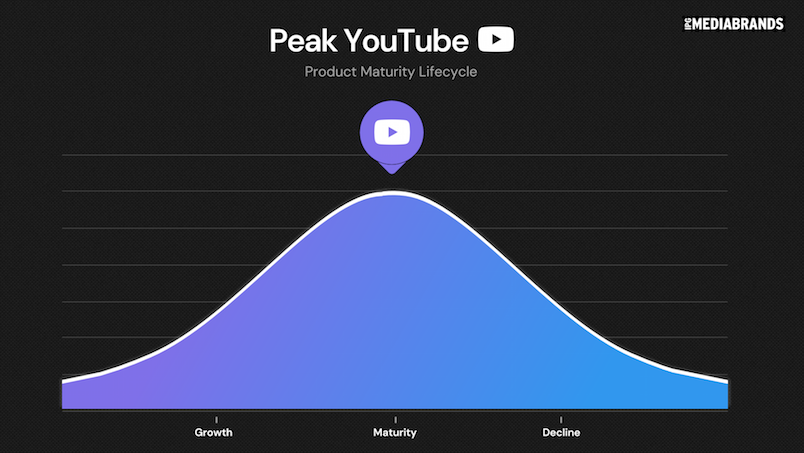
YouTube, after 20 years, is finally hitting maturity on the product lifecycle...
YouTube’s organic growth reaches its peak
It's been 20 years of YouTube, and a decade of that as a household name. For roughly the past 24 months Ipsos Iris has reported YouTube’s reach at about ~95 per cent of Australian consumers.[0] In other words: YouTube already reaches everyone.
That leaves one option for growth: YouTube’s audience must watch more. While Australians do watch eye-wateringly high volumes of video, on average, the figure is stabilising at around ~41 hours a week.[1] ACMA’s annual communication report concurs with Magna research; watch times barely shifted between 2023 and 2024.[2]
That’s the second big problem for organic growth on YouTube; it competes now in a mature ecosystem of sparse attention. And YouTube is threatened on both ends: streaming platforms offer newly produced shows alongside decades of TV and film back-catalogue, while social platform rivals promote their own variety of creator-led video entertainment. These preferences are individual, but if you’ve avoided the lure of “infinite video on YouTube” for the last 20 years, that’s hardly apt to change now.
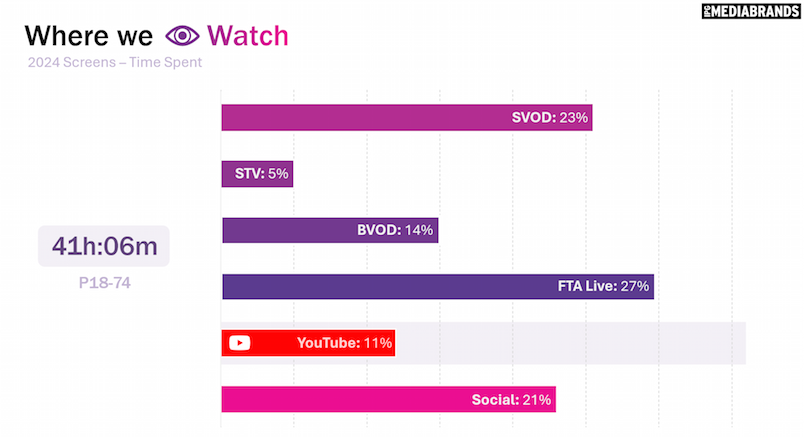
Watch times have remained stable in aggregate at about 41 hours, but we saw the first signs of YouTube’s share stabilising last year. [1] There’s only so much pie.
It’s a sobering thought for the biggest streamer in Australia, but if you can’t reach more people, and you can’t entice them to watch more, then organic growth is at an end for YouTube.
Unfortunately it gets worse for marketers; more-and-more of that reach is unreachable by advertising. That's thanks to “YouTube Premium” – a product that removes ads for a monthly subscription fee. Magna Intelligence research estimates ~10 per cent of YouTube’s audience subscribe to Premium.[1] Per cent-wise, that brings headline reach down into the mid-80s, but at A$16.99 monthly, it’s a product likely to appeal to some of YouTube’s heaviest users. It means that YouTube Premium will whittle down reach on the platform over time; possibly even those who are most engaged there.
Paired with Google’s challenges within Search due to AI, YouTube is likely to feel the revenue squeeze from parent company Alphabet. That’s bad news for advertisers, even for those who see strong results today.
YouTube’s revenue pressure, beyond the peak…
YouTube can still grow revenue without organic growth in audience or watch time. Unfortunately, the avenues to do so will necessarily erode advertiser value in one way or another. Here’s what that looks like:
#1: Increase the cost of ads on YouTube, hurting advertiser efficiency.
Simple and easy, but perhaps the most obvious negative impact to brands. Inflated ad costs will decrease efficiency for advertisers, but in a very noticeable way.
Between September 2022 and June 2024, Mediabrands noted a 20.2 per cent increase in the cost of non-skippable 15-second inventory on YouTube. The following month, coinciding with the launch of Amazon Prime, costs returned to a level not seen since Q2 2022.
There is no transparency into YouTube auction dynamics. It is unclear how floor pricing or other factors influence the auction. Unlike with other large publishers, you simply cannot negotiate with YouTube on price.
#2: Increase the ad load on YouTube, reducing advertiser share of voice.
YouTube can technically conjure up ad slots as needed. During a peak retail period like Black Friday, YouTube could (in theory) inflate its inventory to meet advertiser demand. Higher ad supply means reduced advertiser share of voice (SOV) and cut-through. It’s worse: for users, the increased number of ads could drive uptake of YouTube Premium, quickening the cycle of attrition.
Increased ad loads were suggested by Mutinex as a reason for reduced return on investment (ROI) for some of their customers.
YouTube has no transparency about commercial minutage; no guarantees or averages. Competitor video streamers willingly share partial or full transparency into their ad-slot decisioning.
#3: Increase the extraction from existing demand, reducing advertiser value.
YouTube can aim to move ad-spend into their more profitable ad products. This could increase extraction from existing supply and demand, but will mean advertisers lose out in some other way.
“Video Reach Campaigns” are a prime example. They drive spend into a more profitable ad format for YouTube: the Bumper. The product requires advertisers to cede control over the asset mix shown to users. In our testing, shorter six second “Bumper” ads were overwhelmingly shown to users. This does increase reach, but we also estimate it increases YouTube’s extraction by up to 2.1 times per-second-of-advertising. [3] It also ignores why brands produce different length assets in the first instance.
Platforms tend to like reduced controls for advertisers. After-all: it streamlines the process of converting marketing dollars into their bottom line. For products that promote simplicity at the expense of control, proceed with caution.
The practices above are hard to detect or confirm. YouTube is not transparent about pricing and operational algorithms, which affects how we can evaluate those impressions. It’s not hard to quantify the value of a YouTube impression, it’s impossible. It could fluctuate minute by minute.
YouTube may be a strong proposition for brands today, but low transparency and limited growth conspire to erode that value tomorrow.
The Peak YouTube illusion: normalising 'brand weird' and the 'hyper-long-tail'
On 10 September, YouTube will host advertisers for its annual “Brandcast” celebration. It’s their upfront, and it highlights the best of YouTube and its creators. Brandcast also cements a critical illusion: that spend on YouTube goes to charismatic creators with high production values. And: that those videos are seamlessly mixed-in with licensed and broadcast-quality content, drawn from the world over.
The reality is a bit more complex. YouTube is both of those things… but YouTube is also home to infinite oddities; fringe political ideas, children’s content, AI-generated slop, bizarre animations, sexualised videos, conspiracies, gross-out content, short videos, snippets, memes, music designed for background listening, odd subcultures, and even videos made for people to fall asleep to. Some of it is demonetised – much of it is not.
This isn’t necessarily not brand-safe, but it is… “brand-weird”.
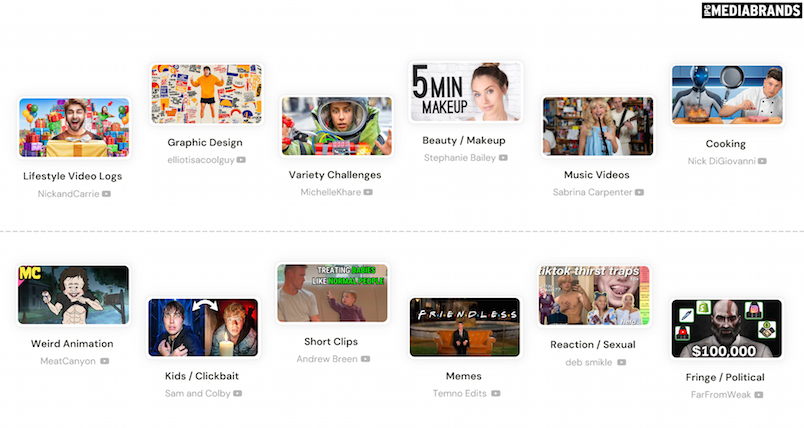
Typical headliners at brandcast (top) and the creators they always forget to mention… (bottom)
The problem we’ve always faced with YouTube is that it can be hard to separate the good from the… freaky.
Google still makes money when brands spend against brand-weird placements. Given YouTube’s brand safety features this may feel like a solved problem, but when did you last see a content report for your YouTube buys?
Ads on the videos linked above included: Woolworths, Amazon, The Good Guys, MINI, Chemist Warehouse, Westpac, Booking.com, JB Hi-Fi, TPG, Disney, and (either ironically or comfortingly) Google themselves.
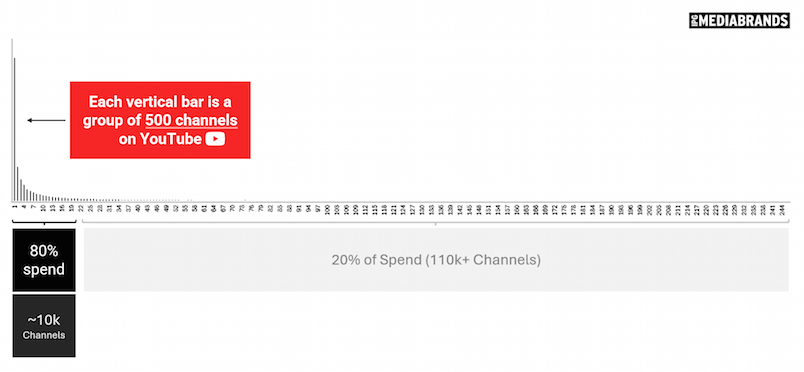
The hyper-long-tail is very, very, very, very, very, very long… [3]
If you do run a report: you may also see the incredible volume of spend that can sit in the inauditably long hyper-long-tail. In one day, Mediabrands’ collective client base ran across 120,000-plus YouTube channels. That is with the full gamut of brand safety measures available – plus a few bespoke measures of our own.[3]
If you are doubtful this is by design, consider that despite two decades of YouTube, we still can’t do position-in-break targeting. It’s hard to read as anything other than deliberately restricting advertiser control. As a further example: imagine offering buyers a “channel minimum size” filter. Simple, yet deliberately absent. An absence that ensures brand spend against the hyper-long-tail continues unabated.
YouTube’s ‘cheap’ reach sneaks up to a fifth of a buy, using “hyper-long-tail” and “brand-weird” channels.[3] That’s a potentially acceptable cost for brands, but one that absolutely needs to be recognised. Combined with the transparency and growth questions, Brandcast has a lot to distract us from this year.
Marketers need to be ready to navigate the next phase of digital platforms...
After the “maturity” stage of the product life-cycle comes “decline”. That’s not an inevitability for all digital platforms, (or products – I’m drinking a Coke right now) but it is something marketers and brands need to watch closely over the next 24 months.
YouTube may be showing the first signs of faltering, but it’s not alone. A new era for digital platforms is coming. Slowing digital growth will create new pressures; it’s critical that advertisers don’t get squeezed by large digital platforms, as they attempt to maintain the hyper-growth they’ve hitherto enjoyed.
Recommendations in the Peak era…
For YouTube:
- Run a content report, check your brand safety settings. Evaluate risk tolerance for hyper-long-tail and brand-weird placements.
- Consider your composition and long-term reliance on YouTube, given growth in other premium digital video opportunities.
- Consider a context-based buy as a replacement for a broad-base reach strategy. This plays into one of YouTube’s greatest strengths: unique, niche content. (Think: YouTube as the new magazines, not the “new TV”)
- Scrutinise Google recommendations for bias and extraction efforts.
For all digital platforms:
- Follow your independent ROI and brand metric reporting, but consider future implications that may not be accounted for in lagged data.
- Demand transparency on any information needed to make informed decisions. Eschew black-box models; assume they privilege the owner.
- Expect changes to come in the next 24 months as growth pressures mount; be reactive and move your investment.
- Seek out alternative placements that meet higher transparency or competition thresholds. Large advertisers, especially, will benefit from this.
Finally: in the era of Peak YouTube, don’t panic – it’s a peak, not a cliff. We’re suggesting advertisers recalibrate consciously.
This article was adapted from a presentation on the 2025 state of online video, presented to IPG Mediabrands clients.
[0] - Ipsos Iris CTV Reporting.
BG: YouTube - July 2023 thru June 2025 - P14+ Australian Internet Users
[1] - Magna Intelligence Research. Consumer Establishment and Behaviours Survey.
Internal Research; Sep’23 n=985, Sep’24 n=1202; P18-74; A1.Thinking about the last couple of weeks, roughly how long have you spent doing each of these activities below during a typical weekday (Monday to Friday)?; A4. Again, thinking about the last couple of weeks, roughly how long have you spent doing each of the activities during a typical weekend (Saturday and Sunday)?
[2] - Communications and media in Australia: How we watch and listen to content - June 2024 and 2023.
https://www.acma.gov.au/publications/2024-12/report/communications-and-media-australia-how-we-watch-and-listen-content
[3] - Internal Mediabrands Data.