Saved by the bots: Google share price pumps after no break-up ruling, judge cites publisher omerta, AI threat as Justice Department thwarted

Timing is everything. After a years-long trial and tens of millions of words of evidence, Google will not be broken up despite being found to be a three-times trillion-dollar monopoly, thereby safeguarding its agreement with Apple that enshrines a mobile search stranglehold. Why? Because generative AI came along at just the right time – and publishers were too timid to give evidence.
After all the evidence and rulings, Google will not be broken up.
A US federal judge yesterday returned his much-anticipated ruling and said it would not be forced to sell its Chrome browser, or halt its US$26 billion payments to Apple which ensure it has a 95 per cent of mobile search.
Instead, it must hand over some of its search data to rival companies that a technical committee will decide are qualified competitors. The judge then changed the rules on who they can be to include OpenAI, Anthropic and Perplexity.
The 233-page ruling fails to follow many of the punishments that had been demanded by the Department of Justice after a minutely-detailed trial which exposed backhand payments between rivals and had the "net effect to basically freeze the ecosystem in place".
He also said he would take no action against Google sucking up premium content from publishers on the open web because no publisher had given testimony in his court about the damage it caused.
“The court does not doubt that publishers face new challenges because of GenAI technologies, but there can be no cure without evidence to support it," he said.
“The court heard evidence about Google’s opt-out offerings, but no testimony from a single publisher."
Bot hurt
The recurring theme through the ruling was that Google was a monopolist in search, but since the trial began in 2022, the world had moved on to AI.
Google now faced major challenges to its dominance from AI companies, and while investing in Google had been a "no fly zone" for venture capitalists for years "billions more money is now flowing".
There was more bad news for marketers.
Despite being caught “using knobs” to “artificially inflate" ad prices without telling customers or providing value, it would not be required to share granular ad data or transparency on its pricing.
It would however be made to share some of the secrets showing how its search engine works, at what the judge called "marginal cost", to accelerate innovation in AI.
“This will still enable rivals to overcome the scale gap by allowing them to more quickly build a competitive search index that is robust in volume, freshness, and utility," he said.
A technical committee will now be appointed to manage the exchange of the data and to approve the appropriateness of the qualified competitors, look after privacy and ensure they meet America's national security requirements.
The New York Times called the decision "the first of its kind in the modern internet era" and "the most significant attempt to level the tech playing field since an antitrust ruling against Microsoft more than 20 years ago".
But the soft soap decision was seen by many as a blow to the US government’s decade-long drive under Presidents Biden and Trump to rein in Big tech excess. It puts a doubt over what's next for the antitrust movement, with Meta, Apple, Amazon and Microsoft all facing rulings of their own.
Judge Mehta said his decision had been influenced by the emergence of AI as a serious contender to search since the trial began.
“Then, venture funding in internet search was considered Silicon Valley’s biggest no fly zone," he said.
“Today, established technology companies are making, and start-ups are receiving, hundreds of billions of dollars in capital to develop GenAI products that pose a threat to the primacy of traditional internet search.
“The money flowing into this space, and how quickly it has arrived, is astonishing. These companies already are in a better position, both financially and technologically, to compete with Google than any traditional search company has been in decades (except perhaps Microsoft).
“They also are moving towards monetising on commercial queries. These new realities give the court hope that Google will not simply outbid competitors for distribution if superior products emerge.”
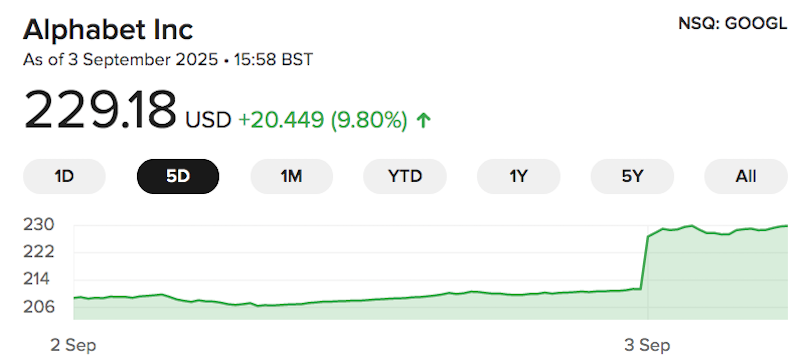
Google and Apple both saw their stock prices pump after the ruling.