News publishers have the trust, influencers have the marketing dollars; Media's battle for attention intensifies; Audio, social, gaming rise as video slips
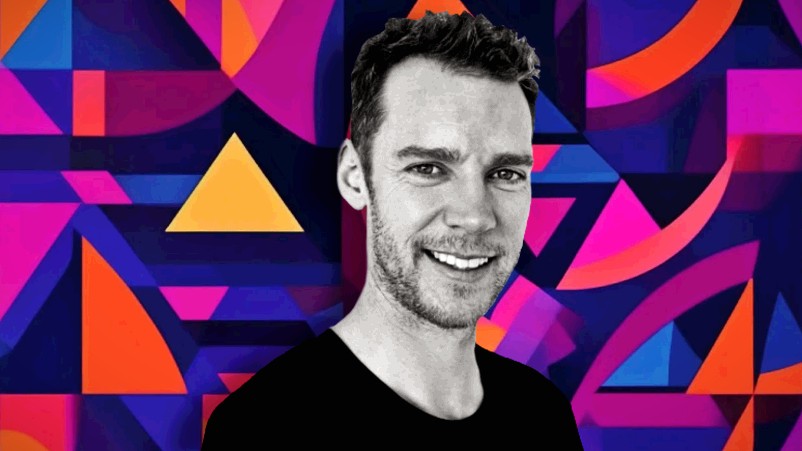
Deloitte's Peter Corbett

Australia’s news publishers have spent decades building trust, only to watch advertising dollars migrate towards social media platforms and influencers whose credibility, at least when it comes to news, is considerably less impressive. Deloitte’s latest research finds almost eight in 10 Australians trust established news publishers, compared with four in 10 who trust news produced by content creators. Yet creators are increasingly influencing what Australians buy, while AI assistants are elbowing their way between brands, publishers and consumers, raising the uncomfortable prospect that journalism’s credibility could become more valuable just as its creators lose control of how that value is monetised. Meanwhile, the battle for Australians’ attention is producing its own casualties. Video has surrendered three hours of weekly viewing in just 12 months, with audio, gaming, social media and news taking a bigger slice of the 45 hours and 20 minutes Australians spend consuming media each week
What you need to know:
- Deloitte's recently released Media & Entertainment Consumer Insights report reveals that journalism wins on trust, but influencers win advertising dollars. According to the study, 79 per cent of Australians trust national news publishers, compared with 40 per cent for creator-produced news and 38 per cent for AI-generated news.
- Creators have serious commercial clout with 38 per cent of Australians having bought something following an influencer recommendation in the past year, rising to 61 per cent of Gen Z. However, 63 per cent of Gen Z have unfollowed creators over inauthentic or excessively commercial endorsements.
- But AI threatens publishers' audience relationships. 48 per cent of Australians regularly use standalone AI tools, while 11 per cent say they no longer click through to original sources after consulting AI-generated search summaries.
- Have Australians reached peak attention? Weekly media consumption remains steady at 45 hours and 20 minutes, but audiences are redistributing their time across platforms and formats. Some 42 per cent regularly consume multiple media simultaneously.
- Video is losing ground as audio surges. Weekly video consumption has fallen three hours to 16 hours and 55 minutes, while audio has increased to 13 hours and 30 minutes. YouTube reaches 89 per cent of Australians, with 45 per cent saying it provides enough entertainment without another paid video subscription.
- Social media's growth is coming from older Australians. Gen X increased weekly consumption by 26 per cent and Boomers by 28 per cent, while Gen Z trimmed its usage. Gaming consumption also grew across every generation.
- News and sport offer commercial opportunities, with complications. News consumption rose to two hours and 30 minutes weekly, while 46 per cent of Australians would pay separately for major sporting events. Publishers meanwhile face the familiar squeeze between advertising irritation and paywall resistance.
Attention is just becoming harder to monopolise. Reach alone tells less of a story when content is being consumed alongside social feeds, messaging, shopping, and search.
Stop the press: People trust journalists!
Read all about it – Australia’s news publishers have spent decades building their credibility, only to watch advertising dollars migrate towards social platforms and influencers whose reputations for trustworthy news are considerably less impressive. But Deloitte’s latest research suggests there's an opportunity to exploit a clear competitive advantage in a world where we are more sceptical than ever. Oh, the irony.
The Deloitte 2026 Media & Entertainment Consumer Insights report found 79 per cent of Australians regard national news publishers as at least moderately trustworthy, with independent and regional publishers close behind at 78 per cent. News produced by content creators manages just 40 per cent, barely ahead of AI-generated news at 38 per cent.
According to Peter Corbett, Industry Leader, Telecommunications, Media and Technology, Deloitte, "Every generation is consuming more news, so that's actually a great thing to see. People are engaged in news, and it's not surprising we've got big global events happening. We've got elections coming up, so it's a really big time for consuming news."
However, for publishers already battling digital platforms for a share of advertising revenue, the findings sharpen a longstanding commercial frustration: Consumers continue to place considerable faith in professional journalism, while marketers increasingly spend their money reaching those same consumers through intermediaries with far less credibility as news sources. As AI search and discovery adds another layer between publishers, brands and audiences, converting that hard-won trust into commercial returns is becoming an even more pressing challenge.
They emerge alongside a significant reshuffling of Australia's media consumption habits. Deloitte found Australians spend an average 45 hours and 20 minutes weekly consuming media and entertainment, unchanged from 2025, but video is surrendering ground to audio, gaming, social media and news. The 15th annual study surveyed more than 2,000 Australians aged 16 to 91 during July and August.
The influencer paradox
The comparatively low trust in creator-produced news contrasts with the influence creators wield over purchasing decisions. Deloitte found 38 per cent of Australians had purchased a product or service following a creator recommendation in the previous 12 months, rising to 61 per cent among Gen Z and 58 per cent of Millennials.
Food and beverages, beauty, fashion, entertainment and health were the strongest categories. Among Gen Z, 64 per cent said they trusted sponsored recommendations from creators they followed more than traditional advertising, while 45 per cent trusted those recommendations more than advice from friends or family.
The figures offer one explanation for marketers' enthusiasm. Consumers may be sceptical of creators as sources of news while remaining receptive to their product recommendations, particularly when they perceive expertise, shared interests or a personal connection. However, that influence carries commercial risks. Almost two-thirds of Gen Z, 63 per cent, said they had stopped following creators after finding their recommendations inauthentic or overly commercial.
Disclosure appears to strengthen their influence, with 57 per cent of Gen Z saying they were more likely to act on recommendations when creators acknowledged being paid.
Journalism's trust advantage meets AI
Despite changes in media consumption, trust in established publishers remains remarkably consistent across generations. Among Gen Z, 79 per cent regarded national Australian news publishers as at least moderately trustworthy, almost identical to the 80 per cent recorded among Boomers.
That consistency contrasts with substantial generational differences in platform preferences, advertising influence and attitudes toward AI.
The commercial challenge for publishers including is translating that credibility into advertising revenue when marketers can point to the purchasing influence of creators.
According to Corbett, "This comes down to it being a source of competitive advantage. The fact is you are a go-to because you are trusted, and we see that in the stats. People are still watching news on TV. It's the highest source. When it comes to advertising, free-to-air TV is the most influential, and it where people have the most comfort with advertising, so you have the ability to attract them there."
AI is giving Australia's news publishers another reason to reach for the Nurofen. Having spent years and considerable sums producing journalism that audiences trust, they now face the prospect of AI assistants helping themselves to that content, answering consumers' questions and potentially leaving the publishers out of the audience relationship altogether.
Deloitte found 48 per cent of Australians regularly use standalone AI tools, rising to 67 per cent of Gen Z and 64 per cent of Millennials. ChatGPT leads the field for everything from searching and researching to comparing products, with Google's Gemini generally the next cab off the rank.
And consumers appear increasingly comfortable letting the machines do the legwork. Some 57 per cent say AI-generated search summaries make searching easier and encourage them to search more often.
There is an upside and a potentially lucrative opportunity here for publishers whose independent journalism, expert reviews and authoritative reporting can help inform the recommendations AI assistants serve up to consumers. That also explains why firms like Nine, News Corp and Guardian are doing deals with the LLM companies.
Already, 11 per cent of Australians say they no longer bother clicking through to original sources after consulting AI-generated search summaries. Another 58 per cent report at least some continued clicking or cross-checking, while the remaining 31 per cent either don't use AI summaries or couldn't offer an assessment.
The growing reliance on AI also comes with deep reservations about authenticity. Three-quarters of Australians said AI-generated content made it harder to determine what was real online, while 84 per cent supported mandatory labelling of AI-generated material. Another 71 per cent said they would stop using platforms that failed to disclose it clearly.
"Traditional news publishers have a clear trust premium over AI-generated news, even as Australians bring AI into their everyday lives," Corbett said. "Australians are more willing to trust AI content when a human has reviewed and edited it, and they want to know when AI has been used. Using these tools does not mean accepting their output without question."
Corbett told Mi3 the central story of the report is that Australians are not retreating from media and entertainment. "I think they're becoming more disciplined, and so what we saw this year is that total attention was stable. So 45 hours and 20 minutes. Subscription portfolios are holding, and it's been on a trend going up."
We may, however, be reaching a ceiling. "This year subscriptions only rose slightly from 3.7 to 3.8, and engagement remains very high."
The Deloitte numbers are in contrast to recent SVOD numbers from Telstye. As Mi3 reported recently, Telstye suggested SVOD services saw an increase to 28 million by June 2026, marking a 5 per cent rise year-on-year. Notably, growth was primarily driven by ad-supported plans, promotional deals, and sports content. Ad-supported subscriptions rose by 11 per cent to 7.1 million, which accounted for 52 per cent of the total net increase in SVOD. Paid subscriptions also increased by 5 per cent, while non-paying subscriptions surged by 17 per cent, largely due to free trials and partner offers.
The discrepancy is partly explained by the fact that Deloitte is measuring a wider set of subscription services than just SVOD,
And the attention mix is also changing.
Video's three-hour retreat
Australians appear to also have reached the limits of how much media they can cram into their lives, although that hasn't stopped the industry from fighting over every available minute. And plenty of those minutes are doing double duty. Deloitte found 42 per cent regularly juggle at least two media activities simultaneously, rising to 58 per cent among Gen Z and 55 per cent of Millennials. For advertisers paying to capture consumer attention, the prospect of sharing the audience with whatever else is happening on another screen adds another complication to an already crowded media market.
Per Corbett, "It is just becoming harder to monopolise. Reach alone tells less of a story when content is being consumed alongside social feeds, messaging, shopping, and search. The point is where is the attention being spent?"
Video remains the heavyweight champion of Australian media consumption, but its grip on the audience is weakening. Australians now spend 16 hours and 55 minutes watching video each week, down from 19 hours and 55 minutes in 2025 and 27 hours and 10 minutes in 2023. Its share of total media consumption has consequently shrunk from 52 per cent to 37 per cent over those three years. Even Boomers, traditionally among television's most loyal audiences, are drifting away, with their weekly viewing falling from 25 hours and 50 minutes to 19 hours and 15 minutes.
And while paid streaming services battle to keep subscribers entertained, YouTube is making a compelling case for why consumers might save their money.
The platform reaches 89 per cent of Australians and an extraordinary 97 per cent of Gen Z. Overall, 45 per cent of respondents now say YouTube already gives them enough entertainment without needing another paid video service, up from 38 per cent last year. Among Gen Z the figure is higher still, at 54 per cent, while Boomers sit at 37 per cent.
Executives hoping that exclusive content will keep customers loyal have another problem: 66 per cent of Australians say their strongest attachment is to the individual programs they watch rather than the platform, broadcaster or studio behind them.
Audio surges as listening habits change
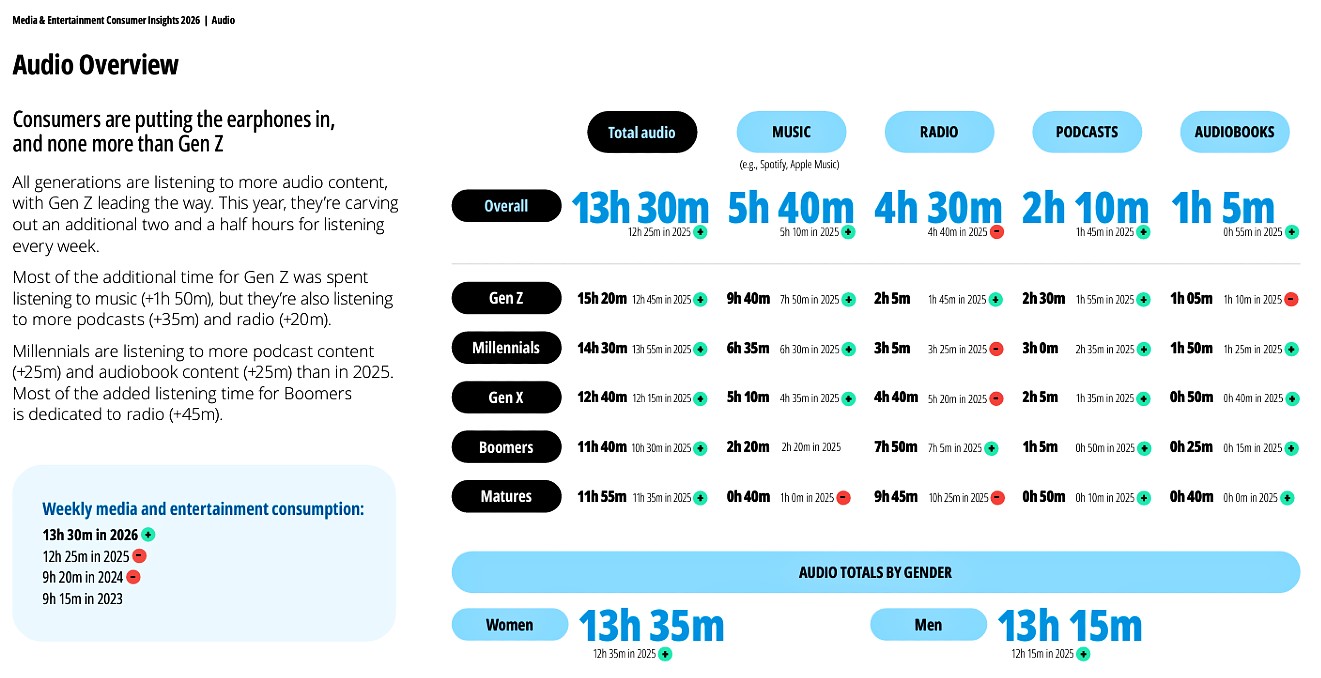
Audio is emerging as the biggest winner in the battle for Australians' attention, with listening time jumping by an hour and five minutes to 13 hours and 30 minutes a week as consumers shift away from video. Deloitte's latest research shows the growth spans every generation, although music, radio and podcasts are attracting different audiences.
Gen Z is leading the charge, cramming 15 hours and 20 minutes of audio into the average week, an increase of two hours and 35 minutes, largely thanks to a growing appetite for music. Millennials are finding three hours a week for podcasts, while Boomers are demonstrating that reports of radio's demise may have been somewhat premature, increasing their listening from seven hours and five minutes to seven hours and 50 minutes. Music remains the undisputed heavyweight, with 70 per cent of Australians listening for at least an hour each week, compared with 42 per cent for podcasts. Audiobooks are also muscling into the competition for listeners' ears, particularly among Millennials.
"Australians are listening to more audio across every generation, with Gen Z leading the increase," Corbett said. "Music accounts for most of their additional listening time, while Boomers' growth is mainly in radio. Audio is taking a larger share of Australians' media time, even as their total consumption holds steady."
Social media's surprising growth
Advertisers still treating social media as a young person's game may need to revisit their media plans too. Deloitte's latest research reveals older Australians are driving some of the strongest growth in social media consumption, potentially opening up new opportunities for brands willing to look beyond the industry's customary obsession with younger audiences. Overall consumption increased by 30 minutes to five hours and 50 minutes a week, with Gen X recording a 26 per cent jump to five hours and 30 minutes, while Boomers clocked up an even more impressive 28 per cent increase to three hours and 55 minutes.
Gen Z, meanwhile, appears to be easing off the accelerator, trimming around 20 minutes from its weekly social media consumption, although at eight hours and 20 minutes it remains comfortably ahead of everyone else. The generational divide also extends to where Australians spend their time. Facebook remains the country's most popular primary social platform at 29 per cent, followed by YouTube at 23 per cent, Instagram at 14 per cent and TikTok at 9 per cent. Younger Australians have rather different ideas about where the action is, with TikTok leading among Gen Z at 26 per cent, ahead of Instagram at 21 per cent and YouTube at 20 per cent.
For marketers, the challenge is keeping pace with an audience whose social habits are shifting in different directions depending on which side of the generation gap they occupy.
News consumption rebounds
Australia's news publishers have some welcome news for advertisers: Audiences are spending more time consuming journalism, although the industry's ability to turn that growing appetite into revenue remains complicated by changing distribution habits and consumers' limited enthusiasm for paying to access the content. Deloitte's research shows weekly news and magazine consumption has increased from 2 hours and 5 minutes to 2 hours and 30 minutes, with growth across every generation. Boomers remain the most committed news consumers at 3 hours and 40 minutes a week, compared with one hour and 10 minutes among Gen Z.
And Australians still have a healthy appetite for serious journalism, despite the industry's periodic anxieties about shrinking attention spans and the triumph of celebrity clickbait. National affairs and politics attract 68 per cent of respondents, closely followed by local news at 67 per cent and international affairs at 64 per cent, while investigative journalism draws interest from 50 per cent. The challenge for publishers is getting that journalism in front of audiences who increasingly have different ideas about where news should live. Younger Australians favour YouTube and social media, while 53 per cent of Boomers still nominate television news as their preferred platform.
Turning that audience interest into revenue presents another headache. A quarter of Australians, 25 per cent, identify excessive advertising as the biggest obstacle to accessing the news they want, while 22 per cent nominate paywalls. Publishers are consequently caught in an awkward commercial squeeze: The advertising that helps finance journalism is putting some readers off, while charging audiences directly is discouraging others. With news consumption growing and distribution increasingly controlled by third-party platforms, the pressure to make the economics work is unlikely to ease.
Grand theft attention
The report also shows gaming elbowing its way into a bigger share of Australians' entertainment time, giving advertisers another reason to pay attention to an audience that extends well beyond the stereotypical teenager glued to a console. Deloitte's research found gaming consumption increased by 40 minutes to 3 hours and 45 minutes a week, with every generation reporting growth. Almost two-thirds of Australians, 64 per cent, now say they game regularly, rising to 90 per cent of Gen Z and 79 per cent of Millennials.
Gen Z remains the most enthusiastic generation, spending six hours a week gaming, up from five hours in 2025, although Millennials are proving particularly valuable customers. They spend an average $103 a month on in-game purchases, compared with $59 for Gen Z, suggesting the generation that grew up with gaming is carrying its enthusiasm, and considerably more spending power, into adulthood.
Mobile is the most widely used gaming platform, while consoles and PCs continue to attract younger audiences. The growing competition for attention now includes an entertainment sector whose audiences are getting older, whose reach extends across generations and whose customers have demonstrated a willingness to spend money inside the games themselves.
Sport holds its appeal
Sport is the key piece giving broadcasters and rights holders something to cheer about, with younger Australians spending more time watching events and showing a healthy appetite for paying extra to see the biggest contests. Deloitte found Australians now consume three hours of sport each week, with Gen Z lifting its viewing from one hour and 30 minutes to two hours, while Millennials increased theirs from one hour and 55 minutes to two hours and 40 minutes. Live sport remains the main attraction, preferred by 60 per cent of respondents, and free-to-air television continues to be the most popular viewing platform overall.
The more intriguing commercial opportunity lies in convincing audiences to open their wallets for individual events, potentially giving rights holders another way to monetise content that already commands considerable attention. Almost half of Australians (46 per cent) say they would pay separately for sporting occasions, rising to 65 per cent of Gen Z and 60 per cent of Millennials. Major finals and championship games generate the strongest interest, while watching with friends or family is a leading motivation among those willing to pay.
It's also worth noting that one of the biggest trends in the broadcaster and streaming upfront season this year was the trend for rights holders to develop influencer networks based on their own talent but also on independent influencers. For example, at its event in early September, DANZ announced Club Kayo, a home create always-on creator teams across AFL, NRL, cricket and motorsport, extending advertiser opportunities beyond the live game.
Commercial dilemma
Deloitte's findings underscore a growing commercial dilemma: Australians have a finite amount of attention, more ways than ever to spend it and increasingly fragmented loyalties. As audiences migrate between formats and platforms, the challenge is determining where that attention delivers the greatest commercial value, and whether the businesses creating the content can capture a fair share of it.