CMO Awards 2026 winners revealed: Banking CMO tops the list, insurance, FMCG and retail strong showing in this year's CMOs of the Year, Growth Initiative and Emerging Marketing Leader


Financial services and insurance CMOs have swept through this year’s list of winners at the 2026 CMO Awards, scooping up three of the top 10 positions including the coveted #1 spot with a combination of the sense and sensibility of modern marketing leadership: Change leadership, cutting-edge tech utilisation, commitment to brand as a growth system, discerning decision making including ruthless media choices – and all with a heck of a lot of pace. Here we reveal the winners and finalists – and some key facts and figures – from our second annual CMO Awards, powered by Mi3.
A marketing stalwart of the financial services industry who spent 16 years at Westpac Group and then spent the last 18 months transforming Queensland’s own bank has taken out the top spot at the second annual CMO Awards.
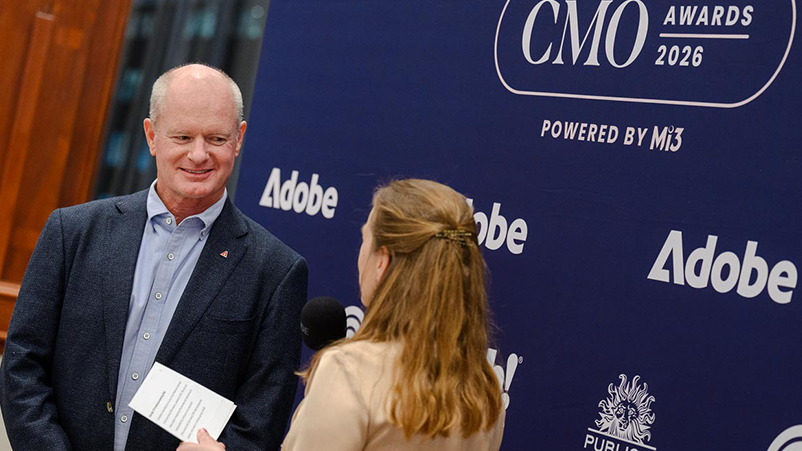
More than 170 of Australia’s finest marketing leaders and industry greats descended on the recently opened Ballroom at The Lands by Capella last night for the annual CMO Awards Gala dinner, powered by Mi3. It’s the second year of this annual CMO recognition program, which celebrates the excellence and progressive thinking of Australia’s top marketing leadership talent and their teams. This year’s program was supported by Platinum Partner Adobe, along with Gold Partners: Publicis Groupe, Commercial Radio & Audio and oOh!media.
This year’s #1 was Adrian McCaffrey, who joined Bank of Queensland in October 2024 after 16 years with the Westpac Group – and faced a very different kettle of fish in doing so. The brand was stagnating, and winning purely on share of voice wasn’t an option. Getting bang from the marketing buck was also challenged.
So McCaffrey set about transforming Bank of Queensland through a multi-year repositioning as Queensland’s bank, integrating brand, media, customer channels and internal culture into a single growth platform dubbed The Bank of Queenslanders. Behind the scenes, it’s required an overhaul of BOQ’s operating model, standing up new martech, rethinking agencies, restructuring teams, reshaping campaign processes, building in new effectiveness and measurement tools, modernising the digital experience on cutting-edge tech and more. Front of house, it’s also required very decisive decision-making on media investments, sponsorships and partnerships, customer channel strategies and creative.
CMO Awards: The top 5
Taking out second place was Tourism Australia’s Susan Coghill, riding high on the back of the first wins from Chapter 2 of the ‘Come and Say G’Day’ campaign platform. Having had such sizeable success with Chapter 1 – +172 per cent long haul visitor growth than originally forecast, and $7.2bn in incremental tourism expenditure – the big question was how to evolve something without diluting what made it work.
Chapter two is proving the compounding benefits of sticking to the knitting. International total trip visitor expenditure grew 10 per cent to a record $53.2bn, consideration is still going up, and the numbers are good. But as Coghill shared in her submission, this wasn’t just a campaign – it’s a testament to the principles, operating models, insights and capability her Tourism Australia team has been working so hard to realise.
Rounding out the CMOs of the Year top five are Michelle Klein, for her work closing out NRMA’s centenary year at IAG as well as the green shoots of her ‘brand as customer flywheel’ game plan as chief growth brand and marketing officer at Westpac; Blackmores Group chief brand, innovation and communications officer, Joanne Smith; and The Iconic’s CMO, Joanna Robinson.
Two new faces in this year’s CMO Awards program also made it to the top 10: Uber and Uber Eats head of marketing for ANZ, Nicole Bardsley (6th) and Qantas CMO, Petra Perry (#10). Also making their appearance in the top 10 for a second consecutive year are Youi CMO, Angela Greenwood (8th) and REA Group GM of audience and marketing, Sarah Myers (9th). Rising up the ranks for this first top 10 showing is amaysim CMO, Pete MacGregor.
The full list of this year’s top 10 CMOs of the Year is:
- Adrian McCaffrey, CMO, Bank of Queensland
- Susan Coghill, CMO, Tourism Australia
- Michelle Klein, Chief growth brand and marketing officer, Westpac Group
- Joanne Smith, Chief brand, innovation and communications officer, Blackmores Group
- Joanna Robinson, CMO, The Iconic
- Nicole Bardsley, Head of marketing, Uber & Uber Eats ANZ
- Pete MacGregor, CMO, amaysim
- Angela Greenwood, CMO, Youi
- Sarah Myers, GM audience and marketing, REA Group
- Petra Perry, CMO, Qantas
CMO Awards program criteria
The annual CMO Awards program has five key aims:
- Recognising Australia’s most progressive and effective CMOs and marketing leaders
- Rewarding and supporting successful, innovative growth strategies and ‘big M’ marketing delivery
- Building excellence and elevating the stature of Australia’s best performing marketing chiefs and their teams
- Supporting excellence across marketing, customer and business growth leadership
- Connecting an alumni of CMOs, marketing leaders and emerging marketing leaders.
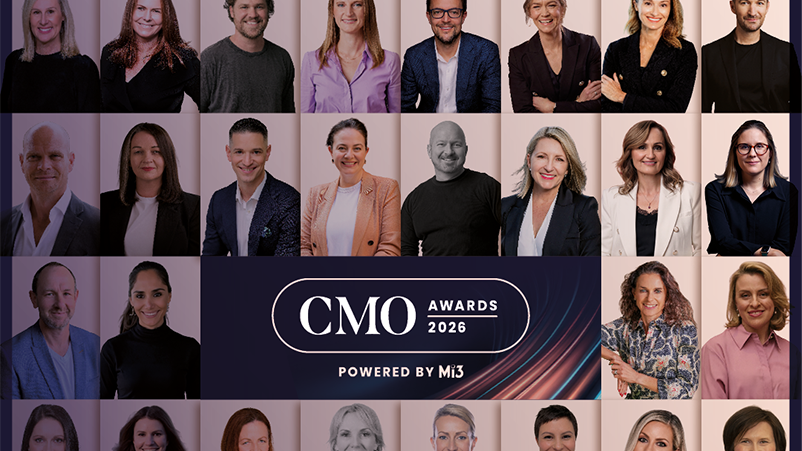
This year, four CMO-level categories were awarded: Chief Marketing Officers of the Year, recognising 51 finalists and a top 25 list of Chief Marketing Officers of the Year, plus an SMB CMO of the Year (up to 150 employees), and First-Time CMO of the Year (held a CMO role for under 2 years). All categories required entrants to complete the main nomination form and were graded by the main CMOs of the Year judging panel. These awards were open to the most senior marketing executive for an organisation based in Australia with a remit that includes the Australian market.
First-Time CMO of the Year
This year’s First-Time CMO of the year was 7-Eleven GM of marketing, Adam Jacka, who impressed judges with the solid work he’s done since stepping into the top marketing role. With a clear mandate from the chief commercial officer and CEO to ‘Go Smarter, Go Faster, Go Together’, Jacka has been undertaking a fundamental reshaping of the marketing operating model and mindset, anchored in a new 3Cs comms framework: Connect with me, convince me, convert me. The submission was also peppered with pragmatic data-driven cases, including a solid effort to boost sushi sales, plus examples of unlocking growth outcomes with solid brand planning.
Already, it’s paying dividends: Food is up +14 per cent and drink +15 per cent year-on-year. As Jacka shared with judges: “This is a story of a rebuilt marketing function, new marketing strategy, new marketing ambition, new marketing capabilities and a newly united marketing team and commercial tribe driving the strongest customer, brand and commercial momentum 7‑Eleven has seen in years.”
SMB CMO of the Year
This year’s SMB CMO of the Year – for the second consecutive year – was Brad Firth, GM and CMO at Mountain Culture Beer Co.
From taking over and redirecting spend to running local pubs, to a Fruit Enhanced Hazy beer brewed out of rapid innovation that sold out on its first festival debut, as well as an array of clever B2B partnerships, Firth offered an enviable example of how to be effective in the beer category. His submission regaled judges with examples of impact using both the latest tools at marketing’s disposal as well as strategic nous.
“We invested heavily in data this year – yet our best results still came from putting an idea into a keg, tapping it under a fake name, and recording real drinker responses over a 3-month period. It's as old fashioned as it gets, but it also led to the launch of the best-selling new craft beer in Australia,” Firth said.
The debut of Emerging Marketing Leader of the Year
Debuting for the first time in 2026 was our new category recognising the future generation of CMOs: Emerging Marketing Leader of the Year, presented by Commercial Radio & Audio. This year’s inaugural winner was Wesfarmers Health head of marketing, Grace Eadie, for her work as both strategist and orchestrator on Priceline’s ‘Anything Menopause’ work.
This multi-year platform is aligning pharmacy operations, digital health, wholesale, merchandise, ecommerce, loyalty, people & culture and health supplier partners around a shared expansion agenda to unlock a new health growth platform. It’s designed to unlock net-new growth and reposition the Priceline brand as a trusted destination for menopause support. Grounded in education and empowerment, 3500 frontline staff have already been trained, confidence in discussing menopause with customers is up, and hefty dispensary sales growth all demonstrate how this differentiated growth engine is expanding the category, attracting new customers while making a tangible difference to Australian women.
Best Growth Initiative of the Year
Returning for a second year was our specialist award, Best Growth Initiative of the Year, presented by Publicis Groupe. This category recognises growth strategies that go beyond the BAU and deliver a net new or incremental product, business or other form of innovation for the organisation. Judges were explicitly looking for examples of data-driven and insight-informed decision-making, new ways of working, operational processes and investment in capability, along with its business impact.
This year’s winner was the AAMI Driving Test, which appeared as an inversion to the concept of growth at first glance: To combat the 42 per cent rise in motor claim costs since 2019 off the back of risky driving, a 22 per cent lift in national fatalities and the subsequent rising repair costs.
Using mobile telematics, AAMI turned every smartphone into a precision driving sensor, tapping real-time data across speed, braking, cornering, acceleration and phone use to create safety driving scores for app users – both customers and non-customers alike. The AAMI app was redesigned to enable participation with new onboarding journeys, lifestyle and behavioural inputs, and seamless access for all.
Already, 7.3 million trips have been tracked off, exceeding targets, and many participants are non-AAMI customers, creating a database for future acquisition. Brand consideration is up double-digits and it’s on track to see millions in claims reductions annually. Importantly, high-risk drivers starting below 70 delivered the strongest behavioural shifts and greatest safety claims as they improved their scores.
Judges recognised the courage it took to invest in the AAMI Driving Test, and the transformational approach to behaviour change. They also noted the short and long-term growth effects from initial engagement and mentality availability to a pipeline of prospective customers for when annual renewals come around.
In all, 15 judges took part in this year’s CMO Awards program across two groups: The main CMOs of the Year category, plus the Growth Initiative of the Year + Emerging Marketing Leader of the Year. Judges include former marketing leaders, non-executive directors, CEOs and industry luminaries and can be found here.
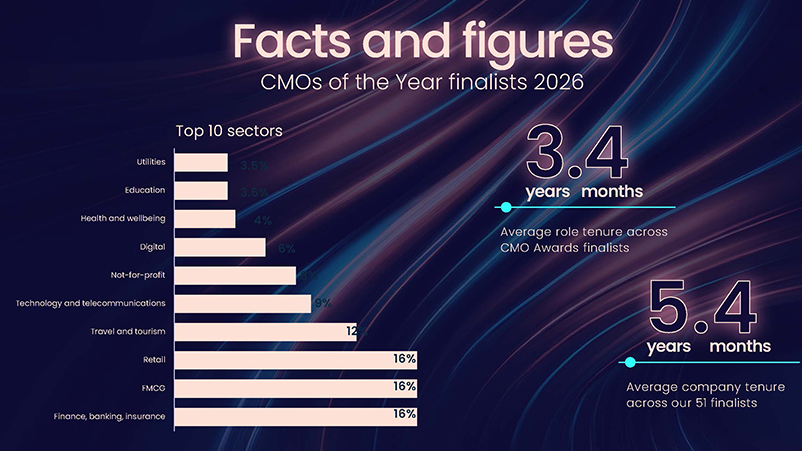
CMO Awards finalists: Facts and figures
In terms of industry representation across this year’s CMOs of the Year finalists, finance, banking and insurance and FMCG had the biggest showing alongside retail.
The average tenure across the 51 finalists came out at 3 years and 4 months – the same as in our inaugural year – with company tenure well over 5 years. Within this mix were longer-tenured marketers as well as recently appointed CMOs in our mix – over 10 per cent of entrants classified as First-Time CMOs with under 2 years in the top marketing role.
Equally, several finalists have been continuing to gain additional responsibilities, while still retaining the most senior marketing position. Again, it’s an example of just how fluid and dynamic the CMO role is.
Just shy of six in 10 (59%) report to the company CEO, MD or ANZ general manager, versus 67 per cent last year. Three in four CMOs are female and six in 10 come from NSW, but notably more finalists came from Victoria this year: 37 per cent in all.
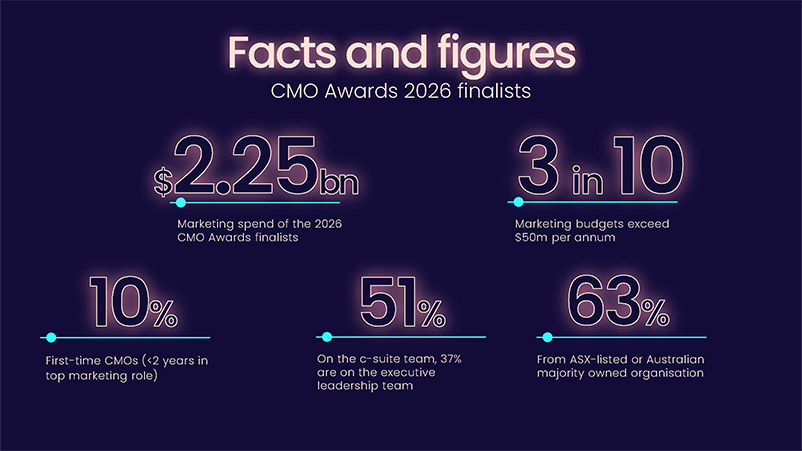
While it’s common to find larger organisations in the CMO Awards top 10 due to the broader nature of the role, scope and budgets, it’s also the case Australian-based or owned organisations tend to serve up more big M marketing overall. In 2026, 63 per cent of finalists were working for ASX-listed or Australian majority-owned organisations.
Respondents were also asked to give an indication – confidentially – of marketing spend, plus team size and company size. Three in 10 have marketing budgets exceeding $50m per annum; about 10 per cent are working with over $100m per year. But 17 per cent also had $10m or less per year to do their work, showing the diversity of CMOs in the ranks.
Based on these estimates, Mi3 calculated the 51 finalists account for over $2.25bn in annual marketing spend.