
“Quietly confident”: Brisbane 2032 Olympic Games CMO on cockatoos over bin chickens, capitalising on earned media and brand building through what the world loves about Australians
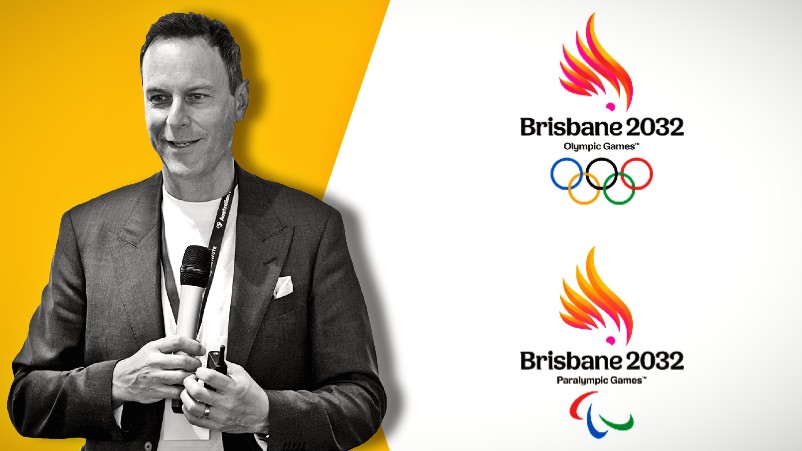
Brisbane 2032 Olympic and Paralympic Games CMO, Brent Hill, speaking at the recent Australian Marketing Institute CPM Summit
What do you do when you’re the CMO of the 2032 Brisbane Olympic and Paralympic Games and have to compete with beach volleyball played under the iconic Paris Eiffel Tower, and the biggest-ever Olympics planned in LA in 2028? You pitch natural, welcoming authenticity with a hint of cheekiness and “quiet confidence”, says Brent Hill. The former tourism marketer has just reached his first major milestone in the six-year marathon to the Brisbane Games, taking the wrappers off its hotly anticipated visual identity for the 2032 Olympics this week. “What we’re doing is still the core things marketing does: It’s about building belief, building excitement and demand, creating belonging, converting demand, then scaling through the ecosystem,” he says. Here, Hill shares the briefing and creative approach to building the new brand, and how he’s playing the short and long-term game when it comes to delivering impact.
No, it’s not a bin chicken. But such larrikin suggestions of what’s Australian enough to make up the Brisbane 2032 Olympic logo gave its marketing team the confidence to have fun, CMO Brent Hill, agrees.
On Monday 5 October, the official Brisbane 2032 Olympic and Paralympic Games emblems, featuring the Olympic rings plus Agitos Paralympic Games symbols, were released to the public. The official debut was pre-empted by a six-stop drip-feed of logo pieces by 12 Australian sporting stars at events down the coast of Queensland and NSW.
Monday was official release day, that is. A ‘wayward’ leak of the full logo occurred on YouTube two days prior. Rather than derail things, Hill says it fuelled hype and chatter around how these games were to be visually represented on the world stage.
And that was critical. As a marketing chief with meagre paid media spend – during the recent Australian Marketing Institute (AMI) CPM Summit, Hill joked his entire six-year Brisbane 2032 marketing was “less than I had in tourism for one year” – maximising owned and earned returns off the logo launch was vital, he tells Mi3.
“We're very fortunate the Olympics is an incredibly powerful brand, and there's a lot of interest. But you can't ever take that for granted. You have to be clever, creative and innovative in terms of how you're putting it out there,” he says. “We engage really heavily with all of our media partners, tourism partners, councils, invite them in, get them involved and tell them the story so they want to tell that story as well.”
At the heart of the Brisbane 2032 visual logo are the pink cockatoo and sulphur-crested cockatoo, native Australian birds known for their cheeky character. Their feathered crests also represent the shape of the Olympic and Paralympic flames, while in aggregate, they’re an outline of the Queensland state as seen on a map. Cockatoos additionally carry First Nations significance, with strong connections to Country and a cultural role as messengers linking people to place, story and ceremony.
Early figures indicate Hill has met his KPIs on the brand debut. He points to over 7500 global media mentions over the campaign so far, with reach well over 15 million on social channels. In addition, early keyword tracking indicates sentiment and brand association are going in the right direction, with terms such as ‘Australia’, ‘Brisbane’, ‘coast’, ‘fun’ and ‘environment’ satisfyingly all cropping up.
Eking out the launch over a week was also a deliberate play to build positive anticipation. “I didn't want the ‘ta da’ moment, and just drop the emblem on everybody and go bang, here it is. Because I think what happens is that immediately evokes the question: Do you like it or not; yes or no,” continues Hill.
“Plus, we've got to use every opportunity we can get to tell the story of Brisbane and Queensland and how beautiful it is, and what our games are all about. So I would say this went wildly well in the sense of how well we thought it would do.
“Being able to tell the story of Queensland, Brisbane, all the way down the coast was amazing. The athletes were brilliant. The interest was huge day by day. We had people guessing left, right and centre. It was dominating press. We had to pivot obviously with that [leak] moment, but it didn't really derail anything. So in that sense, everything we could have possibly dreamt of in terms of the numbers, awareness and showcasing Queensland and our story, we've been able to get.”
There’s also a relief now we’ve finally got the brand out there, as we’ve been working on this for a long time. It just changes the organisation – we have a brand, we’ve got a name.
Devising an Olympic identity
Hill is no stranger to destination and location marketing – he’s the former CEO of Tourism Fiji, as well as former CMO of South Australia Tourism Commission. Prior to this, he held marketing roles across People First Bank, Harris Scarfe Australia and Telstra. But while there are oodles of stakeholders to manage when you’re marketing a destination, the volume of stakeholders, brand guardrails and consumer input when developing an Olympics emblem is another level entirely.
“You’re representing something really large, and something people are really passionate about. You obviously have to involve a lot of stakeholders,” Hill agrees. “In our case, this is literally our city and our country. Having done that before, particularly in tourism, it was great to be able to call on that experience. But one difference with this and the challenge is the global nature of it. The IOC has really strict guardrails and legal elements – we have to register this around the world. It's truly a global brand we're putting in place.
“And you're working within a construct. It's not like you have a blank canvas; you have to work with the Agitos and the Rings. You'll notice little subtle things, like we have to use the words ‘Olympic Games’ and ‘Paralympic Games’ in the logos. There are guidelines around placement and so on.”
Versatility is another huge part of the design process, and Hill points out the logos will be used on everything from table tennis balls to billboards, stadiums and merchandise.
In the case of writing the creative brief for Brisbane, Hill points to previous Olympics logos that have sought to be more controversial. “From our perspective, we didn't feel like we needed to prove a point per se,” he says.
“We wanted something that people wanted to really embrace. We think Brisbane and Queensland is this quietly confident place we really want the world to discover. So we want people to smile and love it – that was really important to us.”
Further weighing into the creative debate was what quintessentially would represent Brisbane – which lacks the iconic landmarks of Sydney or Paris – while also reflecting Australia. “What does the world know about Australia, and what do they love? They love our natural environment, they love our people, and they love our passion for sport,” says Hill. “So the brief became about picking up on those things.”
It’s clear from talking to this CMO that authenticity was another non-negotiable. Hill’s commonly being asked how a location like Brisbane can compete with beach volleyball, for example, played under the Eiffel Tower during the Paris 2024 Games.
“My answer to that is that's man-made, artificial and brought in. Yes, it's spectacular. But arguably more spectacular is having beach volleyball on the beach on the Gold Coast, where they play beach volleyball every day. That natural setting is stunning. We don't seek to compete or try and be a wannabe of Paris, LA or London. We just want to be true to ourselves,” he says.
Likewise, the cycling will take place in the Sunshine Coast Glasshouse Mountains, while sailing competitions will be on The Whitsundays.
“LA 28 will be the biggest games you have ever seen, and it will never be bigger; I can 100 per cent assure you of that,” Hill told marketers at that recent AMI CPM Summit in Sydney. “What LA is doing is gargantuan, with huge budgets. Only the Americans could have a crack at it. They’re going to have 15,000 athletes; we’re capped at about 10,500.
“We just want to do our games in our style. Be authentic. Be Australian. We want Australians to look at how we’re marketing and positioning and go, ‘that’s us’ … So when we did the research, the number thing was: Make it for everyone, invite everyone … And of course use that amazing environment – we’re not relying on the man-made stuff.”
But balancing clichés and ‘g’day’ with the international desire to see unique wildlife, beach and a BBQ is a fine line. Which is why Brisbane 2032 ended up with two cheeky cockatoos in the logo. The fact Australians kept suggesting the Ibis bird, colloquially dubbed the ‘bin chicken’, gave Hill’s team “the licence to consider different options”, he says.
“Aussies love an underdog, so that's why we love the bin chicken. But the world is not going to get that joke,” he continues. “They're going to say, you've got a bird that hangs around in bins and is ugly as hell. Why would you put that on your emblem? But it was also the fact Australians were saying to us, have a bit of fun, guys. Don't be too serious or too corporate.”
Measuring success
The Brisbane 2032 Olympic and Paralympic Games are privately funded. Investment includes a $5.9 billion contribution from the International Organising Committee (IOC), funded by broadcasting and sponsor dollars. The remainder comes from local sponsorship, ticketing, hospitality and licensed products and merchandising.
Awareness is one of the biggest measuring sticks of short and long-term impact for Hill. With global awareness of Brisbane sitting at about 5 per cent right now, per Tourism & Events Queensland data, he says that’s projected to hit 80 per cent by the time the games are done. Potential reach numbers are equally massive: 19.5 million Australians tuned into the broadcast of the Paris 2024 Olympic Games alone, and it achieved 5 billion unique viewers globally.
There’s a lot riding on it reputationally and economically too. Modelling from Deloitte Access Economics speculated the 2032 games could bring $70 billion in economic opportunities between 2032 – 2052, including growth of almost $40bn in south-east Queensland. Deloitte based its predictions on the potential represented through people, places and perception. More than 15 years after the Sydney 2000 games, it was estimated to have brought about a GDP uplift of more than $7bn, created 100,000 new jobs and boosted annual tourism visitation by 1.6m per year.
“When I think about Sydney 2000, we all walked a step taller – it felt like our games, and that we were on the world stage,” Hill said at the AMI CPM Summit. “It’s positioning Queensland as an exceptional destination, a unique place and world-class host. That’s really important. We talked to Tourism Australia about how they position Australia, and we tap into some of that … But at the same time, it’s about harnessing the power of sport to unite people, celebrate our culture, inspire active lifestyles and create lasting benefits for Queensland and for Australia.
“What we’re doing are still the core things marketing does: It’s about building belief, building excitement and demand, creating belonging, converting demand, then scaling through the ecosystem.”
Sentiment is therefore another key indicator. Here again, Hill showed a savviness for both the short and long. “My view is we just have a steady cadence of positive things because we know sentiment goes up and down – that’s what happens,” he told summit attendees. “First, there's 'the Olympics sucks; there’s construction everywhere'. Then, 'We’re four years out. It’s so long, and they’re spending a lot of money'. Then it becomes, ‘the Olympics are here, it’s the best thing ever’.”
But in putting the brand out to market, Hill sees himself finally able to bring people closer. “I absolutely feel like there’s latent demand. We call it permission to get excited,” he said in the lead-up to this week.
A protracted case of project management
Brisbane 2032’s next major steps include the launch of the sports program in early 2027, then work on Australia House and its presence at the Los Angeles 2028 Olympic Games, where the handover to Brisbane takes place.
“There’s a lot more we are looking to bring out about the emblem and more things we can talk to there,” Hill says. “We have also started conversations about mascots, which is early, given they’re usually released with about two years to go.”
But there’s no doubt it’s a multi-year, mega project to manage. Asked at the AMI CPM Summit how he’s managing it as an executive, Hill admitted working on major events during his tourism days “gave me the sweats”.
“When I first thought about 2032, I thought, my God, six years of having sweats,” he told attendees. Right now, the marketing team sits at eight. By the time the games arrive, it’ll be 65 – and the total team will be upwards of 5000.
“I like to go for a run most mornings, and I was thinking about this: How on earth do you just anticipate everything that’s coming at you in a project that is so big and which you are growing so quickly? The answer is you have to break it down into these manageable delivery points and just look at it step by step,” Hill said. “We use horizons: Two-year horizon to LA, two-year horizon to 32. If Covid taught us anything, the five or 10-year plan should be thrown out – too much stuff changes. So I think breaking it down is really important.
“That said, you do need to have a clear roadmap of what you want to do, and one eye on now, and the other on the future. We’re very much focused on launching a brand now, but at the same time, we’re recruiting for ceremonies, we’re recruiting for our torch relay, and thinking about those things which don’t actually start until 2031.”
On a personal and CMO level, the emblem’s reception is both a moment of pride for Hill. “There’s also a relief now we’ve finally got the brand out there, as we’ve been working on this for a long time,” he says. “It just changes the organisation – we have a brand, we’ve got a name.”
