
Formula One’s agentic overhaul sets global media-sports benchmark as Conde Nast, Sony, NY Times align with AWS; Netflix-Warner Bros likely next if deal lands

Blue Origin uses 2700 AI agents to design and build spacecraft; F1 is using the same agentic tech in sport and media to keep pace, said AWS global lead for media, entertainment, games and sport, Samira Bakhtiar.
Netflix struck a surprise alliance earlier this year with Amazon’s advertising tech to sell ads for its streaming platform, which competes squarely with Amazon’s Prime service. But aggressive efforts by Amazon Web Services (AWS) to target media, entertainment and gaming companies globally with its rapid rollout of agentic tech signals Netflix will likely ape the globally resurgent Formula One (F1) motorsport with its proposed but now checked $US72bn takeover of Warner Bros Discovery (WBD). Another tech-controlled legacy media conglomerate, Paramount Skydance, with family ties to Oracle founder Larry Ellison, the world’s second-wealthiest person estimated at $US264.8bn by Forbes, launched a hostile $US108.4bn raid on WBD yesterday. Whatever transpires, F1 “is a master class in what it takes to reinvent” a sports code and a media and content company, according to AWS global sector lead Samira Bakhtiar. She spoke with Mi3 on the sidelines of last week’s heaving annual Re:Invent cloud and agentic conference, which pulled 50,000-plus mostly hardcore tech types to Las Vegas.
What you need to know:
-
Blue Origin’s AI rocket scientists at the Jeff Bezos-owned space company has deployed 7,500 autonomous AI agents – dubbed “Blue GPT” – to design and build spacecraft, slashing development time by 75% and improving performance 40% on traditional cycles.
-
The vision is to move from 100 humans per rocket to one human for 100 rockets - Blue Origin’s transformation boss William Brennan says the goal is to launch 100 rockets with just one operator – enabled by AI agents automating design, testing and operations.
-
AI agents helped design a system to convert moon dust into energy during lunar nights – a major breakthrough led by agents managing everything from requirements to simulations.
-
At AWS re:Invent, execs said millions of autonomous agents will soon run inside every company, with new agent platforms, chipsets, AI models and “AI factories” now available to deploy on-premises.
-
Media, sport and gaming next in line: AWS is targeting the $3.5tn media, entertainment and gaming sector with agent tech – citing Formula 1, Conde Nast and Sony as leaders in using AI to reinvent legacy content and business models.
-
Formula 1 used AWS agents to index 70+ years of footage for dynamic monetisation, advertising, streaming and content remixes – a blueprint AWS says studios, streamers and legacy broadcasters must replicate.
-
Can AI help legacy media under pressure? Conde Nast is revamping Vogue, Vanity Fair and Wired using AWS’ AI stack, while AWS warns others must overcome cultural resistance or risk falling behind.
-
AWS eyes cloud dominance: With 30% market share, AWS is expanding from infrastructure to end-user AI products to fend off Microsoft and Google – betting big on autonomous agents to drive the next growth wave.
We believe in a world where we can agentically design an entire rocket, where we can launch 100 rockets with one person, rather than one rocket with 100 people
Rocket ship agents - literally
The transformation boss at space outfit Blue Origin – another company controlled by Amazon founder Jeff Bezos - has already deployed 7500 autonomous agents on its spaceship program. William Brennan told AWS re: Invent delegates the company was “headed quickly” to a scenario “where we can launch 100 rockets with one person, rather than one rocket with 100 people”.
In a sometimes eye-watering account of Blue Origin’s rapid adoption of autonomous, reasoning AI agents – using the tech stack of sister company AWS, of course – Brennan said Blue Origin had deployed 2700 agents so far, generating 3.5 million agent interactions from 70 per cent of Blue Origin employees and the company’s supply chain.
“We aren't yet developing all of our products using AI, but we will be with millions of people living and working in space,” he said. “We believe in a world where we can agentically design an entire rocket, where we can launch 100 rockets with one person, rather than one rocket with 100 people.”
Brennan cited one live agent case, T-Rex, in which the company invented new portable tech on its spacecraft to turn moon dust into energy to maintain operations on the moon when the solar cycle turns from the sun – essentially a space battery designed to “last for years”, he said.
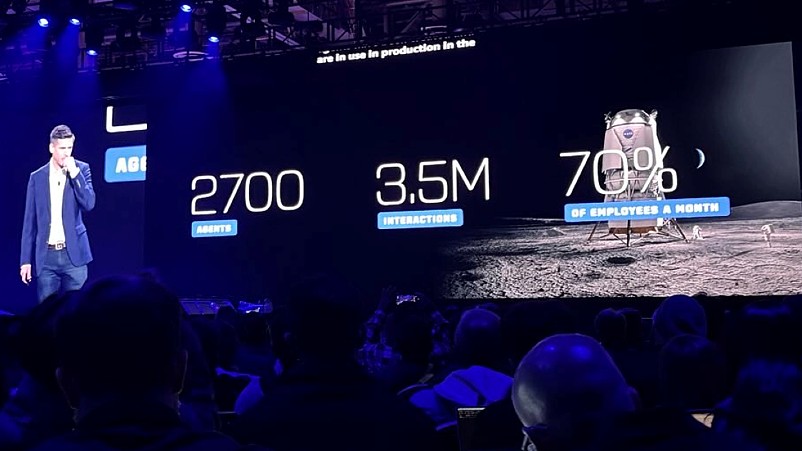
Agentic rocketships: Blue Origin's tech transformation boss William Brennan talks the numbers so far on autonomous agents in and for space life.
Agentic moon dust is real
“While T-Rex is amazing, what's even more amazing is the team of AI agents that helped build it,” Brennan said.
A “Blue GPT agent” - Blue Origin’s custom-built agent platform using AWS kit that it spruiked last week could now be deployed by any enterprise - helped the company detail requirements for a moon dust-eating battery. “Another agent helped us create the system architecture. One of my favourite agents, though, is our simulation and analysis agent, where we're able to automate the iterative design loops, rapidly improving the product with custom knowledge bases and connected to AI native tools…for massive performance optimisation and … deterministic validation and artifact management…the agents run complex physics simulations, iterate on the design, based on results and execute until the requirements are met.”
Brennan said using agents, Blue Origin engineers delivered a product 75 per cent faster with a 40 per cent improvement on original designs versus previous development cycles using more humans.
“Most of you aren't building rockets or lunar infrastructure, but you do deal with specialised knowledge and custom tools and I think could benefit from a few of our learnings from agents,” he told thousands in the AI keynote last week. “First… think of adoption of AI as everyone's job, not just the technology teams. Democratise agent creation and use a simple, user-friendly interface."
That led to 70 per cent company adoption at Blue Origin, he said. "Second, I encourage you to let the process for innovation be messy, but discovery easy. A public marketplace or agent App Store has really helped us here, providing easy-to-use evaluation tools to allow your teams to test and discover their agents.” The third lesson from Brennan was an overt product sell for his sister company: “Let AWS handle the LLM agent primitives and scaling and focus on building with those tools to solve problems for yourselves and for your customers. With agent tech AI, we believe that the future is now, it's just not evenly distributed.”
In the case of Formula One, they've taken over 70 years of archival content, they’ve ingested into the AWS cloud, they've indexed it and they can now use natural language to find things that they didn't even know they had footage of.
Millions of agents in every company
AWS CEO Matt Garman said as much in his keynote a day earlier. A former AWS product manager who has turned the unit into the growth darling at Amazon in the past 18 months, Garman said “there's going to be millions of agents inside of every company across every imaginable field. Already we see agents accelerating healthcare discoveries, improving customer service, making payroll processing more efficient and agents are also starting to scale people's impact, up by 10x in some cases, so they have more time to embed…Bristol Myers Squibb built a new agent that's able to evaluate more than 10,000 compounds across multiple hypotheses in less than an hour. This is a process that used to take their researchers four to six weeks.”
Along with Amazon’s booming, high-margin ad business, AWS is on a roll at present, just as its ecommerce business hits a comparably soft growth cycle.
AWS wants to retain its 30 per cent share and global dominance of cloud computing – ahead of Microsoft on 20 per cent and Google on 13 per cent. To do it, AWS is building out a swathe of AI products, agents and super agents to keep it humming but it’s not all a downhill run for the company. Some analysts last week in Las Vegas noted the AWS announcement to allow its AI infrastructure, or “AI Factories” as it terms them, to run for the first time offsite and inside customer companies is a major turnaround in policy brought about by market demand and by rivals like Google and Microsoft moving earlier on this front.
Still, the frothing was palpable from engineers and developers last week when Garman announced in his keynote a swag of hot new AI chipsets, further advances in cloud compute, new AI models - including giving companies the tech to build their own frontier, or foundational models - and all manner of autonomous agents that were coming to market like an army.

AWS CEO Matt Garman is taking the firm further upstream from cloud and data infrastructure to a full agentic tech stack for end users - and consulting-like managed services for specific sectors including sport, media, gaming and entertainment.
Code is caning content
As geeked as it all seems, code is caning content – tech companies are busting media and production firms, amply demonstrated by AWS and its move up the food chain from tech infrastructure dominance in cloud computing to end user AI products which let enterprises large and small build thousands of agentic use cases, new custom LLM frontier models and tap sector-specific AWS managed services.
The latter includes entertainment, media, gaming, marketing and advertising.
The move by AWS into agentics directly impacts the media, entertainment and gaming sectors, forecast to grow $US600bn to $3.5 trillion by 2029, according to PwC.
While Blue Origin uses agents to design and build spacecraft, F1’s reinvention using the same agentic tech is what companies in sport, entertainment media and gaming need to replicate fast to keep pace with those leading the leap, said AWS General Manager of media, entertainment, games and sport, Samira Bakhtiar.
In the case of media, while Amazon Ads is chomping into media revenues, AWS is selling a fix.
F1 agents set new pace
Bakhtiar cited three macro trends facing companies across these sectors, all of which F1 has used to set new benchmarks for reinventing itself and staging a global comeback. She also pointed to Conde Nast, Sony and the New York Times as early outliers although acknowledged many legacy media businesses “should consider moving faster”
F1 has used AWS AI infrastructure and agents on 70-plus years of archived content to reshape it for a younger set, along with expansion into experiential retail stores and a massive merchandise rollout.
“They are a incredible use case, like a master class for what it takes to reinvent yourself and then also focus on taking legacy content and a legacy sport and be able to increase your reach and your relevance to new demographics around the world.
“Whether it's a studio or a game developer, a betting gaming organisation or a streamer or broadcaster, the macro trends that we're seeing across the board fall into three categories.”
The first was the ability to create content faster, at a lower price point and “with higher fidelity,” Bakhtiar said. "So it’s live, live sport content, film and episodic content, live action.”
70 years of content
The second trend was around “multi-channel monetisation” - finding ways to make money off content in different ways. “In the case of Formula One, they've taken over 70 years of archival content, they’ve ingested into the AWS cloud, they've indexed it and they can now use natural language to find things that they didn't even know they had footage of. Then you can do things with that - you can advertise differently. You can create customised streaming experiences; you could create augmented offerings like the documentary series they have on Netflix as an example. We've also seen customers really index on advanced advertising propositions.”
Bakhtiar said the process of getting projects approved internally by creating “some type of MVP”, wireframes and a business document to justify the case was redundant today. “Times have changed, you can actually create a proof of concept as a live app so I think the companies that are going to really lean into that, experiment more and leverage the technology are going to be in a position to really invigorate their builders to come out with new, novel, creative ideas that will be more immersive and more engaging. I really hope to see our entire industry move faster, the more traditional players and I'm very invested in ensuring that we can help that journey. Tech is in the right place, we're at the right moment in time, if they are to lean in.”
Conde Nast resets Vogue, Vanity Fair
A digital transformation initiative announced last week between AWS and Conde Nast was a case in point for legacy media, Bakhtiar said. “Conde Nast wanted to take media assets across their very popular, very storied brands like Vogue, Vanity Fair and Wired, really beloved brands and really think through how they could be able to unify their digital assets, to do unique things with them.
"So we work with them and leverage our AWS generative AI services as well as our core AWS tech stack to be able to help them really understand their asset libraries and cultivate a media asset management system that will continue to grow with them, that they can monetise in new ways as They look at being able to preserve the rich and robust history that they have with all the new things that they want to do in the future.”
Resistance remains
The New York Times was doing likewise in diversification, but Bakhtiar admits there is resistance that legacy companies have to deal with. “You have to bifurcate the people and cultural resistance with the tech," she said. "The tech is there, there are a myriad of different use cases that we can focus on across content production, media supply chain, modernisation, advanced advertising propositions, gamified viewing experiences - you tell me what you want to build right now from a legacy broadcaster and I'll show you how we can do it, either through AWS services or through the combination of AWS services and our partners.”
It was a big sell from AWS last week at re: Invent, one some in Australia with experience working with the cloud giant say can prove more difficult to execute than is packaged up. But the tech and disruption from agentic AI is coming at pace regardless.
“The combination of their historical experience, all of their content archives and this ability to be able to cultivate new things faster than ever before puts some in a unique position,” Bakhtiar said.
Paul McIntyre attended re:Invent as a guest of AWS.
