The nostalgia trap: Why Australians are looking back when they should be looking forward
Aussies love a nostalgia trip, but fantasising what life was like 50 years ago is actually more alarming than you’d think – not least because it’s a grim indictment of progress in 2026, says Ipsos Australia director, David Elliott. Now, new data shows why brands should think twice before going down memory lane.
Australians are having a serious case of the ‘good old days’. According to new Ipsos research* comparing perceptions of 1975 versus 2025, we’re among the most nostalgic nations on earth. When asked whether they’d prefer to be born 50 years ago or today, 51 per cent of Australians chose 1975, compared with just 24 per cent who opted for 2025. We ranked fifth-most nostalgic out of 30 countries surveyed.
It’s a fascinating result, particularly when you consider that 72 per cent of Australians weren’t even alive in 1975. Most people expressing this preference are romanticising an era they have never experienced firsthand.
What we think we’ve lost
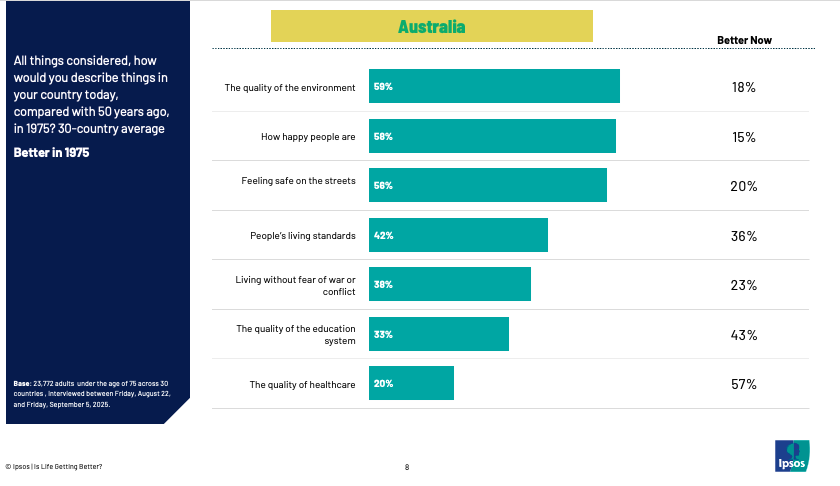
The research reveals what’s driving this yearning for yesteryear. Australians believe life was better in 1975 across several key dimensions: 58 per cent say people were happier back then, 56 per cent think streets were safer, and a whopping 59 per cent believe the environment was in better shape. Only 15 per cent, 20 per cent and 18 per cent respectively, think these aspects have improved.
It’s a grim assessment of progress – or the lack thereof. The ‘Uneasy Decade’ of the 2020s, as Ipsos has dubbed it, has clearly taken its toll on collective optimism. Between the pandemic, climate anxiety, cost-of-living pressures and global instability, it’s no wonder we’re looking backwards with longing.
But here’s where the nostalgia narrative deserves serious scrutiny. Richard Glover’s book The Land Before Avocado offers a bracing corrective to our selective memory. The Australia of 1975 wasn’t the paradise we imagine. It was a country where drink-driving was commonplace — parents routinely drove children around without seatbelts after a few beers. Women couldn’t open bank accounts without their husband’s permission. Being gay was illegal. Indigenous Australians faced systematic discrimination and had their children forcibly removed.
The food was, by all accounts, terrible. ‘The meat ring’ and ‘deconstructed fish’ were dinner party staples. Immigration was viewed with suspicion rather than celebration.
What we’re getting right
The Ipsos data actually supports Glover’s thesis in interesting ways. While Australians are pessimistic about happiness and safety, we do acknowledge improvement in tangible areas. Fifty seven per cent say healthcare is better now than in 1975 (versus 20 per cent who say it’s worse). Education gets similar recognition, with 43 per cent saying it’s improved compared with 33 per cent who think it’s declined.
These aren’t trivial advances. They represent real progress in life expectancy, medical treatment, educational access and opportunity. Yet they’re overshadowed by our emotional perception that something fundamental has been lost.
The research offers a striking counterpoint: South Korea is the only country where more people prefer 2025 to 1975. There, 44 per cent choose today versus just 19 per cent who favour the past. Why? South Koreans have witnessed extraordinary transformation within a single lifetime — from post-war poverty to being a top 10 global economy and cultural powerhouse.
As Ipsos Korea’s Country Manager, Hwanglye, Park explains, many Koreans see the past as “a symbol of deficiency and the present as a symbol of achievement”. They have a tangible connection between progress and lived experience.
Looking forward by looking back honestly
The nostalgia captured in this research isn’t just harmless sentimentality. It’s a political and social force. When 55 per cent of people believe happiness peaked half a century ago, it shapes everything from voting behaviour to consumer confidence to mental health.
The antidote isn’t to dismiss people’s concerns — the cost-of-living crisis is real, climate change is real, social media has created genuine problems. But it is correct to provide proper context; to remind ourselves, as Glover does, that progress is possible precisely because we’ve achieved it before.
The Australia of 1975 had leaded petrol, legal discrimination and genuinely terrible coffee. The Australia of 2025 has challenges, certainly. But it also has marriage equality, mandatory superannuation, world-class healthcare, and yes, excellent coffee and avocado toast.
The question isn’t whether we should return to 1975. We categorically shouldn’t. The question is whether we can channel our dissatisfaction with the present into building something better for 2030, rather than mourning a past that was never quite as good as we remember.
*This article is based on the Ipsos Global Advisor survey “Is Life Getting Better? 1975 versus 2025”, conducted across 30 countries between 22 August and 5 September 2025, with insights from Richard Glover’s 'The Land Before Avocado'.