“You don’t own the customer, but you should own every moment”: How Princess Cruises’ global consumer marketing VP is tapping AI, all-in customer profiles to orchestrate a 3x lift in omnichannel conversion outcomes
The numbers are stacking up for Princess Cruises: 28 per cent incremental offer conversion uplift and one in five win back rate, 4X boost in discovery engagement, and an 18:1 investment payback, according to global VP of consumer marketing, Debbie Zierten. Rethinking and resizing the database and committing to storytelling at scale has been a long road of learnings – not least that dumping your data into a CDP without discrimination will cost A LOT. But the cruise operator is seeing gains after tackling the rather unsexy tasks of data hygiene and unifying customer profiles, permission-based marketing, orchestrating cross-functional connections to ensure each team knows when to “own the customer moment” – from discovery through to the contact centre – and now strategically leveraging AI and the agents to do content and personalised decisioning at scale. Here’s the lowdown.
No one actually ‘owns’ the customer. But someone in your business can – and should – own every moment with them, says Princess Cruises global VP of consumer marketing, Debby Zierten. And that’s what a solid and unified data foundation and customer profile, omnichannel journey management, cross-functionally accepted principles, and now AI are finally enabling marketers to glue together and lead, she believes.
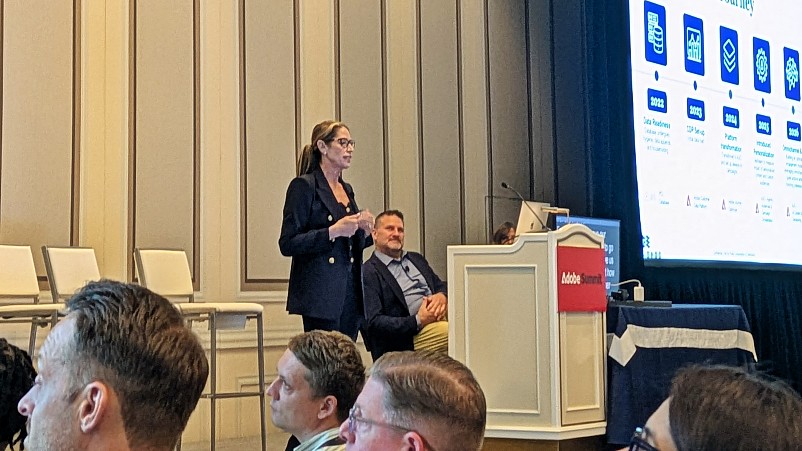
The cruise marketer was speaking at the recent Adobe Summit on how the brand has been building towards a continuous guest relationship across channels and the lifecycle through storytelling at scale.
When Zierten arrived at Princess back in 2022, the company “shockingly” hadn’t changed its data environment since 2019 and was in denial. While bragging it had 15 million people on its database, it could in fact only communicate with 7m of them.
“We had a lot of people on our database that were deceased, and we were still mailing and emailing them,” she recalled. “We created an entirely new way of looking at our database and most importantly, collapsed our household … It’s a journey every day and a struggle at the senior levels to get them to understand what we’re going through, but if we don’t get it right, it’s just not going to work.”
An initial vital step was building out a common profile to follow guests, from website to marketing and contact centre. This is enriched with multi-channel engagement data, transaction data, booking channel preference, model propensity scores, guest segmentation and demographics and marketing permissions.
“The web team had a profile, the contact centre had a profile, then we had our own targeting metrics. We got together in a room, and asked: What's the key data you look for? It's not as hard as it sounds … and we came up with a shortlist of what our ideal guest profile is,” said Zierten. “The goal is that the profile follows the guest throughout their journey. When they’re on the website, we know what they’re looking for, and the last thing they’ve looked for. If they're calling the contact centre, we know what they’re looking for. Then when we follow up from a marketing perspective, we know what their last interaction and interest was.”
To execute, Princess Cruises then implemented a Customer Data Platform (CDP). Zierten admitted marketing learned the hard way it needed to manage to an “optimal state because there are charges that exist with that many defunct profiles”. The transition from Oracle Responsys to Adobe’s Journey Optimiser (AJO) occurred in 2024, and Princess has most recently deployed AJO-AI Content and Offer Decisioning.
“We started with our always-on tactics and triggered tactics – something that could really be managed as a journey,” Zierten explained. “We’re introducing personalisation … and today, we’re automating it. We’re using what we know about our guests to power some content. It’s in small amounts, but we’re seeing big returns.
“And what I’m most excited about is we’re now delivering an omnichannel, AI environment.”
For Zierten, Princess had been doing what many brands probably have done in the name of ‘omnichannel’: Dishing up one offer in one channel, then pushing it through others without discernment.
“What we’re building for is really knowing the guests and being able to communicate with them through a seamless conversation, regardless of what channel they want to be in. Because we know it’s not a linear experience,” she said. “I may want to go online and get some information; I still may want to talk to my travel agent to book my cruise. So the goal is a continuous guest relationship from a marketing perspective. And yes, we want to make revenue while we’re doing it.
“We have primary audiences, secondary audiences. We’ve built some models for next-best recommendation and being relevant in that recommendation, plus real time – I know it's coming, but sometimes you have batch environments, or sometimes as marketers, you’re just having to accept it’s near real time.”
The other piece is consent. “In today’s environment, you could have the largest database in the world, but if guests won't allow you or give you permission to come into their mailbox or their mobile phones, or to even have a conversation, you’re going nowhere. It’s all about trust,” commented Zierten.
We had to put a stake in the ground and say: Where does it really make sense, and where do we think we can get the biggest bang for the investment? Because in the long run, every executive wants to know what you are generating in addition to what you were generating [before AI]. So you always have to measure everything.
Willy-nilly AI adoption versus strategic use case management
When it came to bringing AI and agents into the equation, Princess then had to find a way to corral early enthusiasm and experimentation into a strategic, unified play. “We had people going crazy with AI, so we said let’s create a home so we know where all the AI projects are, and let’s think about what everybody's doing,” Zierten said.
“We had to put a stake in the ground and say: Where does it really make sense, and where do we think we can get the biggest bang for the investment? Because in the long run, every executive wants to know what you are generating in addition to what you were generating [before AI]. So you always have to measure everything.”
Take the pre-booking phase. Princess is leveraging AI-based audience curating to take all prospect interactions and build out a model, complete with business rules, to target the right people with the right questions through the experience and ultimately improve conversion rates.
“Guests come in and out of the website, they come back an hour later, or they went to the contact centre and made a phone call, clicked on marketing communication, or to social media. How do we model and build for who to target? We can ask the right questions, but for us to do it without the AI capability would take us years,” Zierten said.
On the conversion front, Princess is tapping agentic AI – Offer Decisioning this time – for content heavy lifting at scale.
“We only have so many people we can hire and keep in-house, and we have our agency partners we use. But we're really trying to bring more internally and start to process things faster,” Zierten said. “So we have to rely on AI to help us do that.
“In post-booking and measurement, it’s bringing all this together and looking at how what we're doing is actually driving to the bottom line. That’s one of the main areas we have our focus on.”
Princess works with Qualtrics on its post-cruise survey, and the vendor helps tap into how someone's reading experience and its Net Promoter Score using AI. “What you can then do with that data in an AI environment is really powerful,” Zierten claimed.
Own the moment for conversion uplift
When it comes to orchestrating omnichannel strategies, Zierten described her consumer marketing team as “the quarterback”. “The quarterback’s role is to make sure you're speaking for the guests and being the voice of the guests,” she said.
“We have excellent ecommerce partners; they are just genius at making a guest work through that UX flow of the booking funnel. We have a fantastic contact centre team; they know how to manage guests, the next vacation they want to take. And they do fantastically from a channel perspective. From a marketing perspective, we just want the guests to convert where they're comfortable converting. Our goal is you can book online, you can book through the contact centre, or you can book with a travel agent, because all of those lead to a wonderful Princess cruise.”
To ensure this happens culturally, Princess has created a cross-functional team consisting of ecommerce, contact centre and two tech teams, driven by marketing “as the glue”.
This orchestration leadership is essential, and Zierten cited her former SVP of customer managed relationships at Disney, Tom Boyles who one said: “No one owns the guest”.
“We said to everyone: The fragmentation has to stop. No one owns the guest, but you always own the moment. So own the moment. If someone's in your site, if someone's on your phone, if someone's in your email, or someone's voicing a letter of complaint, or they're in the experience, whoever is working that guest owns that moment. And it actually really works for us.”
Sitting alongside this are five guiding principles supporting Princess’ marketing teams and partners throughout the UK, Australia, Japan and the US.
“Honouring guest preferences is number one. You can have the best database in the world. You can have beautiful marketing materials and great TV commercials, but if you are not honouring your guest preferences, you’re going to lose trust,” said Zierten. “Another is using your data wisely: Yes, we went crazy and we loaded all our profiles in our CDP. But what we did do is pick the right data we wanted as part of our profile, so we use this a part of our journeys: Which channels do they engage with us? Where do they transact? What did they purchase? Did they give us permission to communicate with them in these channels? What’s their booking channel?
“What are our model dependencies for? We have lots of models and results, and we load that into our data for robust segmentation and demographics. All of it goes in, combined with our database hygiene, and we get outstanding outcome outputs.”
For example, in targeting the affluent segment, instead of starting with a price offer, the team starts by talking about how great its sanctuary suites or presidential suites are. If the guest still doesn’t book, but that individual has relationship with a customer vacation planner, the vacation planner can reach out to the guest with those insights and offer personalised offers and deals and schedule an appointment.
This omnichannel approach has already led to 3-fold lift in shopper conversion and 28 per cent uplift in incremental offer conversion, Zierten said. “When they talk to a live body, that person's able to sell them back up to the presidential. It really works … You're just being honest; you're just being fair to the guest,” she said.
“With AI marketing solutions, there's a ton out there. You have to pick where you really want focus. There’s so much you can do, you can get lost,” she added. One was the web-based cart campaign example, which includes tailored content based on the trips they’ve looked like. Zierten cited a 20 per cent win-back rate (guests who cooled off after about two years – saving about $135 on re-engagement versus seeking out a new prospect entirely).
The next step will be marrying in contact centre data, she said, and scoring in real time to ensure the call-to-action is the channel the guest wants to book in. Through it all the team is testing more and more, and Zierten cited 4-10 test per campaign.
“The operational efficiency piece is the halo – 15 per cent growth in our database, and 35 per cent of that is updated every year,” Zierten added. “The investment pays off 18:1, at least.”
- Nadia Cameron travelled to Adobe Summit as a guest of Adobe.