
Upfronts: YouTube comes for podcasts, locks in Ad Council’s Effies, cites Analytic Partners for ROI supremacy, resurrects 60-second unskippable ads and touts 'behavioural economics' AI ad placements
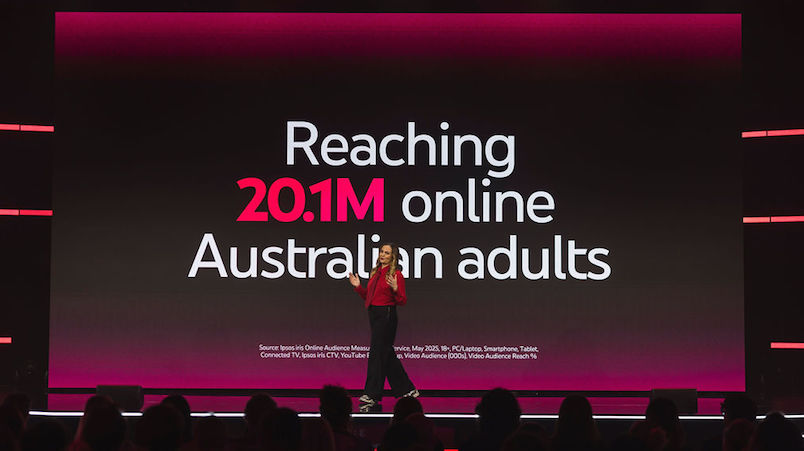
Google boss Mel Silva: From registering youtube.com.au 18 years ago to becoming "the number one streamer" as it turns 20. Now Youtube's coming for podcasts too.
YouTube set a high bar for the upfront season, lining up marketing science and effectiveness big guns to back its claims for primacy and stepping up its offensive to claim the biggest screen in the living room - and held up a mirror to the marketing industry that dazzled with reflective hot topic buttons. As well as TV, YouTube’s also coming for podcasts – and it's ramping up integration with Gemini AI to create dynamic ad placements to hit the behavioural economics principle of the peak end rule as well as connect brands with influencers and creators. And in a flashback to TV pre-2000, YouTube is bringing back the big 60-second ad spot – unskippable – but reckons 30-seconds is the relic of a bygone TV age, with the worst ROI...
I'm pleased to see Google and YouTube making a positively refreshing statement that being interesting is the only thing that counts. Too much focus is on format, channel and best practice. People seek out interesting.
Thirteen years ago, YouTube started setting up studios around the world, from Howard Hughes’ old airport in LA, to London, Paris, Tokyo, Mumbai and beyond, seeding a generation influencers and creators – giving them equipment, advice, nurturing them and handing over cuts of the billions of CPM dollars they would go on to generate.
Now some of the biggest consumer marketing companies in the world are likewise ditching decades-long practice to hand over billions to creators. Unilever, for instance, wants an influencer in every postcode, and its new CEO aims to divert half of its circa €9.4bn budget to them. YouTube claims it can go one better – hundreds of Australian influencers with a million-plus followers and thousands more longtailers in every living room and now with 60-second ad formats to tell brand stories, as well as wooing traditional ‘big ad’ creatives. But the platform is still eschewing the 30-second ad, the relic of “a different age of attention”. Completion rate data backs that up – at least on YouTube.
More ad cake, effectiveness lock-in
YouTube turned 20 this year. ANZ CEO Mel Silva joined Google in 2007 and said one of her first jobs was to register its local .com.au (smart move, given what happened to Twitter.com.au). “When I did register that domain name, I had no idea that it would become the number one platform for streaming in Australia, that's according to Kantar, or that it would reach 20.1 million online Australian adults in 2025,” Silva told marketers and media buyers last night.
“According to Ipsos Iris, YouTube reached over 13.3 million Australian adults on connected TVs in May 2025, that's up from 12.9 million in May 2024,” per Silva. On that basis, annual CTV reach grew 3.1 per cent. (Though on another basis, per figures presented at last year’s upfronts – 14.8m in June 2024 – it fell circa 10 per cent, potentially adding further credence to those suggesting Australia has now reached ‘Peak YouTube’, with organic growth “running out of road”.
Either way, given Australia’s adult population is circa 21m, and almost all of them are already watching YouTube, per Ipsos, there’s not much reach left to hit. Which may be why YouTube is now coming for podcasts. “It turns out people want to watch,” per Silva, “they don't just want to listen.”
YouTube brought in Analytic Partners, Kantar, and marketing effectiveness consultant Rob Brittain while remixing Mark Ritson’s 2023 upfronts endorsement to underline its effectiveness credentials, as well as announcing a “marquee sponsorship of the Effies for the next three years,” per Silva, with the firm claiming that meant “exclusive use” of the Effies database, while bolstering its commercial partnerships with the major advertiser, media and advertising supply chain industry bodies.
Attention spans are not shrinking … it’s our tolerance for what we don’t want [that is diminishing]
ROI king?
Google has its own market mix modelling product. But it brought in an external validator to do the affirmation legwork in Sydney.
Analytic Partners MD, Paul Sinkinson, stated: “YouTube's got this unique position in that it gives you a really good short-term sales result. Well, once you add on that long term brand building impact that it's got, it becomes the number one channel for ROI that we measure in Australia.
“That efficiency and effectiveness is driven by numerous touch points and really brief exposures,” said Sinkinson, echoing his UK colleague Dr Grace Kite’s Cannes presentation that “lots of of little ads are a perfectly good substitute for lack of attention on any one ad”. Kite also backed YouTube – or digital video more broadly – as delivering best ROI.

Media ROI by channel according to Analytic Partners, as presented by Dr Grace Kite at Cannes 2025.
“It's the way that we've always been taught, that advertising is working from fleeting attention, rather than necessarily needing a long play to come through,” said Sinkinson. “So how do you leverage that fleeting attention? Well, it's heavy branding, it's contextual targeting and contextual relevance on their own – they might look small and little, but you put it together, it's a tremendous impact.”
Nevertheless, YouTube launched a 60-second ‘big ad’ format at the upfront.
Sinkinson said YouTube watched on the main screen is already outmuscling TV in terms of return on investment.
“If we see YouTube on CTV, for instance, [it delivers] 30 per cent higher ROI. It's already a pretty high ROI, but it goes up to 250 per cent [compared to] that of the likes of TV from a linear perspective,” he suggested.
Coming for podcasts – and everything else
Long-time Google creative director turned Sundogs Creative agency founder Ben Jones then unpacked where YouTube sees the next growth leg: making the internet “an ocean of video where we expect everything as a default state to be in video, from search results to entertainment to education to reviews … Over time, all other forms of media, text, images, audio, by themselves, will seem less compelling,” per Jones. “You can already see this happening in the podcast world.”
Notice served to the likes of SCA and ARN.
Lots of bigs?
While Analytic Partners has pushed the theory of lots of littles, Jones suggested “attention spans are not shrinking … it’s our tolerance for what we don’t want [that is diminishing] … we reject it much more quickly and more fully.” Jones then cited Analytic Partners data that suggests for video ad ROI, “the most powerful length is longer than 60-seconds, which means it is content that people must choose to watch.”
Hence YouTube announcing a 60-second ad format – albeit non-skippable.
That same Analytic Partners dataset suggests, “the next most effective” ad format is the six second slot, “if we are forced to watch”, per Jones, while the 15 second ad “is still the benchmark”. But TV’s mainstay, the 30-second ad, per Analytic Partners' data, “is sitting there in the valley of despair," Jones suggested. "It is too long if we’re forced to watch it, it is too short if we choose to watch it – it is the vestige of a different age of attention.”
Jones's assertions appear to align with completion rate data provided to Mi3 by MiQ via its Sigma platform, which suggests completion rates for YouTube ad formats are as follows:
- 6-second bumpers: 90 per cent completion
- 15-second non-skippable: 85 per cent completion
- 15-second skippable: 60 per cent completion
- 30-second skippable: 15 per cent completion
The return of the 60-second ad got a nod from Omnicom Oceania's recently appointed group CEO, Nick Garrett, who is leading a global trial for the US holdco in which media, creative and diversified marketing services have been consolidated under his remit. "I'm pleased to see Google and YouTube making a positively refreshing statement that being interesting is the only thing that counts," he told Mi3. "Too much focus is on format, channel and best practice. People seek out interesting and when they find something they love and find relevant, they will deep dive in that content. Brands have an opportunity to engage and perhaps even inspire when they get it right."
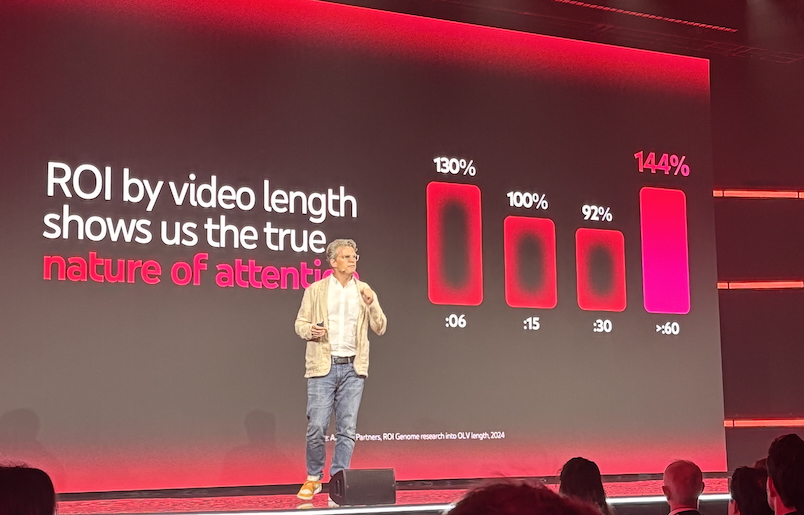
The ROI of different lengths of video ads, per ex-Google creative director turned Sundogs Creative agency founder Ben Jones (via Analytic Partners data).
Long-tail influencers and L'Oreal
Jones unpacked data from a L’Oreal study of “30,000 organic videos by creators” that suggests longer-tail influencer content could be a solution for brands struggling to keep up with feeding the platforms. The average length of those videos, he said, was 20 minutes, while 35 per cent of those watched were more than a year old. So while brands are being urged to churn out fresh content for platforms like Meta’s or risk reach being algorithmically crimped, Jones claimed on YouTube, the longtail “can persist over years and be the foundation of a brand proposition, and is starting to feed large language models at scale”.
For brands determined to keep feeding the video content machine, he touted creators and AI as a solution. But there are nuances in how creators perform – and engagement does not always translate to sales, per L’Oreal’s YouTube data across circa 3,000 campaigns.
“Almost 80 per cent of these campaigns did not deliver conversions,” said Jones. “Part of the problem is constraining creators into a narrow range of best practices, treating their content like an ad … resulting in a loss of the sort of magic,” he added.
“The second insight was that younger creators –18-24 – were more effective at creating engagement, driving views … but older creators, 35-44 were actually more successful at selling.
“Finally, we saw pretty significant differences in tonality: Lighter and more humorous content drove views and engagement; more focused and serious tonality drove more sales.”
Either way, he said, it’s critical not to treat creator videos as ads – “they are two different things”.
L’Oreal marketer Georgina Hack backed the platform for delivering both reach and engagement – for the former stating its Maybelline brand had been “able to connect with 20 per cent of Australians in four hours”, and for the latter tapping an NRL livestream (game 3) with content creators that delivered “an 85 per cent video completion rate” for L’Oreal Paris Men Expert.
“Exclusive Effies database access”… proves ROI gains
YouTube’s MC for the evening, former Olympic diver turned YouTuber Sam Fricker, claimed the platform’s “marquee” sponsorship of the Effies “means YouTube and Google have exclusive access to the Effies database” for the next three years. As part of the sponsorship, the platform tasked effectiveness expert and Effies judge Rob Brittain with analysing 550 campaigns within the database, separating online video from TV, BVOD and SVOD as well as social video to see what came out on top. (Answer: YouTube.)
“When I say online video, I’m primarily talking about YouTube,” said Brittain. “And if you’re not using online video, you risk a significant 20 per cent performance penalty. That’s because … YouTube is a critical driver of both immediate sales as well as long-term brand profitability and market share growth, making it essential for business impact.” He cited Effie winner Telstra, where “YouTube drove five times return on their ad spend for their Christmas campaign.”
For brands with smaller budgets, Brittain said the Effie database dive suggested “when 25 per cent of social spend was reallocated to online video, the campaigns became, on average, 30 per cent more effective”.
He also cited major ROI gains for the likes of MLA after it shifted 22 per cent of total budget to YouTube. Brittain didn’t mention TV, but did suggest that YouTube was a better bet than social video.
“Some advertisers fall into the trap of chasing low cost impressions. In doing so, what they don’t realise is they are giving away more than they gain in effectiveness. While a lower CPM on a channel like social might seem appealing, it often signals a broad and less engaged audience that’s not as effective in driving your marketing objectives,” said Brittain.
“The landscape has shifted.”
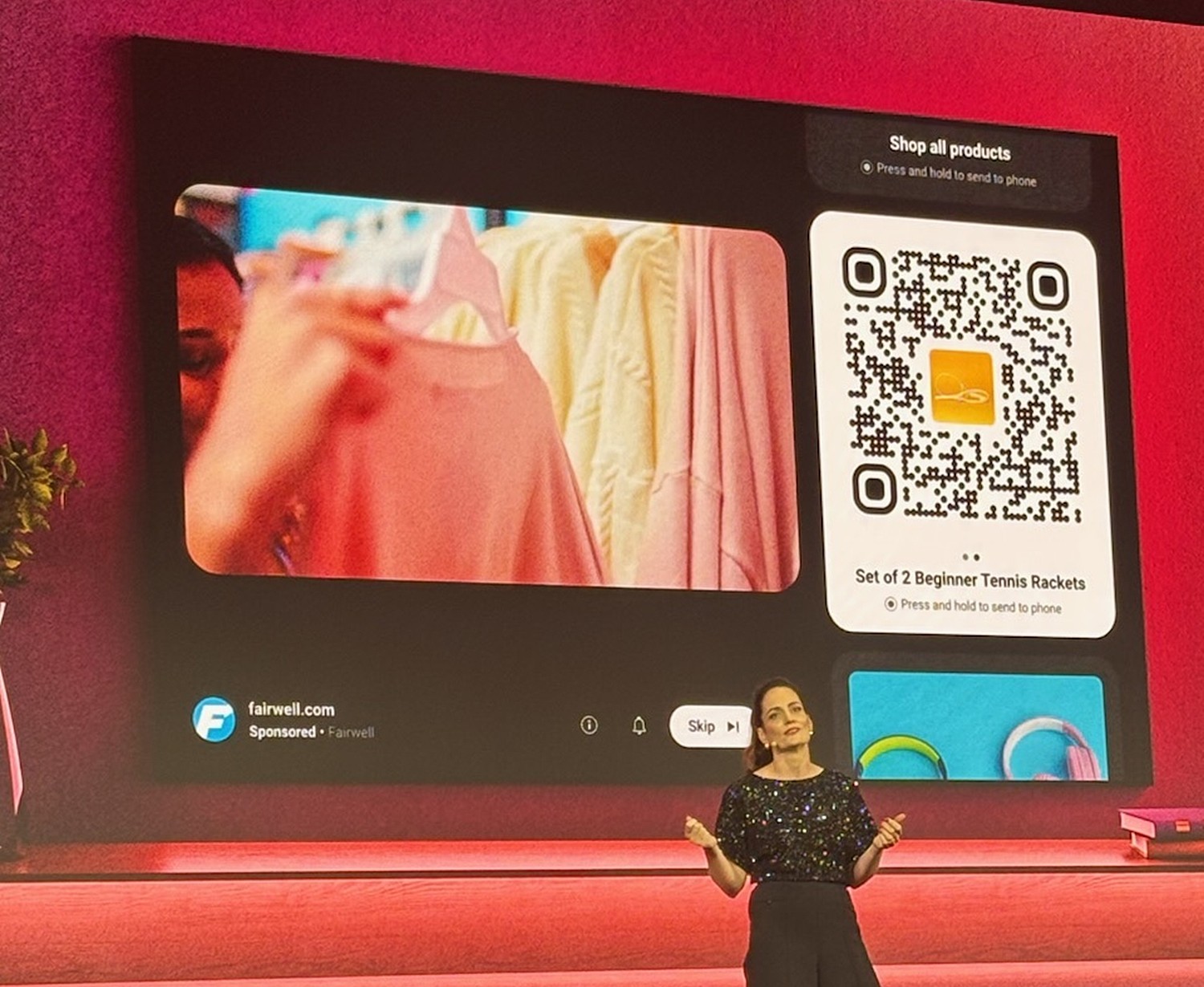
YouTube ANZ boss Caroline Oates announces shoppable video
87 minutes of YouTube a day, now hit them with AI - and shoppable video
YouTube boss Caroline Oates claimed Australian adults “watch over 87 minutes of YouTube per day” citing Ipsos Iris data from May this year.
She touted Google’s AI ad insertion as the best way to hit those viewers at the ”right moment”, with YouTube launching Gemini-based Peak Points to deliver ads based on “the behavioural science principle that we remember the emotional peak of an experience… using micro signals to deliver your ad precisely when your audience is most receptive to it.” (Basically Gemini scans video, audio and transcripts, finds what it deems emotional charged moments or climaxes, and then recommends ad insertion via heatmaps in YouTube Ads Manager. This could work, or it could annoy people more. Time and experimentation will tell.)
Oates also touted a video commerce rollout and YouTube’s Creator Partnerships Hub, “a new centralised spot to discover creators, manage your partnerships and integrate them across your entire ecosystem.” It’s now plugging the hub into various SaaS platforms, per Oates, which means the 20.1m Australian adults that Ipsos suggests watch YouTube can expect to see a lot more influencers on their screens.
All those early studio investments have paid off handsomely.
