Inside NFL’s 8.8m Australian fan play: Seven chases ‘tier-one’ status as brands get a chance to build fandom beyond game day
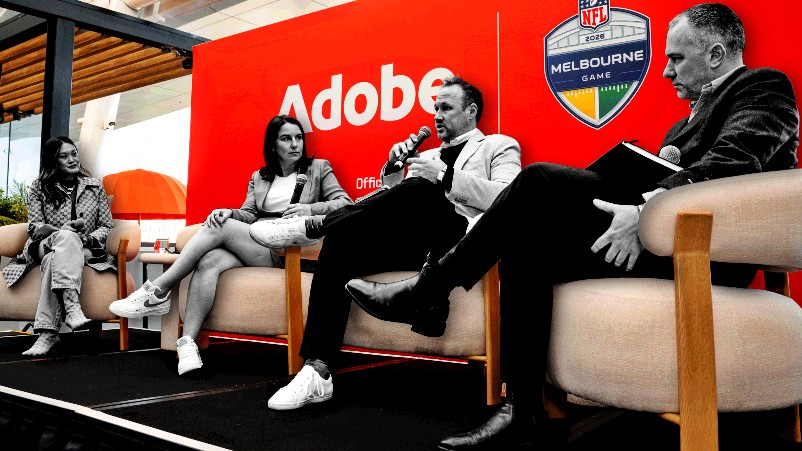
Marissa Dacay, Global Vice President of Enterprise Marketing; Charlotte Offord, General Manager of Australia & New Zealand, NFL; Adam Karg, Professor of Sport Management, Deakin University; Chris Jones, Director of Sport – TV, Audio & Streaming, SCA
The NFL has grown its Australian fan base by 54 per cent in three seasons, packed 100,021 into the MCG and pulled the second-largest crowd for an NFL regular-season fixture outside its home country. Now comes the real test: Turning Melbourne’s spectacle into a season-long habit. For NFL executive, Charlotte Offord, the growth strategy stretches across fashion, food, culture and gaming, while Seven’s Chris Jones is taking a seven-day approach to make the NFL a “tier one sport”. The spending signals for brands are already there: Adobe recorded a 310 per cent jump in NFL merchandise traffic in August. Per Deakin University’s Adam Karg, there's an opening to accelerate fandom by helping newcomers understand and enjoy the game - and build connections that go deeper than clicks and likes.
The NFL game last week at the MCG delivered the crowd. But its next Australian growth opportunity - or challenge - is to keep those fans engaged after the “calculated” spectacle leaves town.
Los Angeles Rams’ collision with the San Francisco 49ers drew 100,021 spectators to the MCG, with almost half of ticket holders travelling from interstate or 30+ overseas countries, according to the Victorian Government. Coverage across Seven and 7plus Sport reached 2.19 million Australians.
NFL ANZ general manager, Charlotte Offord, said the game “exceeded our expectations” and was a “defining moment”.
“The passion, energy and commitment shown by our fans, partners and entire community throughout the entire week demonstrated just how deeply the NFL resonates with Australian audiences,” Offord said.
The game followed a substantial expansion in the league’s local audience. Speaking on an Adobe-backed panel before the match, Offord said its Australian fan base had grown 54 per cent in three seasons, from 5.7 million to 8.8 million. For Offord, that sparked a “turning point”: The “dramatic” growth of the fan base created an opportunity to justify bringing a first fixture to Melbourne.
But the game, which drew the second-largest crowd for an NFL regular-season fixture outside the United States, wasn’t even part of the narrative four years ago. “It might have been an aspiration of mine, maybe at one point, that we might get one,” she said.
The fact it materialised came from an audience-building strategy that reaches well beyond football - or, in Offord's words, a “cross-section of different verticals”. She said the league has strategies in the bag across fashion, culture, lifestyle, technology, food and gaming. Each offers a way to connect “organically” with people through an existing interest, even when they know little or nothing about the sport.
“We never want to feel forced. You never want to feel like you’re shoehorning a brand into any of those spaces," she commented.
The Melbourne event was also designed to reach consumers at different stages of that relationship and expand beyond the usual die-hards. "We need to show up for people that like us a little bit, but never really had any ties to us. We want to show up for people that think they don’t like us, but they don’t know our game,” said Offord.
Adobe’s research, presented in the lead-up to the game, suggests the potential audience is sizeable. Its survey found 36 per cent of Australians follow the NFL to some degree, comprising 26 per cent who follow a little and 10 per cent who identify as dedicated fans. A further 24 per cent surveyed did not follow the NFL but expected to watch the Melbourne game.
Adobe principal strategist for retail, media and travel, Carly Lynch said the league’s younger audience offered a foundation for further growth. Among NFL fans surveyed, 32 per cent expected to increase entertainment spending over the next three months, while 86 per cent used AI assistants in some way.
That interest is also showing up in shopping behaviour. Adobe Digital Insights recorded a 310 per cent year-on-year increase in online traffic to NFL merchandise in August, with a pre-game forecast pointing to traffic 400 per cent above August levels over September 11-13. Across Australian footy finals more broadly, 79 per cent of consumers expected finals-related purchases, with 18 per cent planning to spend $500 or more.
“One of the clearest themes in this research is that people are really continuing to prioritise the moments that matter most to them, despite the cost-of-living pressures that we all face day to day,” Lynch said. “The broader point here is that sporting moments really create economic activity. And that extends far beyond the game itself. That impact starts well before the kick-off as well.”
What we did with the footy a couple of years ago is we said we want to live every single day, and that’s how we’re going to create habitual changes to bring people into Seven Plus.
Seven’s seven-day play
For Seven, turning the NFL hype into a tier-one sporting property is now a priority. Southern Cross Media’s boss of sport – TV, audio and streaming, Chris Jones, wants to convert growing fandom into a regular viewing habit and “lift it from what has been a tier-two sport to a tier-one sport”.
Melbourne gave that ambition an early result. According to Seven, it delivered a national total TV audience of 938,000, becoming its most-watched regular-season NFL game. More than 155,000 watched on 7plus Sport, a record NFL audience for the platform. For Seven executive producer of NFL, Kirsty Bradmore, the result showed the league’s growing momentum was translating into viewing, underlining Australians’ appetite for the sport.
“Seeing it translate into an audience of this size, on a free-to-air platform, at 9 o’clock on a Friday morning, is a fantastic result. It sets us up perfectly for the rest of the season, and we can’t wait to keep building the NFL’s audience on Seven and 7plus Sport,” Bradmore said.
That approach begins with keeping audiences engaged between matches. Jones pointed to Seven’s AFL strategy, which extends programming beyond the Thursday-to-Sunday match window and gives viewers a reason to return throughout the week, as a proven playbook.
“What we did with the footy a couple of years ago is we said we want to live every single day, and that’s how we’re going to create habitual changes to bring people into Seven Plus,” he said.
That means building a content schedule that carries audiences into the next round of live football. Jones said NFL Tailgate, for example, would move from once to twice a week this season. The second part is distribution and “meeting the audience where they are” across television, radio, streaming and social, supported by the Seven and Southern Cross merger.
“You can wake up, chuck Sunrise on, jump in the car in Melbourne, listen to Fox or Triple M here. Chuck on Seven Plus when you get to work,” he said.
For younger audiences who don’t naturally seek out 7plus, that means finding them on YouTube first, continued Jones. “We’ve got to go and talk to them on YouTube and find them where they’re consuming.”
But reaching an audience is only part of the job. Jones said broadcasters also need to establish an “emotional connection” between the athlete on the field and the viewer at home. “We just need them to have a reaction. It can be a good reaction, or a negative reaction.”
In action, that looks like Seven’s former tennis coverage, when players shared their personal stories off the court. For Australians watching the sport for only two to four weeks a year, that gave them a reason to care about an unfamiliar competitor and keep watching, Jones argued.
For advertisers, the implication is a sporting property’s value travels across the content and platforms where those connections develop. “Traditionally in Australia, it’s all been about broadcast television, but we’re seeing many fans migrating through social media," Jones added.
It's an opportunity sitting within a broader shift in how Australians follow sport. Take News Australia's research: 54 per cent of sports engagement is now outside the live event, rising to 61 per cent among what it dubs 'New Wave Fans'. During last week's Uber Advertising upfronts, EssenceMediacom MD, Pippa Berlocher, also cited figures suggesting up to 70 per cent of investment around sport is going "from field to feed" as more consumer engagement occurs outside the 90-minute live sporting match.
Get in early, add value
Deakin University professor of Sport Management, Adam Karg, sees the NFL’s Australian growth as an opportunity to get in early, but only if brands can “add value to the fan and engage in a certain area”. The appeal for advertisers is the NFL offers far more territory than the game itself.
Karg described the NFL's expanding presence as a case study in building a brand through physical and mental availability: Making it easier for people to find, follow, discuss and share the sport. “We can be really simple about how you build a brand, and that’s having physical availability and mental availability. And this is a perfect case study of how that’s done," Karg said.
Take social content and the sport’s overlap with culture, gaming, technology, statistics and fantasy competitions: This gives brands different ways to establish a role over several years. “That’s an opportunity for brands to think beyond behaviour or the clicks and the likes, more deeply about that connection,” Karg said.
For brands, the question is where they can become useful along that journey. "Can I enable? Can I add value? Can I own consistently help them come along on the ride?" Karg asked.
An engagement example could be helping newer fans understand the sport by learning the rules, players and tactics. This builds the confidence to discuss a game with friends or join a fantasy league. Participation through flag football gives people another way to develop that understanding, said Karg.
Other media owners are following through on that intention: DAZN Media+ is building recurring creator formats through Club Kayo, while SBS is extending its advertiser proposition through outdoor, retail and creator partnerships, including opportunities around sport.
For Karg, these multiple entry points challenge the old assumption that committed fandom takes years to develop. "We used to think about the fan as an elevator that took a long time to go up. It's not like that anymore. You can get fans elevated very quickly. Brands can play a critical role in that.”