
AI search: Airbnb, Expedia, Hyatt, TripAdvisor, Yelp, Pinterest, Reddit CEOs warn discovery, marketing and revenue models are shifting - answers replace clicks; agentic commerce rises
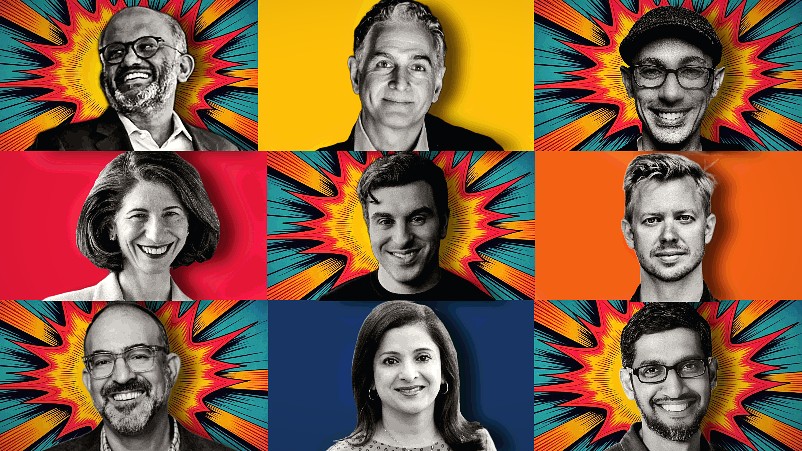
(Top L to R) Adobe's Shantanu Narayen, Hyatt's Mark Hoplamazian, Shopify's Tobius Lutke, Expedia's Ariane Gorin, Airbnb's Brian Chesky, Reddit's Steve Huffman, TripAdvisor's Matt Goldberg, Hubspot's Yamini Rangan, Alphabet's Sundar Pichai

With the rules of search being fundamentally rewritten, some of the world’s largest discovery companies are hell bent on using the advantages of scale to stay on top. That means lots of experimentation, big bets on innovation, more partnerships, more tech. Mi3 dug deeply behind the Q4 2025 earnings calls, and analysed the insights of CEOs and their key execs from global travel, discovery, and digital media firms including Expedia, TripAdvisor, AirBNB, Hyatt Hotels, Yelp, Pinterest, and Reddit, along with martech, adtech and e-commerce vendors such as Criteo, Alphabet, Adobe and Hubspot. What we found is that as generative AI turns queries into conversations, the old logic of keywords, rankings and traffic is giving way to a new contest over intent. Travel platforms, retailers and media groups are re-engineering how they surface products and ideas, no longer trying merely to be found, but to be selected by machines that increasingly act on users’ behalf. Some experiments are cautious, while others are strategically charged. And the building block agentic commerce are emerging at a rapid rate. Behind the scenes, firms are rebuilding data, governance and distribution for a world in which answers matter more than links. The race is no longer to sit atop the results page, but to become the answer itself.
What You Need to Know
- Global firms are very particular about what information they put in their market-facing investor packs, and what they discuss in their earnings calls with analysts. So it's very telling that AI search, and even agentic commerce, featured so prominently in the Q4 2025 pitches.
- Airbnb CEO Brian Chesky said generative AI is turning discovery into dialogue, with “AI search” live to a small slice of traffic as the company experiments with conversational trip planning and future ad formats.
- Owning intent, not traffic, is the new land grab. Travel, local and commerce platforms see conversational AI as a structural reset that will determine who controls discovery and demand over the next decade.
- Travel giants are retooling for AI mediation. Expedia Group is investing in “answer engine optimisation”, native integrations and agentic browser compatibility to ensure its brands surface inside AI systems, not just search results pages.
- Partnerships with AI platforms are proliferating. TripAdvisor is working with OpenAI and others on agentic AI, multimodal experiences and licensing deals, generating revenue via link backs and integrations while learning how AI reshapes alliances.
- Hotels are plugging directly into LLMs. Hyatt Hotels Corporation has launched an app within ChatGPT and built AI governance and infrastructure over two years, positioning itself to capture bookings as users move from search results to direct answers.
- Local discovery meanwhile, is being rebuilt around actions. Yelp has rolled out natural language search, AI powered business highlights and an expanded Yelp Assistant, aiming to connect conversational queries directly to bookings, orders and calls.
- Vertical search players are drawing a line. Pinterest argues fit-for-purpose search in verticals like shopping will outperform general purpose LLMs, claiming 80bn monthly searches and a majority commercial intent.
- Community platforms are leaning in. Reddit says its generative AI search now outperforms traditional search for most queries, with weekly active users of its LLM search rising sharply quarter on quarter.
- AI-driven commerce is emerging fast. Shopify reports orders from AI search up 15x since January 2025, albeit from a small base, as it syndicates product catalogues into ChatGPT, Gemini and Copilot for “agentic commerce”.
- Adtech and martech are selling the picks and shovels. Adobe is acquiring Semrush to help brands manage visibility across LLMs and traditional search, while Criteo is testing conversational ads and sponsored placements inside retailer agents.
- B2B demand gen is also feeling the shift. ZoomInfo says AI-driven changes to SEO have dented top-of-funnel traffic, forcing new optimisation strategies.
- Google’s dominance is being tested but not toppled. Alphabet reports longer, more complex and increasingly multimodal queries in AI Mode, with AI Overviews and AI Max expanding monetisable inventory against richer prompts.
- Monetisation is the open question. Executives agree behaviour is changing rapidly, but how conversational and agentic search translates into sustainable ad and commerce revenue remains the critical test.
We generated meaningful revenue through these in a diverse way. I do not think we have broken that out publicly, but we expect it has been growing, and we expect that to continue growing across licensing revenue, link-back traffic, and integrating our products. We also learned a lot.
Search, long the profit engine of the internet, is being ripped up and rewritten in plain English, or frankly, any language you like. Airbnb's chief executive, Brian Chesky, believes generative AI will kill the keyword and replace it with conversation, turning travel discovery into a dialogue and ads into something that has to earn their place mid-sentence. Chesky is betting that whoever redesigns search first will own the next decade of intent, not just traffic.
He is not alone in his assessment, as Mi3's analysis of the earnings calls of global discovery-based businesses, and the martech and adtech providers who support them attests.At AirBnB, Chesky says generative artificial intelligence is shifting discovery away from keywords and towards conversation, forcing a rethink of how platforms surface ideas, places and possibilities. He argued travellers are beginning to ask broad, open-ended questions rather than hunt for specific destinations or listings.
For his firm, that change looks less like a threat than an opening. Chesky said the company wants to be out in front as conversational AI reshapes how people find places to stay and plan trips.
"One of the things that’s been really clear after the launch of ChatGPT was that traditional search is going to essentially become conversational AI search. And what we wanted to do is really design AI search, really see how that works, and then if we are gonna do sponsored listings, design that ad unit in that form factor. So we’re focused first and foremost on the most perishable opportunity, which is AI search," he said.
The effort, however, is still in its early stages. “We are doing tests as we speak,” he said, noting that “AI search is live to a very small percent of traffic right now.”
Rather than a single launch moment, Chesky framed generative search as something that will be built iteratively. Airbnb is experimenting with how conversational AI can be woven more deeply into the travel journey, extending beyond simple queries toward trip planning itself. “Over time, we are going to be experimenting with making AI search more conversational, integrating it into more of the trip,” he said.
The emphasis, Chesky suggested, is on learning rather than spectacle. AI search is not being treated as a side feature bolted onto an existing product, but as a core area of experimentation that could reshape how Airbnb connects travellers with experiences. “So AI search is live to a very small percent of traffic right now,” he said. “We’re doing a lot of experimentation.”
Across the wider travel sector, companies are moving quickly to adjust to a world in which search is becoming less about typing a place name and more about asking a question. As generative AI reshapes how travellers explore ideas and plan trips, some of the industry’s largest players are retooling how they market, distribute and capture demand.
New discoveries
At Expedia Group, chief executive Ariane Gorin said the shift is already changing how the company thinks about discovery. “As GenAI changes how travellers do trip discovery, it opens up new growth opportunities for us,” she said. The goal, she added, is to make sure “our brands show up prominently in GenAI searches and function effectively with agentic browsers.”
"We’re working with all the major platforms to capture traveller demand, ensuring our brands show up prominently in GenAI searches and function effectively with agentic browsers," she said.
That ambition goes well beyond the familiar mechanics of search engine optimisation. Gorin said Expedia is adapting to a landscape in which answers increasingly come from AI systems rather than search results pages.
“We’re doing the work, whether it’s ChatGPT or Google and the like,” she said. “We’re doing work in answer engine optimisation, in native integrations, work with agentic browsers. All of the work we do there benefits our suppliers, because we’re doing the complicated work to help them drive demand to them through our business.”
In prepared remarks before the analyst Q&A around its latest financials, Gorin said, Expedia is experimenting aggressively, "and while volume is still small, every additional integration gives us data and learnings about how to better surface our brands and how consumer behaviours are evolving".
"These learnings, coupled with insights from our own brands, are in turn informing the development of AI experiences in our own products. That’s important because while third-party AI experiences are a new way to attract travelers and turn them into loyal members, our biggest long-term opportunity remains direct engagement."
The message is that established travel platforms are being forced to contemplate their place in an AI-mediated world.
On TripAdvisor’s earnings call, analysts pressed executives on how generative search might reshape the company’s alliances. One analyst asked about “the potential for evolution in the partnerships with the larger AI search platforms,” a question that underscored how traditional discovery businesses are reassessing their dependence on upstream gatekeepers.
Addressing that issue, TripAdvisor CEO Matt Goldberg said, "We are very excited about what is ahead in our partnership. I would say that 2025 was very much about establishing a foundation. We wanted to learn from partners what worked, what did not, what we had that was valuable, and really get a set of partners going. So you saw us working with OpenAI, with TripAdvisor and The Fork app, and we just announced that this week, the Viator app is there."
Through that integration, TripAdvisor said it is learning a great deal about agentic AI, supported by a licensing arrangement. With companies such as Amazon and Snap, the company is exploring multimodal AI. It has examined marketplace data with Microsoft and is experimenting with others on new AI form factors and devices, such as glasses, with more to be shared in the future.
Goldberg told investors, "We generated meaningful revenue through these in a diverse way. I do not think we have broken that out publicly, but, you know, we expect it has been growing, and we expect that to continue growing across licensing revenue, link-back traffic, and integrating our products. We also learned a lot."
Hotel stay
Hotels are seeing the shift play out in bookings as well as marketing. Hyatt Hotels chief executive Mark Hoplamazian said the company has already begun to capture demand emerging from conversational AI tools.
“We began last year building an intent-based search,” he said, framing the effort as a response to how guests are increasingly expressing what they want, rather than where they want to go.
Hyatt has pushed further than many peers. The hotel group has launched an app inside ChatGPT and, Hoplamazian said, “there is a live link to hyatt.com so you can complete your booking on hyatt.com.” For travel companies, the race is no longer just to rank first, but to be the answer.
According to Hoplamazian, "We are one of the very few hotel companies that has already launched an app live on ChatGPT, and we are learning a lot just watching and learning from how people are actually using that app in relation to search. And so we are studying it."
He stressed the giant hotel chain has been working through the infrastructure requirements for AI enablement for two full years.
"Starting in January 2024, I actually chaired the effort, but we put together a steering committee, we set up our infrastructure and built it, we set up governance, we set up our control environment, and we identified use cases, four of which have already been executed as large-scale agentic platforms. And we are moving forward on a number of different initiatives at the same time. With respect to search specifically, we have been working with OpenAI for months, which is why we have advanced to getting an app up and running with them so quickly."
How many stars
Local discovery, once defined by lists and star ratings, is being rebuilt around answers. Over at Yelp, chief executive Jeremy Stoppelman described a wave of generative AI-driven innovation.
"We introduced more than 55 new products and features, many powered by AI, as we continue to transform the experience for consumers and businesses."
CFO David A. Schwarzbach brought the details to the discussion. “We are reconceiving the Yelp experience to focus on delivering answers and actions,” he said. “We are reconceiving the Yelp experience to focus on delivering answers and actions. We set the stage for this in 2025 by introducing natural language search, launching AI-powered business highlights, and expanding Yelp Assistant to RR&O business pages."
The firm plans to expand Yelp Assistant in 2026 to function across categories and entry points, "with the goal of making local discovery and task completion seamless. We began testing this comprehensive experience in the fourth quarter and expect to fully roll it out by the end of the first quarter."
To tighten the link between discovery and transaction, the company broadened its food-ordering network, adding hundreds of thousands of restaurants through a partnership with DoorDash and embedding RepairPal’s booking system into Yelp. It is also rolling out AI tools aimed at helping service professionals and other local businesses expand, manage their operations and compete more effectively.
"Building on years of investment in delivering value to our advertisers, our focus is shifting toward becoming an even more valuable partner for businesses by helping them operate more efficiently through AI-powered tools. In 2025, we introduced Yelp Host, our AI-powered call answering service for restaurants, which has answered more than 190,000 calls and handled thousands of reservations since launch," Schwarzbach said.
As generative AI changes how people look for information, consumers are already recalibrating their expectations of what search should deliver. The finance chief added, “With the changing search landscape, some portion of share going to a more generative AI or a ChatGPT-like experience, consumers are changing their expectations.”
There are countless places to buy, but few great places to shop, and that’s where visual discovery matters most. As AI adoption accelerates, general-purpose search is increasingly up for grabs as the largest players pour capital into general-purpose LLMs. But fit-for-purpose search still wins in key verticals like travel and consumer products.
Digital players
Across media and content platforms, executives are increasingly measuring themselves against AI systems rather than traditional rivals. Pinterest chief executive Bill Ready framed the comparison starkly, placing his company’s search activity alongside the scale of ChatGPT itself.
"You can go look at third-party data as to what other platforms are doing. If you ask ChatGPT how many prompts per month ChatGPT does, it will tell you about 75 billion monthly prompts. And so we’re doing 80 billion monthly searches and generating 1.7 billion monthly clicks. You know, that makes us one of the largest search destinations in the world," he said. "Importantly, more than, more than half of those searches are commercial in nature, compared to OpenAI [which says] that they have approximately 2 per cent that would be commercial there."
Later, Ready noted, "There are countless places to buy, but few great places to shop, and that’s where visual discovery matters most. As AI adoption accelerates, general-purpose search is increasingly up for grabs as the largest players pour capital into general-purpose LLMs. But fit-for-purpose search still wins in key verticals like travel and consumer products. Our differentiation is clear: we’re using AI to power visual search, discovery, and shopping, not general-purpose text-based search."
Better results
Reddit, long a destination for answers crowdsourced from other users, is leaning into generative AI to sharpen that role. Chief executive Steve Huffman said the company’s AI-powered search tools are quickly outperforming traditional approaches.
“The traditional search on Reddit, Inc. and then the Gen AI search results will just be better for most queries,” Huffman said.
Usage figures suggest that users agree. “When we thought about traditional search, it’s more like navigation, right? Take me to this topic, to this subreddit," he continued.
"But we’re actually finding that the LLM search results, is, in many cases, better for this as well. So that’s the direction we’re going. Search WAU [weekly active users] in the last year is up 30 per cent from 60 million to 80 million. The answers WAU, so the LLM search, went from 1 million in Q1, to 7 million last quarter, to 15 million this quarter. So we’re seeing a lot of growth there, and I think there’s a lot of potential."
We've been building for this new era AI shopping for a long time, and it's now here. In fact, since January 2025, orders coming to Shopify stores from AI search are up 15x. Now that's on a small base, but that's still a really big jump in 12 months. And this matters for our merchants, it matters because it powers the long tail of commerce, servicing smaller merchants to the right buyers who might otherwise have never discovered them. This is a merit-based discovery at scale.
Pick and shovels
Every technology boom produces its own gold rush. And as ever, the safest money is often made not by the prospectors, but by those selling the picks and shovels. Generative search is no exception.
The software-as-a-service sector has been battered in recent years, its reversal beginning in earnest in 2023 and reinforced by higher rates and tighter budgets. In recent weeks, it has been getting hammered as the implications of agentic AI become better understood. Yet many of its largest vendors now argue the upheaval in search is creating fresh demand for their tools, as brands scramble to adapt to a world in which discovery is increasingly mediated by artificial intelligence.
At HubSpot, chief executive Yamini Rangan said the shift is already visible in how companies attract attention online. “Search traffic is declining as AI-generated answers become the starting point for product and brand discovery,” she said on the company’s fourth-quarter earnings call.
"Marketing is going through the biggest shift we have seen in decades," she said. "Search traffic is declining as AI-generated answers become the starting point for product and brand discovery. Customers are spending time across more channels, and AI is creating new ways for companies to be found."
"We saw these changes coming and have deliberately diversified our marketing channels. Last year, YouTube leads grew 68 per cent. Newsletter leads grew 53 per cent. And HubSpot became the most visible CRM in LLM-generated answers."
That diagnosis conveniently points toward a new category of marketing spend, and firms like Adobe have moved via acquisitions - such as its purchase of Semrush for $US1.9bn - to be better placed to capture the opportunity.
CEO Shantanu Narayen also stressed the work the firm has done establishing itself within what he called "leading AI ecosystems with partnerships and integrations across AWS, Azure, Google Gemini, Humane, Microsoft Copilot, OpenAI, and others, offering unprecedented access, choice, and flexibility to customers."
Adobe's President, Digital Experience, Anil Chakravarthy said, "The pending acquisition of Semrush we announced a few weeks ago, brings complementary assets to help us address marketers' growing need for sustained brand relevance in AI search. Over the past decade, Semrush's data-driven search engine optimisation and generative engine optimisation solutions have earned the trust of industry leaders like Amazon, JPMorgan Chase, and TikTok."
“Together, Adobe and Semrush will deliver a solution to enable marketers to shape how their brands appear across own channels, LLMs, traditional search, and the wider web."
Commerce platforms, too, are keen to frame generative search as a growth lever rather than a threat. Shopify chief executive Tobi Lutke said the company is already seeing signs that AI-driven discovery can send shoppers directly to merchants.
“In fact, since January 2025, orders coming to Shopify stores from AI search are up 15x,” Lutke told analysts, though he was careful to note that the increase comes “on a small base”.
Per Lutke: "We've been building for this new era AI shopping for a long time, and it's now here. In fact, since January 2025, orders coming to Shopify stores from AI search are up 15x. Now that's on a small base, but that's still a really big jump in 12 months. And this matters for our merchants, it matters because it powers the long tail of commerce, servicing smaller merchants to the right buyers who might otherwise have never discovered them. This is a merit-based discovery at scale."
His CFO Harley Finkelstein, laid out the longer-term pitch outlining the why behind the shift to AI search - the shift to agentic commerce.
"Now remember, last quarter, when I said on this call that we were laying the rails for agentic Commerce. Well, here they are. First, Shopify agentic storefronts syndicates billions of products through our catalog to all major AI platforms. Google AI mode in Gemini, ChatGPT, Microsoft CoPilot, one click and our merchants get instant access to millions of potential buyers who are actively looking for their products.
"We've already seen huge brands like Galasier, Steve Madden and Spank sign up and start selling plus through the catalog, our partners get the most accurate up-to-date data for billions of products for millions of the best brands on the planet," he said.
Pick and shovels sellers
It is little wonder then that advertising and commerce technology companies are clearly positioning themselves for a future in which discovery is shaped less by rankings and more by AI agents acting on users’ behalf, and are eager to sell the tools they say brands will need to stay visible. As search fragments and recombines inside AI systems, a growing cast of intermediaries is jockeying to define what comes next. Some are betting that the future of commerce lies in AI agents that do the choosing as well as the searching.
Criteo CEO Michael Komasinski, said the advertising and commerce technology firm is building tools for agentic commerce, in which AI assistants help guide shoppers through decisions rather than simply point them to results.
He said, "We are testing new conversational shopping experiences, including conversational ads and sponsored products within retailer agents. We have progressed a proof of concept and are seeing strong client interest, pointing to a path for monetization within these new experiences."
According to Komasinski, "Over time, we see meaningful opportunity for sponsored discovery as retailers extend their agentic shopping experiences through retailer-owned apps embedded in LLM platforms. Together, these efforts position agentic commerce as a natural extension of our strategy, reinforcing Criteo's role at the center of discovery, relevance, and measurable outcomes as shopping continues to evolve."
He also noted Criteo is embedding agentic capabilities directly into its solutions for marketers. "Our Model Context Protocol [which lets its software connect to external sources] infrastructure allows external agents to interact with Criteo in new ways, enabling more dynamic demand creation, activation, and optimisation. Agentic workflows are already live across multiple campaigns and expected to drive broader adoption of our solutions among agency partners and brands."
Business-to-business software vendors, meanwhile, argue the same forces are rippling through corporate buying. ZoomInfo chief executive Henry Schuck said shifts in AI-driven search are already reshaping how customers find products at the top of the funnel.
"On SEO and AIO, what I'd tell you is first, the negative impact has stepped down modestly. But we haven't seen a return to prior levels. We had a period of time where we were reacting and then now and then finding ways to optimise against what was changing in the search landscape," he said.
"But we feel really good about our strategy there. And I've already started executing against the strategy to improve the top of the funnel demand that was impacted by the changes on AI and SEO. And we're really optimistic and confident about the playbook that we're running there."
Alphabet soup
Then of course there's Alphabet. The initial fears Google could surrender its dominance are fading, although there's also a recognition in the market that its effective monopoly is over for now.
At the infrastructure layer, Alphabet said the behavioral shift is already visible in its own products. Chief executive Sundar Pichai said that as AI becomes embedded in search, the way people ask questions is changing.
"In the US, we saw daily AI Mode queries per user double since launch and AI Overviews continue to perform very well. Second, people are engaging in longer, more complex sessions. Queries in AI Mode are 3x longer than traditional searches. We are also seeing sessions become more conversational, with a significant portion of queries in AI Mode now leading to a follow-up question," he said.
Third, Pichai said, people are searching in new ways beyond text. "Nearly one in six AI Mode queries are now non-text, using voice or images. And Circle to Search is now available on over 580 million Android devices."
The commercial implications are still unclear. Analysts pressed Alphabet on how such behaviour might translate into revenue, asking about the “monetisation of AI search activity” as users move from terse keywords to sprawling prompts.
Per Google's SVP and CBO, Philipp Schindler: "We see AI Overviews and AI Mode continue to drive greater Search usage and growth in overall queries, including important and commercial queries. Gemini-based improvements in Search Ads help us better match queries and craft creatives for advertisers."
Schindler said a deeper understanding of user intent has greatly expanded Google’s ability to serve ads against longer, more complex queries that had previously been difficult to monetise. "AI Max, for example, is already used by hundreds of thousands of advertisers and continues to unlock billions of net new queries in that sense."
Trendlines
For now, executives across industries describe the same underlying pattern. People are asking questions rather than typing keywords, and companies are racing to ensure that when machines supply the answers, their brands are not left out.
