
An influencer in every postcode on the planet: Unilever unpacks its 50% budget swing - and why half of creator ads are 'wasted' from a simple ad effectiveness misstep
An Mi3 editorial series brought to you by
QMS


Piling into influencers for the last two years – and it's paying off, but vetting and matching is key: Unilever Food's VP of digital, media and ecom business unit, Afke van de Klashorst.
An Mi3 editorial series brought to you by
QMS
Unilever has unpacked how its massive multibillion dollar advertising pivot to influencers is tracking – getting young people to say they can cook in their Tinder profiles is driving hot stock-cube action, according to the digital, media and ecom boss of its €13.4bn food business unit, Afke van de Klashorst. But as the FMCG giant commits half of its €9.4bn ad budget away from publishers and into creators and their platform hosts, effectiveness platform CreativeX warns half of all media budget amplified influencer campaigns are literally being wasted due to basic branding fails. Time honoured effectiveness ground rules still apply, per CEO Anastasia Leng.
Unilever’s CEO made headlines earlier this year when telling a Barclay’s interviewer the FMCG giant will soon spend 50 per cent of its ad budget on influencers – and have at least one influencer in every zip code on the planet. Preferably more.
Fernando Fernandez’s commentary followed a year in which Unilever ramped its brand and advertising budget 120 basis points to 15.5 per cent of its €60.8bn turnover, equating to a circa €9.4bn marketing war chest (A$$16.74bn).
Fernandez, a 37-year stalwart of Unilever who started out in marketing, sales and supply chain before climbing the ranks to become CFO in 2024 and a year later claim the big chair, intends to hold the feet of the firm’s thousands of marketers to the fire on its major flip from traditional media.
But while his 50 per cent statement made the papers take note, Unilever’s Afke van de Klashorst said the firm has actually been massively expanding influencer activity for the last two years. It just took the CEO spelling things out to shake the rest of the market awake.
“We've been at this already since 2023 and our roster of creators in this network has grown by 800 per cent since then,” she told Cannes.
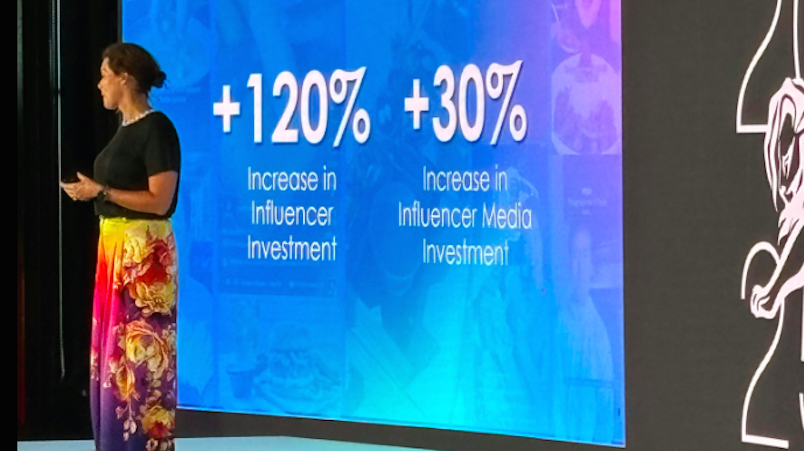
“The shifts that we have been making in this space speak for themselves … it really is about the strategic intent that we are putting behind this program: 120 per cent increase in influencer investment, and over 30 per cent of [increased ad budget] investment [now goes] into influencer led media.”
The point is not if the returns are higher versus the past, the point is the returns [via influencers] are higher versus any alternative allocation of funds today and versus any other option. They are higher returns.
Precision marketing era over
According to van de Klashorst, Unilever’s VP digital, media and ecom for foods, the game has moved on from “one-to-many, to precision marketing to now – this whole era of what we call many-to-many”.
Food, “has a really big role to play”, she suggested. “You may think the influencer space is all about beauty. Well, maybe that’s how this whole piece started, but [an executive at] Meta gave me this staggering stat that in 2024, food was driving 3.6 times more engagement [on Meta platforms] than Taylor Swift. So … there is a massive, massive opportunity – and that is why we need to make sure that we win in this space.”
Boss Fernandez is totally focused on that win, and “absolutely committed” to Unilever’s multi-billion dollar strategic marketing pivot.
“Let me be very clear. I will be a frontline CEO. My focus will be being all over our brand plans and being all over our market execution. That's where I will allocate 95 per cent of my time,” he said in March.
“Messages from brands coming from corporations are suspicious messages. So, creating marketing activity systems in which others can speak for your brand at scale is very important. Influencers, celebrities, TikTokers … There are 19,000 zip codes in India, there are 5,764 municipalities in Brazil. I want one influencer in each of them. In some of them, I want 100, but at least I want one in each of them,” per Fernandez.
“That's a significant change. It requires a machine of content creation very different from the one we have had in the past. AI plays a very important role in that, but I'm absolutely committed. This is one of the things I will drive like hell in the company in the next few years. Desirability at scale and marketing activity systems of ‘others say’ at scale will be the fundamental principles of our marketing strategy. I'm 100 per cent behind that. I need to really ensure that that happens in the company.”
Why? Because the economics demand it, per Fernandez:
“The point is not if the returns are higher versus the past, the point is the returns are higher versus any alternative allocation of funds today and versus any other option. They are higher returns.”
A month later, Fernandez doubled down on that message of “building new models of reach and persuasion”, during a Q1 analyst call.
The influencer-led strategy crystallised:
“A strong activity system of what we call ‘others say’ in social media. I have mentioned the need of really covering every zip code with influencers and other people talking about our brand. In the last few weeks I have spent a lot of time with my top marketers defining what we call the ‘4V model’ of social media: variety of creators, volume, virality, and velocity of content – and really focus on that, because the next stage in the transformation of Unilever is about creating a machine of demand creation both in marketing and sales,” said Fernandez. “So, these are the short-term priorities and the long-term priorities I have.”
Influencing the influencers
The key to a social-first strategy? Meeting the influencers in real life, per van de Klashorst, plus almost national security-grade vetting that focuses on creator “fit” versus potential reach.
“We treat them as the bridge from our brands to the audiences that we want to appeal to. So we need to make sure that when we are pre-vetting these creators and influencers that they are aligned to our brand values and cultural spaces.”
Hence pressing the digerati flesh.
“We have been doing a lot of in-person events … in the US, Mexico, Brazil, Spain, Arabia, Indonesia, Philippines and UK … where we are really educating and building capability with these creators and influencers, hosting events for them, getting them together. It drives a great vibe – they are experiencing our products and it’s also adding to the more tactical way that they can then drive our strategies and brand jobs to be done,” she said.
“We are building through collaboration … and we are seeing it really pay off … We are empowering these influencers with brand knowledge, and we are co-creating content that connects and also converts, because, of course, we are not an NGO [non-government organisation, i.e. profit matters]. So we need to drive this community-driven content, integrating influencer activity into planning processes with intent.”
In turn, she said, that is unlocking the flexibility for Unilever’s €13.4bn food division, “to react to trending moments and insert our brands into cultural conversations”, a degree of reactivity many corporates to date have struggled to achieve, or avoided altogether. But for Unilever, the returns driven to date by that approach – in terms of engagement – are “staggering” per van de Klashorst, though caveating that “we’re coming from a low base”.
She was referring to a campaign launched with influencers and Tinder that basically told platform users that putting they can cook on their profiles – in a dating world where one person's red flag is another's green flag – is a no lose. The upshot?
- 660 million impressions
- 3000 per cent social media mention gains
- 725,000 Tinder users added 'cooking' to their profile
- 80 per cent apparently got a date as a result
Unilever’s influencer strategy in a nutshell? Get deep vetting right, get the fit right, get geographical saturation right. Then, risks minimised, to become more comfortable with “authenticity over perfection,” per van de Klashorst. “Because 79 per cent of young consumers are tired of polished ads – they want real, relevant content, and this is now what is driving engagement.”
Some may disagree, but Unilever’s former CFO turned CEO is betting several billion dollars a year the multinational can convert that engagement to hard financial growth.
'Half of my influencer ad budget is wasted'. CreativeX boss Anastasia Leng knows which half.
Bad influence: basic effectiveness fails
Unilever’s van de Klashorst shared the stage with Anastasia Leng, a “data nerd” and founder-CEO of creative decision-making platform, CreativeX.
Leng unpacked what she said was data based on a “statistically significant” sample that effectively proves the John Wanamaker adage remains applicable within influencer marketing – i.e. half of it is wasted.
The difference is Leng knows which half, at least when it comes to influencer creative amplified by media spend versus organic.
“We pulled out 1.6 million ads over the last 18 months that correspond to nearly $2bn of ad spend. We analysed creator ads across three platforms – TikTok, Instagram and Facebook – across 800 brands, dozens of markets and five verticals: CPG; beauty; food and beverage; alcohol; consumer health,” said Leng. “Which means that for all these findings, we are confident that if we do it again, we are very likely to get the same results.”
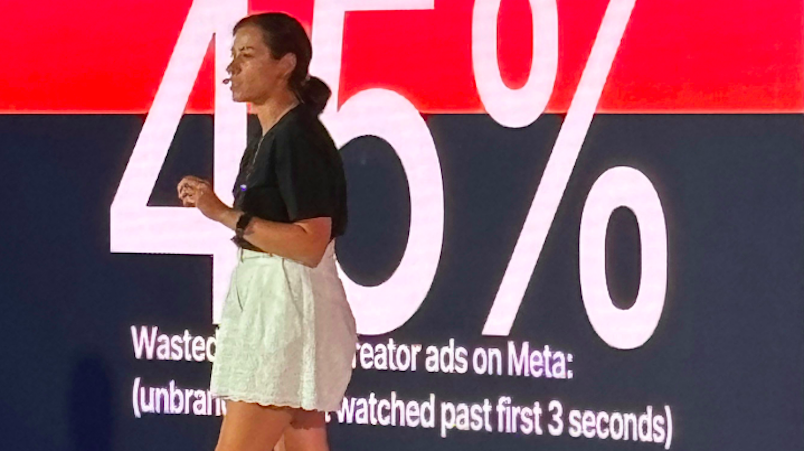
What CreativeX found was that: “45 per cent of the media spend invested behind creator ads … actually meets a definition of waste, meaning those ads were unbranded and not watched past the first three seconds,” per Leng.
“You might say, ‘that’s okay, creator ads are different, people watch them for longer, they will watch them to the end … like a TV ad, you can put the brand in the last second and it will be fine.’”
Wrong.
“The data tells a bit of a different story. In fact, only 14 per cent of creator ads will be watched past the first three seconds.”
Meanwhile, “We found that creator ads that were branded in the first few seconds had a 16 per cent higher completion rate on video views,” said Leng.
“I know creator advertising is not about efficiency but about effectiveness, but I would be remiss if I didn’t mention that creator ads that were branded in the first few seconds also had a 13 per cent lower cost per completed view.”
Which means branding early on influencer ads “is more effective, and it costs you less.”
‘Lots of littles’… and one big
Kite told Cannes delegates that "lots of little bits" of attention – even if they don’t meet Dr. Karen Nelson-Field’s 2.5 second attention threshold – can do the same brand building job, provided media buyers spread them across lots of channels and contextual niches. Roach, who worked with ad effectiveness supremo Les Binet at Adam&EveDDB in London, backed that view with data of his own, suggesting brand building via small bursts could work, provided everything ladders up to a big idea.
Leng urged brands to ensure their fragmented influencer strategies likewise always plot a path back to the strategic big picture.
“There's much talk about ‘lots of littles’, which I firmly agree with. But as you’re deploying these lots of littles, you have to map back to a big: What is the core message you are trying to send – and how do you use every media opportunity to amplify that message so everyone is singing the same song?”
