How not to screw up marketing's commercial credibility: Ex-CMOs warn performance marketing’s c-suite ascent risks squeezing out long-term brand building, talk up commercial aptitude
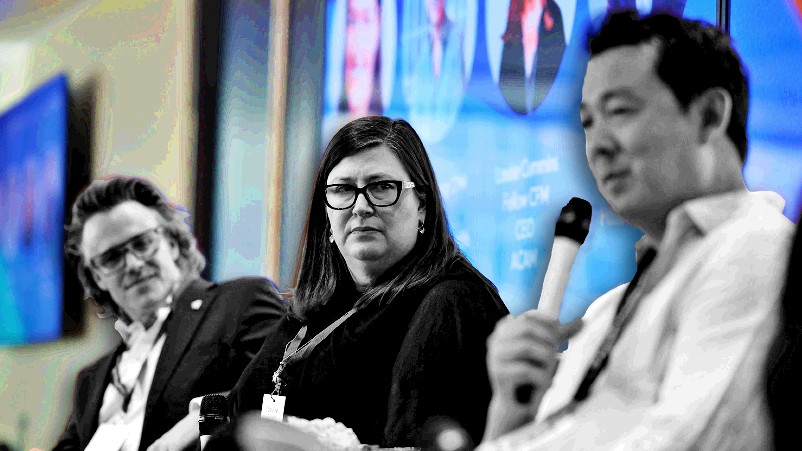
From left: Posca Hydrate's Ed Stening, ACAM's Louise Cummins and Next Practice's Simon Cheng
Have marketers drunk too much brand Kool-Aid? Or are the growing number of performance-oriented marketers stepping into marketing leadership positions of power screwing up the pathway for CMOs to a better relationship with the CFO because of their short-term attribution fascination? Three CMOs turned CEOs – Next Practice’s Simon Cheng, Posca Hydrate’s Ed Stening and ACAM’s Louise Cummins – took on the debate to argue what’s too much art versus science, commercial versus creative and strategy versus hustle when striving to attain credibility with the CFO, CEO and board.
What you need to know:
- CMOs-turned-CEOs speaking on a panel at the inaugural AMI CPM Summit urged marketers to think like business leaders, understanding P&Ls, revenue management, unit economics and the commercial levers driving growth. Panellists also agreed: marketing needs to frame its case around business problems, not marketing budgets.
- Yet even so, the CFO relationship isn’t a one -way street, former CMOs agreed. While marketers need commercial fluency, finance leaders also need to understand marketing’s intangible contribution and the role of judgement alongside spreadsheets.
- Per former Menulog CMO and now Next Practice CEO, Simon Cheng: “We need to talk the science, the numbers and stuff, and that's really important with the language they understand. But it's also really important to educate a CFO that there are certain intangibles. That's what we're hired for.”
- Panellist, Posca Hydrate CEO and former FMCG marketer, Ed Stening, warned against an overcorrection towards performance marketing and short-term attribution. Per Stening: “One of the major fear factors we have is a lot of the CMOs making it to the c-suite or making the crossover have come from performance. They haven't necessarily come from the creative side. That's also quite dangerous – the CFO loves the performance marketer because the performance marketer talks about last-click attribution.”
- However, for ACAM co-founder and CEO, Louise Cummins, there’s a danger of being too creative focused. “I feel like we've all drunk the brand Kool-Aid a bit because there are a lot of CMOs that then become very much known as being the campaign people. You're meant to be understanding data, science, tech,” she argued.
- The comments come as marketing still struggles for boardroom, CEO and CFO-level credibility. Per international data, just 9% of S&P 500 CMOs have gone on to become CEOs, versus about 20% of CFOs, while former marketers account for only around 3% of board members.
- For CMOs who have now taken up the CEO mantle, the common thread is growth and being choiceful: Curiosity, adaptability, resourcefulness, strategic choice-making and the ability to work across the whole business were cited as key strengths of marketers in making it to the top job.
There’s plenty of continued pressure heaped on marketers to speak the language of finance and the board. A panel of CMOs who’ve become CEOs, speaking at last week’s inaugural Australian Marketing Institute (AMI) CPM Summit, also had plenty to say on the subject, urging more of their professional peers to get across the commercials, revenue management and unit economics.
Yet it’s not a one-way street, and as one audience member pulled them up on, there is something to be said for educating the rest of the organisation – including the finance chief – about what marketing can really deliver beyond pantones and promotions. You’re just going to have to somehow earn their respect first. And decide on how much “science” versus “creative” marketing truly needs to exhibit.
“Influence without power”, “having to hustle”, “resourceful”, “adaptability” and “marketing with what we have got” is how three former marketing chiefs now in the CEO hot seat described the critical and differentiating capabilities of great modern marketing leaders versus sub-standard ones. And they’re all skills and attitudes that can make great CEOs. But for all that, marketers continue to shoot themselves in the foot by not orienting their craft around the business problems at hand – and it’s why we’re still seeing a persistently low percentage of marketers taking the top job, panellists agreed.
The panel: Simon Cheng, ex-Menulog marketing director and now CEO of Next Practice, a network of medical clinics and IVF services; Louise Cummins, ACAM AI co-founder and CEO and former CMO of World Vision Australia and H&R Block; and Ed Stening, co-founder and CEO of Posca Hydrate and former marketing director for Lion and Suntory; and was moderated by Kathryn Illy, acting CEO of the AMI and former GM consumer marketing for Destination NSW.
The trio were speaking at the Australian Marketing Institute (AMI) Certified Practising Marketer Summit, held in Sydney, a dedicated event for those who retain CPM status with the professional organisation, which attracted about 100 attendees.
While arguably a motley crew of backgrounds, all three described themselves as entrepreneur by nature, and attributed their path to CEO to a strong curiosity to understand how all parts of business operate. They also showed consensus on why marketers can make great CEOs: Growth mindsets.
“In my journey going towards this CEO role, I haven’t necessarily walked away from marketing; I think I’ve gotten closer to marketing, where the decisions of marketing are made,” said Stening, for example. “I was able to move into general management at Lion, which wasn’t something I necessarily had in my plans, but my obsession around this 4P structure led me to the point of wanting to move into general management. Now I'm CEO of a roller coaster of a startup.”
Stening cited other similarities between marketing leadership and being the CEO, including the fact that excellence comes from choosing what to do – and ignoring the rest. “The difference between a good marketer and a bad marketer is that a good marketer knows what not to do. I would say that's the same answer for a CEO: It's about making choices,” he said.
For Cummins, a winning differentiator in the marketer’s favour is strategy and being able to adapt, test and learn. “If you’re a CFO going into a role, I don’t think you’re as flexible in your thinking about testing and learning, trialling new things, because your default is probably more in the conservative.”
Cheng, who spent the last seven years of his marketing career at Menulog, and was one of the 120 employee casualties when the digital aggregator closed Australian operations in November, agreed.
“I like to operate without boundaries, and I like the feeling of possibility,” Cheng told attendees. “I feel like in marketing, you get involved in every part of business, and you get your hands in it all. But unlike the CFO, you’re doing it through a completely different lens, and you’re always looking to improve things, how to grow, how to move and step past the boundaries. CFOs don’t think that way … that’s why I think this profession should have more CEOs. Our brains are designed to lead and grow businesses, not just count beans.”
Yet numbers are still pretty bleak on this subject. Per Spencer Stuart US data, 9 per cent of CMOs of S&P 500 companies went on to become CEOs, compared to about 20 per cent of CFOs. And while board representation is inching up to include former marketers, it’s still around just 3 per cent. That’s pretty dismal in comparison to the other professional backgrounds of board members.
“Most boards actually still see us as a cost centre,” Cummins commented. “Boards like brand, and they understand it in part. But our role is not to try and educate the board on the brand. The boards are generally full of lawyers, CFOs and bankers, really, and they just want to know how much money you're bringing in.
“We tend to spend a lot of time talking about awareness and the funnel, and they're just like, ‘Well, just tell me how much I'm going to make out of this’. There's a challenge in that.”
One of the major fear factors we have is a lot of the CMOs making it to the c-suite or making the crossover have come from performance. They haven't necessarily come from the creative side. That's also quite dangerous – the CFO loves the performance marketer because the performance market talks about last-click attribution … We need to have CMOs who understand the art and science as well, so there's not just the science marketer who's getting in there. Because if that's the case, this industry is screwed.
Teacher versus tutor: Marketing versus finance
And here’s where the impetus for marketing leaders to strengthen their commercial and financial muscles kicked in.
“Make sure you own the P&L if you can, and try and see if you can move into a growth marketing role, so you have both sales and marketing,” recommended Cummins. “Because at the moment, there is a challenge. Sometimes marketers aren't great at speaking the language of growth and making those big, hard financial decisions because often, we're going in saying, we need more money.”
Cummins cited a recent meeting with the chair of a financial services organisation who told her: “Fundamentally, marketers just can't seem to communicate as well in that growth mindset”. “As a result, they're just seen as a cost centre. And when things go hard, it's an easy lever to pull,” she added.
Cheng backed Cummins up. “The competency gap there is, and this is kind of obvious, but it's the financial part. Everyone should know how to read a P&L. I don't mean just put it in ChatGPT and understand sales. Really understand the levers and really speak the language of the CFO and speak the language of business. We don't do ourselves any favours or our discipline.
“There are great marketers out there who are really commercial and are speaking the language of business, then there are others who don't do that. As a discipline, that’s one of the most challenging things I think: We’re not always on the same page in terms of how we communicate what we do, and that can be challenging.”
Stening admitted he’s experienced this directly. “We come with a marketing point to business people, and that's, I think, where we fail. When a marketer like me goes into a room and tries to defend my marketing dollars, I'm not looking at that as a business decision. I've seen myself fail so dramatically in those discussions,” he said.
“If you do want to get that seat at the table, you have to be looking at it from a business problem perspective. Innately, marketers can do that quite easily; it’s just a mindset shift.”
Campaign cool aid versus marketing science
What’s compounding the problem is the rise of performance marketers into senior role, and an overwhelming obsession with the short over the long, panellists agreed. But they disagreed on how much is too much science in marketing.
“One of the major fear factors we have is a lot of the CMOs making it to the c-suite or making the crossover have come from performance,” pointed out Stening. “They haven't necessarily come from the creative side. That's also quite dangerous – the CFO loves the performance marketer because the performance marketer talks about last-click attribution … We need to have CMOs who understand the art and science as well, so there's not just the science marketer who's getting in there. Because if that's the case, this industry is screwed.”
Yet countering this, Cummins noted that meeting with 15 staff in the data team as CMO in one former role had been an anomaly.
“I feel like we've all drunk the brand Kool-Aid a bit because there are a lot of CMOs that then become very much known as being the campaign people. You're meant to be understanding data, science, tech,” she argued.
“Brand is incredibly important, but I feel we've potentially gone the other way. And there are certain things I think now, especially with AI, where we're seeing that some marketers don't know how to have conversations about tech – yet it’s the biggest area.”
Cheung also admitted, “We probably did position this a bit too much as we just need to operate in their [the CFO’s] theatre.
“Unapologetically, we need to educate the c-suite and CFOs that marketing is both an art and a science,” he said. “That's the language I always use with them. We need to talk the science, the numbers and stuff, and that's really important with the language they understand. But it's also really important to educate a CFO that there are certain intangibles. That's what we're hired for. We're hired to make a call that the smile in that ad is going to go viral. That our educated view is it’s going to be much better doing that, than making a decision off that ad via this spreadsheet over here. That is definitely a balance and something we need to educate the c-suite.
“I have found when you work with CFOs one-on-one, most of them get it. They may not understand it, but they get there is an art element to the job, and they need to have the faith they put in you to make those creative calls.”
And here’s where educating the finance team on what marketing can do comes into its own for Cummins. “I had to take my CFO through the 80/20 rule and through quite a long period of learning around who we are and what we stand for, because the last CMO had been very much about performance, and that was all they were talking about,” continued Cummins. “Our CFO was actually the one that spoke to the board about the importance of brand investment, so it was a two-way street.”
Yet before you earn the right to teach the CFO a lesson or two about marketing, you have to earn their respect in the first place, argued Stening. “I think that’s what sometimes marketers get lost,” he said.
While talking logos might be appropriate in some setting, for most in the room, “this is the worst thing you could ever do”, argued Stening.
“If you get put on the project to redo the corporate logo, run a million miles away. Because if the CFO last remembers that your conversation was arguing about Pantones with the board, you don't have that respect.”
Stening’s advice instead? Get on projects with that CFO, and work to understand gross to net earnings and revenue management. “How do you work on goal adjustments? How do you build that respect with the CFO first? Because then they won't think you're a colour person, right ... We love colours, but they don't want to hear that.”
Another input: The volatile economic environment and the pressure that’s pressing onto boards, CEO, and CFOs as another factor in the mix marketers will have to navigate.
“We're going through a really uncertain time at the moment, and people are really struggling to – especially boards – work out where the investment should lie because they're going to need to make some big strategic bets,” Cummins commented.
“That's why it's so important to actually be aligned with your CFO because there will be times when people make mistakes, and so actually to go, I don't actually have all the answers. I'm not going to get up here and pretend otherwise. But this is where we believe we need to actually put our investment because boards at the moment are going; they're really struggling because they're going to have to make some deep choices about where they redeploy investment.”