Reach downgraded: L’Oreal overhauls $24bn advertising system, notches record margin, aligns with Wavemaker and Oxford University on new category-channel planning approach
An Mi3 editorial series brought to you by
QMS

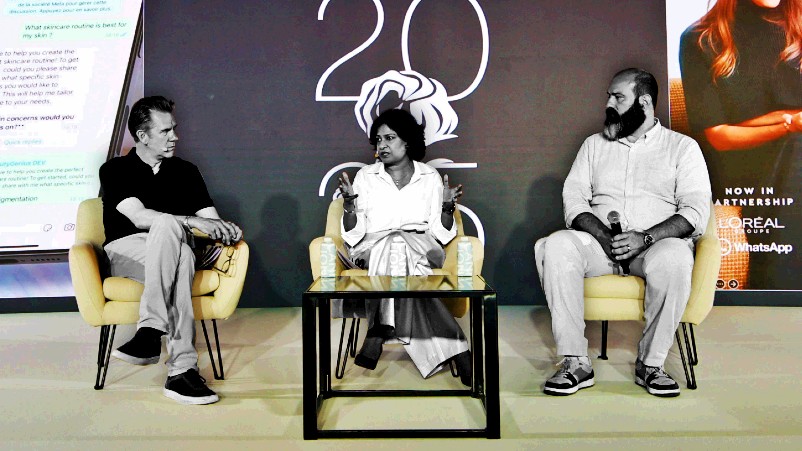
Big bucks versus pesos: Wavemaker global chief strategy and product officer Stuart Bowden. L’Oreal Groupe chief digital and marketing officer Asmita Dubey and Oxford University Associate Professor Felipe Thomaz on rewriting reach-based planning rules.
An Mi3 editorial series brought to you by
QMS
L’Oreal has spent five years overhauling how and where its A$23.85bn ad budget is allocated – and last year posted the best operating margin in its history. The firm is fully aligned with Oxford University Associate Professor Felipe Thomaz and Wavemaker on moving beyond blunt reach – and blanket paid media approaches full stop. It’s the latest in a series of evidence and market moves that strongly indicates industry is shifting rapidly away from long-held growth rules and play-books. L’Oreal Groupe chief digital and marketing officer Asmita Dubey, Oxford University Associate Professor Felipe Thomaz and Wavemaker global chief strategy and product officer Stuart Bowden on what next looks like for paid, earned, shared and owned (Peso) media, the category nuances that torpedo reach-based planning – and the structural challenges it presents.
You have to have reach, but it only gets us so far … we need to add receptivity, the concept of influence-ability and how consumers and categories get moved to action is not the same.
Know your audience
Oxford University Associate Professor Felipe Thomaz last October unpacked a peer-reviewed paper that fundamentally challenged the economics, assumptions and relevance of audience reach. His analysis – based on more than 1,000 campaigns via Kantar and Wavemaker data – found blunt use of reach will not deliver business outcomes, because not all reach is equal. It was one of Mi3’s highest read story of 2024.
Per that research, only one per cent of campaigns delivered meaningful double-digit business lifts. The average was sub two per cent – an outcome described by Thomaz as “really mediocre”.
Thomaz has since dived deeper into 1.1 million customer journeys via an expanded data set to better understand what does work in moving people to make a purchase, across as many as 72 touchpoints. The bottom line: 84 per cent of purchases have already been decided by the brand - and paid media at the pointy end via lower funnel performance marketing, plays a bit part, trying to win over the 16 per cent that can be influenced. While there are differences by category, there are no category exceptions; the majority of purchases are already pre-decided based on brand preference.
“When [people] are building the consideration set, when you’re wondering what you are going to buy, the brand had already decided what the victory was going to be,” said Thomaz
Which means marketers relying on broad reach to catch those in buy-mode are only ever going to sway 16 per cent of potential customers at best, per Thomaz’s analysis. “If you are not building a differentiated brand that competes in the marketplace and creates those attachments, connections and value for the customer that gives them a reason to choose you, you’re leaving 84 per cent of the fight to someone else,” Thomaz told Cannes delegates.
“It turns out brand matters for everybody. Your brand matters, your brand is driving choice. That asset that we keep saying is the most powerful thing we have as marketers is the most powerful thing we have as marketers. We were right all along.” And yet, “we’re just optimising the sales piece to an inch of its life and leaving the brand to hopefully fend for itself.”
Lemmings vs rocks
How people react to brand messages is very different – both at an individual level and a category level, per Thomaz, which the research attempts to quantify.
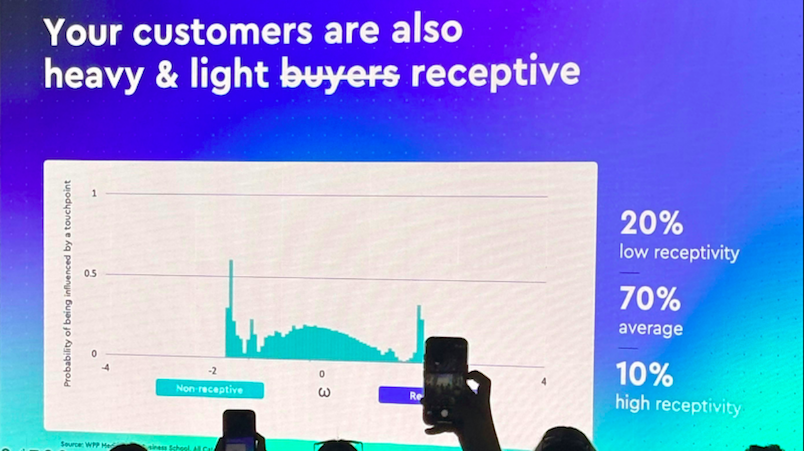
Mining the 1.1 million Kanter-Wavemaker customer dataset, Thomaz came up with what he calls an “Omega score – which describes how easy you are to influence and how receptive you are to signals, the higher the number, the more open you are to signals.”
Most people – 70 per cent – are “average, moveable a bit”, per Thomaz, while 20 per cent are very hard to move due to a “very low receptivity to stimuli – it doesn’t matter what you do to them, they just say ‘yeah, no, don’t care.” Then there is the 10 per cent of the market that Thomaz likens to “lemmings … they react to everything, every channel, every stimuli.” Which makes them easy to influence via any channel – but also means that any competitor will stand an equally strong chance of getting their money, and marketers face the paradox of choice in terms of best lemming ROI channel.
But across the dataset, “The trick is that different channels, different touch points, different media, have different capacity and ability to influence people at each one of those different points,” said Thomaz.
Equally, different demographics – particularly age groups – react differently. “As we age, we start to become more stubborn,” added Thomaz, whereas 18-35s are generally “very high on influence-ability – they are seeking information, they are easy to shift” and hence being prized marketing targets. “This is not new news, it’s just a different way of validating what you’ve known to be true. But we’ve recovered this from the data, so it’s further evidence.”
Category variables bust blanket approaches
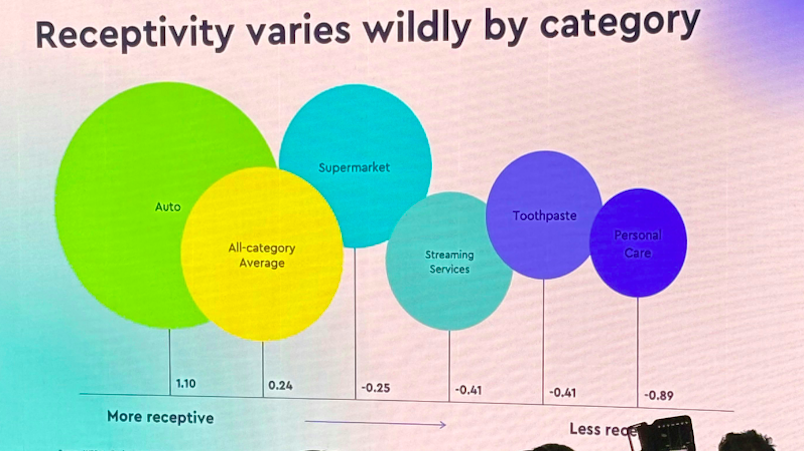
But there’s a catch: different categories have different levels of ‘influence-ability’. The automotive category, for example, has “very high receptivity”, as buyers seek new information to inform a major purchase. Whereas personal care, is the “complete opposite”, per Thomaz. “Toothpaste? It’s very hard to get people to shift their mindset, update their thinking, get sales on that side of things.”
Which underlines why applying broad reach-based play-books across categories usually results in mediocre outcomes.
“If I worked in toothpaste and I copied a plan from BMW, that’s not going to be a pretty result. That person has a completely different characteristic and set of behaviours and constraints for his customer. Copying someone’s homework is an absolute nightmare – and yet we do … and then just buy more eyeballs. It’s not getting results, so add a little bit more complexity.”
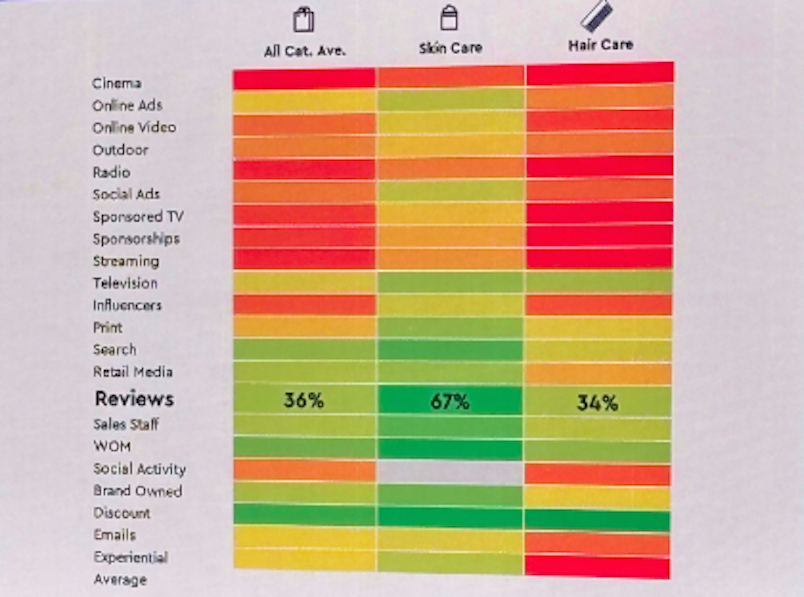
There’s a further complication: differences within sub categories. In personal care for example, haircare has “resistance to signalling”, per Thomaz, so “it’s harder, media is doing a little less work”. Whereas skincare is “much closer to the average. So even within a general category, you have to respect those differences when you’re thinking about whether you are going to build a brand: What is the function of that channel? What is it doing? It’s not just audience building, it is not just building scale. It is actually getting the channel to do a job, to influence the money – they all have different abilities and they combine differently to deliver on those messages.”
L’Oreal: Beyond foundation layers
L’Oreal Groupe chief digital and marketing officer, Asmita Dubey, knows deeply the subcategory nuances within cosmetics – and the firm has built its own measurement tech, called BET IQ, to work out where its €13.4bn (A$23.85bn) advertising and promotions budget is driving best bang for buck. That applies both to longer-term brand metrics and short-term performance ROI, Dubey told Cannes. It measures across “paid, owned and earned media”, but also shopper experiences and professional channels, she added, then “finds the ROI of all of these touch points”.
“The skincare journey is different from the makeup journey which is different to the haircare journey which is different to fragrance,” said Dubey. Which necessitates a more nuanced approach.
“Skincare, we want to be educated about what we are putting on our skin. Make-up is all about social trends and the latest offer. Haircare is more about being top of mind. Fragrance is very emotional – you want to feel something when you buy a fragrance. These journeys are then different by age group, gender, where you’re coming from … So what we do is systematic rules of engagement by category and consumer segments.”
In other words, a very similar approach to the one Thomaz is suggesting more brands and media planners need to adopt.
Agents of change
L’Oreal mixes up its media approach across brands – blending PR, influencers and celebrities as paid vehicles to then drive earned media across socials, amplified by paid across traditional, digital and retail media. Recent campaigns include working with Sabrina Carpenter for haircare brand Redken (position: “Everyone deserves a good bang”, per Dubey), Dua Lipa for Yves Saint Lauren and basketballer Anthony Davis for CeraVe.
But it’s also invested heavily in both technical and product R&D, for the former particularly within VR and AI in recent years. Last month the firm pushed deeper into agentic conversational commerce with L’Oreal Paris’ bot-based Beauty Genius personal assistant now live via WhatsApp. Customers can talk to the agent, get personalised recommendations and buy without leaving the Meta-owned messaging service.
“The whole customer journey is changing,” said Dubey. “This is one example of how.”
The likes of Deloitte Digital agree, recently suggesting agentic commerce is set to rapidly present a multi-trillion dollar opportunity for brands – and a $200bn content contract bonanza for consulting firms and agencies – because content structures require a total overhaul to better sell to agentic middlemen acting for consumers, rather than touring wares directly to humans.
Wavemaker: Reach restructure required
Wavemaker’s global chief strategy and product officer, Stuart Bowden, said reach remains important. “You have to have it – but reach only gets us so far, it is a relatively blunt tool. We need to add receptivity, the concept of influence-ability and how consumers and categories get moved to action is not the same.”
He said the uphot for brands – and increasingly media agencies – is thinking far more carefully about paid, earned, shared and owned media (PESO) combinations for different brands and categories. “It’s simply not possible to extract adequate competitive advantage by focusing purely on paid,” per Bowden.
But that poses a challenge both for brands and their supply chains.
“If we think changing human behaviours is complicated, I’d say it’s a walk in the park compared to changing organisational behaviour, or forcing organisations to try new ways of working. But that is really what we are going to need to try to do,” he added.
“Humans will use almost any other data source than an ad to help them make that final [buying] decision.” He said people were “three times more likely” to be swayed by earned shared and owned media than ads. But ads were basically easier to measure and organisations hadn’t structured themselves to measure other interventions. So that is what many are stuck doing: measuring the rump.
Bowden suggested that leaves brands and agencies facing a “systemic” challenge. “if you're going to decide that we need to invest more deeply in a website or in a digital experience or an app, or in a celebrity or in a sponsorship, that takes time … the way you make the case for it is more complicated. But we need to go through some of that hard work, because you can't just buy a GRP [gross rating point] of earned-shared-owned, you have to be specific. And specificity is where the detail of this research, I think, is super helpful … it starts to break down exactly where that value sits,” he added.
“Earned, shared, owned – you have to know your onions. You have to know exactly, by category, by touch point, which are the right selection for you to use.
“If you're not selecting correctly for your sub category, your investment in an influencer, or your investment in sponsorship … it won’t get you the payback that you expect”
L’Oreal reaps rewards
That restructuring is a process L’Oreal has worked through, though Dubey said it had taken significant effort to get there – and remains fluid across the entre organisation.
“The rules of engagement is step-by-step journey … All our brand teams in global and in country need to be upskilled and are part of it – even our CFO and finance teams, because what we have done with the rules of engagement is now part of our P&L, and how we see the A&P [advertising and promotion budget] in our P&L, and also our agency teams, because we work on the strategic [budget] allocation with our agencies.,” per Dubey.
“It’s been a three, four, five year journey.”
But it’s working: L’Oreal’s last financials showed record operating margin – at 20 per cent of sales – and outperformance across the board.
Per CEO Nicolas Hieronimus: “We’re confident in our ability to keep outperforming.”
Which is something few CEOs can say with honesty.