“Level of saturation advertisers can no longer ignore”: Samsung Ads promises guaranteed incremental reach, attention as it makes inaugural upfronts showing
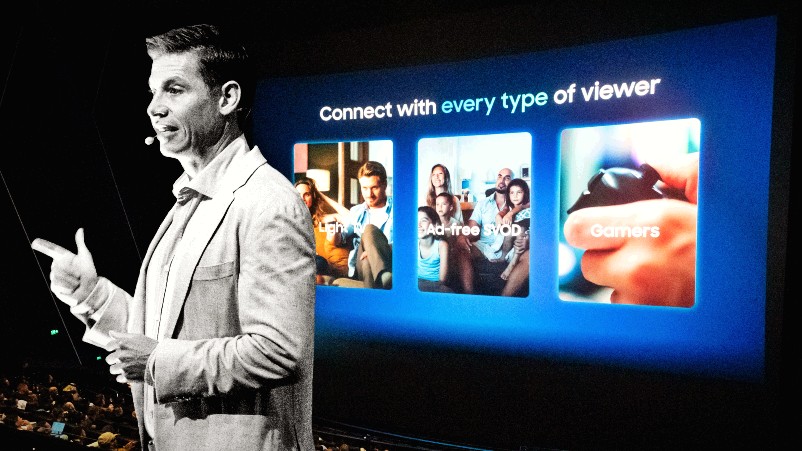
Samsung ANZ and South East Asia MD, Alex Spurzem, at yesterday's inaugural Samsung NewsFront
Samsung Ads doesn’t just want incremental reach advertising dollars. Nor does it want to just supply device data about Australian households – although it says it's guaranteeing both. As operator of the connected TV experience, it’s pitching itself as arbitrator in the battle to bring better advertising effectiveness to the fragmented TV table, local MD Alex Spurzem told Mi3. And it has startling new facts to add to the mix. Per its household data, 44 per cent of linear ad impressions in the first six months of 2026 (including Foxtel Pay TV) went to just 6 per cent of the households using its hardware. It’s also cited only 27 per cent of total viewing as being linear TV (excluding BVOD). Laden with such viewing behavioural and ad frequency data across over 4 million Australian households, and in command of premium TV hardware and software in the lounge room, Samsung Ads is endeavouring to carve out a unique position around what people want to watch, including bringing more of its own subscription-free curated channels and content propositions to the box.
What you need to know:
- Samsung Ads is pitching guaranteed incremental reach and attention as it makes its inaugural Australian upfronts, positioning itself as a cross-platform TV advertising effectiveness partner amid growing audience fragmentation.
- And it’s throwing some data bones of contention into the mix as a result. Data across its 4.1 million Australian smart TVs households suggests just 27% of viewing in the first half of 2026 was linear TV, while 35% was ad-funded channels and 38% SVOD – a contrast to OzTAM’s Q2 Streamscape figures, which put broadcast TV at 49.7% of TV-set viewing.
- Samsung Ads claims 44% of linear TV ad impressions in the first half of 2026 went to just 6% of households using its hardware, highlighting the potential for excessive frequency and wasted ad spend.
- Its response to this is the Optimal Reach measurement and optimisation solution, which is now in beta in Australia, promising a unified view of ad exposure across linear TV and streaming to help advertisers identify incremental audiences and improve efficiency.
- Samsung is also opening its TV Home Screen inventory to programmatic buying in Australia for the first time, with Video Masthead and 3D video creative formats also in development. It claims Home Screen ads delivered 2.4 times the consideration lift and 1.7 times the brand favourability lift of Kantar’s digital norms.
- New lower-funnel product Smart Outcome uses AI and audience data to optimise towards business results. Samsung cited one telco campaign that lifted website visits by 456%, and a BVOD partner campaign that increased app installs by 235% while cutting cost per install by 71%.
- Samsung is also expanding its content ambitions through Samsung TV Plus, which offers more than 200 free channels, and the launch of Samsung Television Network. New partnerships include Mamamia’s first 24/7 channel from 2027 and a cooking show with chef Luke Nguyen.
Samsung Ads wants to bring better advertising effectiveness to the table, its local MD, Alex Spurzem, told Mi3 following the company’s inaugural Ads NewsFront event in Sydney yesterday.
“In some ways, we operate the connected TV experience itself,” he said. “Samsung has been the leading TV manufacturer for many years. That gives us a great position across both hardware, software, discovery, the home screen, everything you've seen.
“It gives us an opportunity to bring advertising effectiveness to the table. TV viewing is fragmented. It will probably remain fragmented, if not fragment even further. That's where Samsung Ads can bring value with a focus on transparency, responsible data practices, and so on. And unlike a broadcaster or a streamer, we tend to have a bit of a broader view across the whole of the smart TV ecosystem. Including how audiences move between linear TV, streaming, gaming and applications. A streaming service, for instance, tends to view more narrowly on what happens in their environment.
“We can use that to make sense of some of the complexity and make that actionable for advertisers.”
Samsung’s upfronts event may possibly have been the most surprising in what’s fast becoming the most diverse set of ‘media’ upfronts we’ve seen in recent years. Streaming and video services, including Disney+, YouTube and Amazon Prime, that are increasingly capturing audience attention, viewing time and now, advertising dollars, have been lining up to push their wares for 2027.
Then came Samsung Ads’ turn yesterday, the first TV device manufacturer to join the fray.
The event was eye-opening, firstly because of the breadth: The group put up a comprehensive narrative at a time when both TV viewing and the ecosystem of players competing for a share of the billions spent in the channel as it takes on a new shape.
Samsung’s story claimed scale, attentive reach and full-funnel potential of its two current ad format offerings, available across 4.1 million smart TVs across Australian households (and soon to be sold programmatically), to its data-fuelled advertising planning, buying, trading and reporting solutions, through to the growing Samsung TV network it’s building. Content partnerships were also on display, including the first 24/7 Mamamia channel, plus a new programming partnership with chef and TV presenter Luke Nyugen.
Co-opetition it is: Samsung Ads might be a device manufacturer, software system player and media operator partner on one hand, but it’s also an ad format provider, content curator and network producer, data and insights source on the other. And while Samsung promised to be removing the fog, there was at least one media buyer noting that another player, another ad format and another take on TV doesn't lend itself to achieving that.
Kaimera chief digital and product officer, Trent McMillan, told Mi3 he was impressed with the “surprising yet clear view” Samsung Ads gave of how it’s evolving to tackle local challenges in delivering business results for brands, backed by its scale in devices and data.
“It was also interesting to see it launch its own TV network, STN [Samsung television network], just as the local networks are moving the other way,” he said. “We’ll be watching how Samsung allows its data to feed into current screens planning and buying approach, to complement the work we’re already doing at Kaimera to untangle the continued fragmentation of the TV landscape.”
The shift away from linear TV is creating a serious problem for advertisers: Significant wastage. As linear reach potential declines, but ad dollars fail to shift at the same pace, we’re seeing the same heavy linear viewer being hit again and again, driving a staggering level of frequency. On Samsung TV, almost half of all linear TV ad impression are delivered to just 6 per cent of households … This is definitely the level of saturation that advertisers can no longer ignore.
Viewing data contention
One of the immediate points of contention is the discrepancy Samsung has thrown into the mix around viewing data. Samsung’s viewing data set, now based on 4.1 million smart TV devices across Australian households, paints a very different picture to what current Australian Total TV data indicates about where audiences are truly putting their eyeballs.
According to Samsung’s first-half 2026 stats, only 27 per cent of total viewing was linear (FTA and STV), 35 per cent was ad-funded channels (including FAST and BVOD), and 38 per cent was SVOD – meaning 73 per cent of all viewing time sat outside linear TV.
It’s a strikingly different ratio to OzTam Streamscape data from Q2, 2026, which reported broadcast TV making up 49.7 per cent of all TV set viewing. BVOD added another 10.7 per cent to that to bring total TV to 60.4 per cent of all viewing, with digital video (including streaming services, YouTube and other video) making up the other 39.6 per cent.
This difference between viewing reporting data was raised last year by Mi3, when we showed Samsung data (on 3.6 m households at the time) was almost the exact reverse of OzTam Streamscape data. While OzTam data for the June 25 quarter showed broadcast TV’s viewing share at 60.8 per cent of all TV sets, BVOD adding another 8 per cent, and streaming at 31.2 per cent, Samsung reported the opposite: Just 30 per cent of all viewing was FTA TV, 6 per cent was BVOD, and streaming made up the rest, with subscription streaming at 39 per cent and ad-supported streaming and FAST TV at 26 per cent.
At that time, OzTam CEO, Karen Halligan, pointed to a mix of factors that could explain some of the discrepancy: Samsung data is from smart TVs only, not accounting for homes without a connected TV. It also commands a more premium price point, thereby potentially omitting some lower income households. OzTam data is panel data coming from 8300 homes with a meter installed that records viewing; Samsung uses automated content recognition to capture what’s on its screens every half a second, matching that fingerprinting to the content library stored on its servers.
Spurzem reiterated to Mi3 post-upfronts it’s not in competition with other local panel-based viewing data or systems, and was rather a “complementary, super robust”, deterministic data set.
“Obviously, if you were to treat TV in the way where you look at it in a linear-only fashion, that would be a waste of money because it would lead to this incredible oversaturation and overfrequency,” said Spurzem. “But it remains a big challenge for advertisers to understand who have I reached, and where do I find incremental gain?”
CTV is the biggest screen in the home, and you're in a premium, highly visual environment. People are engaged and therefore more receptive to the kind of brand storytelling that we're doing, and this delivers strong attention, recall, and brand impact.
44% of linear ad impressions to just 6% of households
The Samsung Ads team brought the point home with a startling stat on stage: Per its household data, 44 per cent of linear ad impressions in the first six months of 2026 (including Foxtel Pay TV) went to just 6 per cent of the households using its hardware. That’s based on the earlier figure of only 27 per cent of total viewing being linear. According to its data, total viewing hours also increased 6 per cent year-on-year.
“The shift away from linear TV is creating a serious problem for advertisers: Significant wastage,” Samsung Ads head of data and analytics for APAC, Virgile Edragas, told attendees at yesterday’s event. “As linear reach potential declines, but ad dollars fail to shift at the same pace, we’re seeing the same heavy linear viewer being hit again and again, driving a staggering level of frequency. On Samsung TV, almost half of all linear TV ad impressions are delivered to just 6 per cent of households … This is definitely the level of saturation that advertisers can no longer ignore.”
Samsung Ads’ response to this is Optimal Reach, a measurement and optimisation solution giving advertisers a full view of total ad reach across the Samsung Smart TV ecosystem, and spanning both linear TV and streaming. Already available in the US, UK, Canada and Germany, it’s now in beta in Australia.
“Because Samsung sits at the very centre of the TV experience as the owner of both the hardware and the software, we see viewing across the full spectrum,” Edragas said. “That means only Samsung Ads can provide a truly unified view of ad exposure across total TV.
“Optimum Reach isn’t designed to replace industry solutions, it’s designed to complement and strengthen them. It’s built to sharpen your understanding of what’s working, what’s not, and give you an in-platform activation and optimisation layer that ensures every dollar invested with Samsung Ads delivers maximum punch.”
Again, Spurzem expressed the view that deterministic data across a partner like Samsung Ads is important because it brings another level of granularity to the conversation.
“The key is to not treat one source as the complete answer. It's an opportunity to use the market-wide measurement in place, and combine it with the things we bring in terms of granular, privacy-safe audience insight that can be used to optimise, to plan,” he said. “It helps us identify across both linear and streaming environments where those unreached audiences are. I think for advertisers, this will be super valuable because it gives them a lot of room to optimise and improve efficiency.”
Advertising innovations
Owned advertising improvements on the runsheet at yesterday’s upfronts included making Samsung Ads’ TV Home Screen inventory available via programmatic buying in Australia for the first time and via a number of DSPs by the end of this year. It’s leveraging Magnite’s SpringServe to do it. A new ad offering, dubbed Video Masthead, is also on its way, bringing video into the TV Home Screen format, while a 3D video creative option is also in beta. Both are due by the end of the year.
Samsung also pitched fresh insight into how its two advertising offerings span the funnel. It’s worked with Kantar on 13 brand lift studies in six categories and with 4500 respondents, finding Samsung TV Home Screen ads were 2.4 times stronger at driving consideration and 1.7 times stronger at building brand favourability compared with the firm’s digital norms.
In addition, Samsung Ads cited data from Amplified Intelligence that it’s getting 59 per cent active attention.
On stage to showcase the array of brands now using Samsung’s core Home Screen Ad format was Woolworths Group. Head of digital media, data and partner and publisher services, James Perry said reach matters, but “finding environments where people are genuinely engaged and where our message can cut through” had led it to Samsung’s home screen as a “scale and attention” play.
Woolworths is using Samsung TV Ads for always-on campaigns, such as ‘My kind of Woolies’, Everyday Rewards and its Olive AI assistant, and for reinforcing its brand positioning ‘fresh food people’, but also for tactical activities, such as Big W toy sales.
“CTV is the biggest screen in the home, and you're in a premium, highly visual environment. People are engaged and therefore more receptive to the kind of brand storytelling that we're doing, and this delivers strong attention, recall, and brand impact,” Perry said.
Other brands to use Samsung Ads Home Screen takeovers are AFL, to amplify its biggest matches during the season, Allianz for brand campaign work, and Michael Hill to mark a key seasonal moment in the retail calendar, Mother’s Day.
To bolster the lower-funnel story, Samsung debuted Smart Outcome, powered by Samsung Audience Intelligence. This uses machine learning and AI across billions of data signals from its ecosystem to push further down the funnel and allow advertisers to target consumers with the highest propensity to take an action.
Edragas pointed to an Australian telco brand that used Smart Outcome to drive uptake of its mobile plan. Compared to Samsung's standard audience targeting or website conversion, the solution delivered a 456 per cent uplift in website visitation. In a second example, he said one Australian BVOD streaming partner focused on using Smart Outcomes for app acquisition, lifting app install rates by 235 per cent while reducing the cost per install by 71 per cent.
“Those aren't media metrics; those are business metrics, and that's exactly where connected TV is heading – not simply as a channel for awareness, but as a channel capable of delivering real, measurable impact at every stage of the customer journey,” he claimed.
For Spurzem, Smart Outcomes is another way it’s removing guesswork from the planning process.
“We're not trying to replace the role of TV here. TV is an important medium in terms of building brand awareness, long before the consumer has told you what they want. The industry has understood that TV plays that role and has for decades. And it still plays that role; it's still arguably one of the best, if not the best, brand building medium that there is.
“What's new now is that with a strong data proposition and a capability like Smart Outcomes, we can also optimise and track alongside that, or even just show what it does in terms of outcomes.”
Samsung as another TV network
The other broadening of Samsung’s offering is its own network and content play. As well as more than 200 subscription-free channels across entertainment, news and creator-led programming, it announced it’ll kick of Mamamia’s first 24/7 channel from next year, along with a partnership with chef and TV presenter, Luke Nyugen, on an Australian-based daily cooking show filmed in food markets across the country.
It’s also just debuted the Samsung Television Network, a channel curating the most in-demand programming from across Samsung TV Plus into one guide and schedule.
“We are focused on giving Australians content they want to come back to every day,” said Samsung TV Plus head of business development, Sam Hall. “Sure, you can get millions of people watching something once a week. But we’re focused on something much more valuable: Daily habits. That’s why we see a 79 per cent audience retention after three months, the highest of any streaming app on Samsung TVs. That’s what matters – not spikes, not just one-off fleeting hype.
“We have more than double the reach of every commercial BVOD service combined on Samsung TVs … Our top two channels alone have more viewers than our entire service had four years ago, and viewing time is increasing six times faster than overall streaming growth.”
Spurzem described Samsung TV Plus’ role as bringing back what’s gone missing from TV in the last few years and helping to tackle “the task of discovery becoming a problem itself”.
“Viewers like the flexibility of streaming, but there is also something to be said for the convenience or ease of discovery of programming, curated viewing experiences. That’s where Samsung TV Plus comes in,” he said. “We used to sit down in front of the TV and zap through channels, and somehow that got lost. Samsung TV Plus brings that lean back experience back a little bit … in many ways it fills a void in viewing behaviour that has existed.”