'ROI isn't the growth engine': Les Binet says budget is up to nine times more important to profit; warns brands chasing efficiency risk a 'death spiral' of shrinking reach and sales
Small thinking leads to small profits, says Les Binet, the international marketing effectiveness researcher whose work has shaped a generation of advertising strategy. After more than a decade of marketers chasing efficiency, attribution and ever-higher returns on investment, Binet argues many companies have optimised themselves into slower growth. The problem, he suggests, is not that businesses care too much about performance, it's that they have confused efficiency with effectiveness. Marketers are worshipping the wrong god - ROI - as they obsess over squeezing more return from every advertising dollar. However, the factors that most reliably drive long-term profit growth remain stubbornly unfashionable: Bigger budgets, broader reach, stronger brand building and a larger share of voice than competitors. As artificial intelligence, measurement technology and performance media promise ever-greater precision, Binet warns that the industry's fixation on ROI risks overlooking a simpler truth: Brands grow when they capture more attention than rivals, invest at sufficient scale and build memories that endure long after the campaign ends.
What you need to know:
- Marketing effectiveness expert Les Binet told marketers at Google Marketing Live Sydney that the industry's obsession with ROI is undermining growth, arguing marketers are optimising efficiency instead of profit.
- Binet said advertising ROI has improved by 4% since Covid, but the incremental profit generated by advertising has fallen 11% in real terms over the same period.
- Research cited by Binet found budget size is a far bigger driver of profit than ROI, with marketing investment influencing profit outcomes by a factor of eight-to-nine times more than efficiency metrics.
- He warned tighter budgets, narrower targeting and short-term performance tactics can create a "death spiral" of declining sales, shrinking investment and weaker future growth.
- Marketers were urged to shift conversations away from clicks, awareness and engagement metrics and instead prove impact through sales, cash flow and profit.
- Binet said CMOs need robust financial models and closer collaboration with CFOs to justify investment levels and forecast the long-term business impact of marketing decisions.
- While performance marketing efficiently captures existing demand, future growth depends on brand building that reaches buyers before they enter the market and increases future consideration.
- Yet Binet distanced himself from rigid interpretations of the famous 60/40 brand-versus-performance split, saying the right balance should be determined by experimentation, econometrics and business context.
- Strong brands create more than awareness, Binet argued; they reduce price sensitivity, support premium pricing and improve margins.
I'm not sure Peter Field and I ever called it the 60/40 rule. If we did, that might have been a mistake. People latched on to it because it's a very memorable thing. But what we've always said is that's kind of like a benchmark, and then you aim either side of that depending on things like your category and your situation.
Marketers have spent a decade chasing higher ROI but famed marketer researcher, Les Binet says they've been optimising the wrong thing: Budget size drives profit far more than efficiency, and the industry's fixation on returns is undermining growth.
The advertising effectiveness researcher delivered that message to marketers gathered at Google Marketing Live Sydney this week, arguing that the industry's pursuit of ever-greater efficiency has produced a paradox. Advertising is becoming better at generating returns on each dollar spent, yet the total profit generated by advertising is falling.
For years, brands have invested heavily in technology, measurement systems, attribution models and targeting tools designed to improve efficiency. Those investments have often delivered exactly what they promised. What they have not always delivered, Binet argued, is growth.
"The good news is that advertising is becoming more efficient," Binet told delegates. "The latest data suggests that efficiency measured in terms of profit ROI has risen by 4 per cent since Covid."
But then came the sting: "The best measure of effectiveness is the incremental profit generated by your ads, and that's fallen by 11 per cent in real terms over the same period."
Those figures formed the foundation of Binet's argument marketers have become increasingly focused on improving the performance of individual advertising dollars while paying insufficient attention to the scale of investment required to drive meaningful business outcomes. The distinction matters because profit depends on more than efficiency alone, he argued. "Profit effectiveness depends on two things, the ROI and the budget," Binet said.
According to Binet, researchers asked a panel of 500 chief marketing officers which mattered more for driving profit – budget or ROI. Marketers overwhelmingly nominated ROI. However, analysis of actual business outcomes from the IPA Databank told a different story.
"The main driver of profit is not ROI, it's the budget by a factor of eight or nine to one. ROI is not the main driver," he said. "Budget is nine times more important than ROI, and that suggests that the most important decision in marketing is actually how much to spend, which is kind of depressing for lots of reasons. It's depressing, particularly if you're a CFO. Nobody wants to spend more money, but it's also depressing because budget setting is actually one of the crudest parts of the marketing process."
You could also argue it's depressing because it's a finding that sits at the centre of a broader critique of how marketing has evolved over the past decade.
The rise of digital media and performance marketing brought extraordinary advances in accountability. Brands gained unprecedented visibility into customer behaviour, conversion rates and media performance. Marketing leaders could identify which channels were working, which audiences were responding and which investments were generating returns.
The downside, according to Binet, is that the industry gradually became preoccupied with efficiency.
"We've become obsessed with the small, so we love clever little tactics and creative little stunts, and we're all trying to do more with less. And I think that's killing our industry," he warned.
The consequence, Binet argued, is a planning mindset that rewards precision while often neglecting scale. Tighter budgets push brands toward smaller audiences and shorter-term opportunities. "Now this tightly targeted, narrowly focused approach does increase efficiency a bit, but it reduces effectiveness a lot," Binet said. Over time, sales and profits fall, budgets come under further pressure, and the cycle can become a self-reinforcing death spiral.
Marketing increasingly reliant on financial credibility
That diagnosis leads directly to Binet's second major theme: Marketing's future increasingly depends on financial credibility.
If budget size exerts more influence on profit than marketers generally recognise, then budget setting becomes one of the most important responsibilities inside the marketing function.
"The most important decision in marketing is actually how much to spend," he said.
Marketers devote enormous effort to channel allocation, audience segmentation, creative testing and performance optimisation. Yet many organisations spend comparatively little time determining the level of investment required to achieve specific business outcomes.
Binet believed that the gap reflects a deeper problem. Many firms continue to focus on what he describes as intermediate metrics. "Our survey showed that most firms focus on intermediate metrics like clicks, brand love, and awareness, rather than actual business outcomes like sales, cash flow, and profit," he said. These all have value, he conceded, but they do not necessarily provide the evidence required to defend investment decisions at board level.
The result is a growing disconnect between the language marketers use and the language finance teams require.
During a question-and-answer session following the keynote, Binet repeatedly returned to the need for marketers to become more fluent in financial thinking.
"We all have to be able to talk about marketing in financial terms," he said. "I think we do ourselves a disservice when we talk about what we do in fluffy terms, like brand love and brand equity and awareness, and so on. We need to at least be able to translate it into sales and cash flow and profit. But ideally, even better than that, we need to be able to sit down with the CFO and do the financial modelling. It is really crucial CMOs actually have a financial model, one that they share, so that they can interrogate it together. Otherwise, you're never going to be able to justify the investment you need."
Such models allow marketers to move beyond retrospective reporting and towards forward-looking decision-making. Instead of explaining what happened last quarter, they can demonstrate what is likely to happen under different investment scenarios.
"There's nothing that might be convincing as if you've got, like, a spreadsheet or a model or whatever, but you can say, if I pull this lever, this is what happens to your sales over the next two to three years."
The emphasis on modelling also reflects Binet's view that marketers should optimise for net profit rather than ROI.
"Notice, net profit, not ROI," he said. "Maximising ROI is not the way you grow."
Where to spend
Once the budget question is addressed, attention turns to how that budget should be deployed. It was here Binet's longstanding work on brand building and sales activation reappeared, although in a slightly different context.
The debate is no longer primarily about the balance between brand and performance. It is about how businesses create future demand while converting existing demand. Performance marketing focuses on consumers who are already shopping. These are the buyers demonstrating intent, researching products and moving towards purchase decisions.
Brand advertising addresses a much larger audience.
"This is about reaching people before they start shopping, before they even show any intention, before they even begun to think about it," Binet said, arguing it's a distinction that matters because only a small proportion of category buyers are actively in market at any given time.
And he reiterated his much-quoted argument that performance activity can efficiently capture existing demand, but that future growth depends on influencing consumers long before they enter the market. Brand advertising works through memory and familiarity. It increases the likelihood that consumers will think of a brand when a future buying occasion occurs. It makes subsequent performance marketing more effective because consumers already recognise and trust the brand.
The argument inevitably fed into Binet's perhaps best-known work with fellow effectiveness researcher, Peter Field, whose analysis of thousands of campaigns helped popularise the broad principle that brands should balance long-term brand building with shorter-term sales activation.
Per Binet, the industry has become more attached to the ratio than the underlying lesson. "I'm not sure Peter Field and I ever called it the 60/40 rule. If we did, that might have been a mistake. People latched on to it because it's a very memorable thing. But what we've always said is that's kind of a benchmark, and then you aim either side of that depending on things like your category and your situation."
The benefits of a brand also extend beyond awareness, and he explicitly linked it to pricing power.
"The really big win that people don't talk about nearly enough is the fact that it produces price sensitivity," Binet said. "It allows you to charge higher prices and make fatter margins and make bigger profits if you've got a strong brand."
Those dynamics help explain why Binet continues to argue for broad reach. Marketing's increasing ability to target specific audiences has delivered substantial efficiency gains, but Binet believes many organisations have taken that logic too far.
Successful brands, he argued, reach beyond the narrow group of consumers actively shopping today. "
"We've known for a long time that really effective brands, really successful brands, reach out to all buyers of the category. But that's not what most firms do. Most firms go, 'okay, we'll focus on a smaller segment of the market and own that segment', so they leave large chunks of the market neglected. Not content with that, they then focus their firepower further on the 5 per cent of that segment who are in-market at any given time, neglecting 95 per cent of the segment they've chosen. And then they match that now," he said.
Raised voice
That principle also underpins Binet's views on share of voice. "Advertising is, to a large extent, an arms race," Binet said.
"What matters is how much you spend relative to your competitors, your share of voice. The higher your share of voice, the higher your sales. Brands that set their share of voice above their market share tend to grow, and the rate at which they grow tends to be proportional to what we call ESOV, the extra share of voice. That's the difference between share of voice and share of market,"
On average, he said the data indicates 10 per cent ESOV buys a brand about 0.6 market share points a year in growth. But he also stressed that varies by category. "So share of voice is the first thing you need to pay attention to."
According to Binet, "Then the second thing is the advertising-to-sales ratio. What share of voice theory tells us is that it's not all about spending massive budgets. Small brands only need relatively small budgets to grow, as long as they punch above their weight. So it's about setting share of voice above share of market, looking bigger than you are."
He said as those brands grow, they need to increase their budgets ahead of their sales. "If you don't keep increasing your budgets as you grow, then your growth stalls. The key metric here is the advertising-to-sales ratio. Typically, you need 5 per cent or more to grow, though it does vary by category. The higher your advertising-to-sales ratio, the faster you grow."
His point: "What matters is not simply how much a brand spends, but how much it spends relative to competitors. Brands that maintain stronger visibility than their market position would suggest often create conditions for future growth."
The idea has long been central to effectiveness theory, but Binet presented it as particularly relevant at a time when many organisations face pressure to reduce spending. The objective is to create enough exposure to influence future buying behaviour.
Reach, however, is only part of the equation. A large audience means little if advertising fails to capture attention or create lasting memories. That challenge formed the final major section of Binet's presentation, which explored emerging research into video advertising and attention.
The more attention you get, the more you sell, and voluntary attention is better than forced attention. We want relevance. You want to make it clear to your audience what you're selling and why it matters to them. You want strong branding. Use your distinctive brand assets to make sure everyone is crystal clear which brand is in the ad. I mean, it makes obvious sense, but it's often neglected.
Attention
Attention has become one of the most heavily debated topics in marketing measurement. Advertisers, agencies and platforms continue searching for better ways to understand how media exposure translates into business outcomes. For Binet, the latest evidence points to a relatively straightforward conclusion.
"The key thing that determines how effective each format is is attention," he said, before noting that research examining different forms of video advertising suggests attention correlates strongly with sales impact.
"The longer people watch an ad, the bigger the short and long-term sales effects; up to about 20 or 30 seconds when dilution returns set in. But interestingly, the new research shows that ads can also affect people when they're not looking at the screen. How does that work? Sound. The new research suggests that sound accounts for 20 per cent to 30 per cent of the same sales effect of video, so sound on formats like YouTube are particularly effective now."
Skippable and non-skippable formats also work differently. "Non-skippable ads work a bit like radio with sound doing a lot of the work, you can look away from the screen, but you can't close your ears," Binet said.
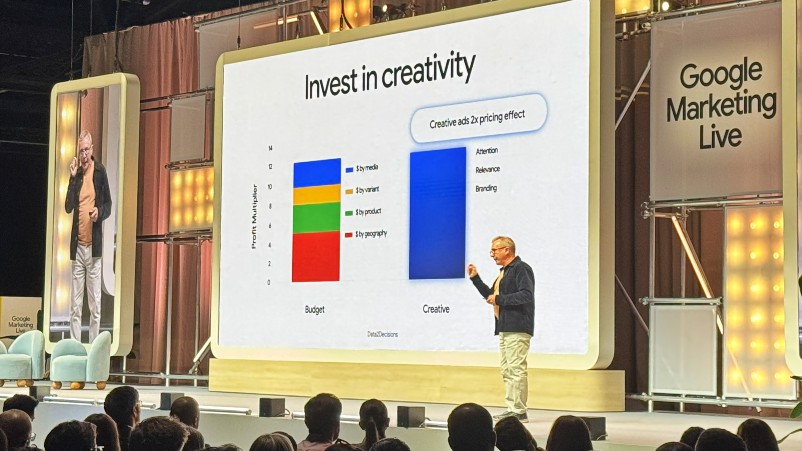
He then lent into the argument that creativity remains one of the most powerful drivers of effectiveness because it determines whether advertising captures attention, generates emotion and creates memories. "Creative is just as important as media," Binet said.
"We want attention. The more attention you get, the more you sell, and voluntary attention is better than forced attention. We want relevance. You want to make it clear to your audience what you're selling and why it matters to them. You want strong branding. Use your distinctive brand assets to make sure everyone is crystal clear which brand is in the ad. I mean, it makes obvious sense, but it's often neglected."
Binet added, "You want emotion. Research shows that feelings matter more than what people think, and one reason for that is that emotion gets attention. But emotions also build stronger memories, and strong memories build lasting brand preference. So you want ads that are emotive, memorable ads that people want to watch, and that means you need outstanding creativity and outstanding craft."
Bottom line
Throughout the keynote, Binet returned repeatedly to the same concern: Marketers are becoming exceptionally good at improving efficiency while often overlooking the broader conditions required for growth.
The industry's tools may have become more sophisticated and accurate, and measurement more precise, but the fundamental drivers of growth remain remarkably consistent.
Brands need sufficient investment to achieve reach, and that reach ultimately needs to drive attention, ideally with memorable creative work. And of course, marketers need financial discipline capable of demonstrating how marketing contributes to sales, cash flow and profit.
But most of all, they need to avoid confusing efficiency with effectiveness. The danger, Binet argued, is that organisations can improve many of their marketing metrics while simultaneously weakening their future growth prospects.
Binet began his keynote by saying, "Small thinking leads to small profits," For marketers navigating an increasingly complex media environment, it was both a warning and a challenge: Stop optimising for the appearance of growth and start investing in the conditions that create it.