Nine presses play on ‘sofa to street’ strategy – integrated media offering, buying and reporting shares stage with Australian content line-up; media buyers cozy up to cross-channel, outcomes-based play
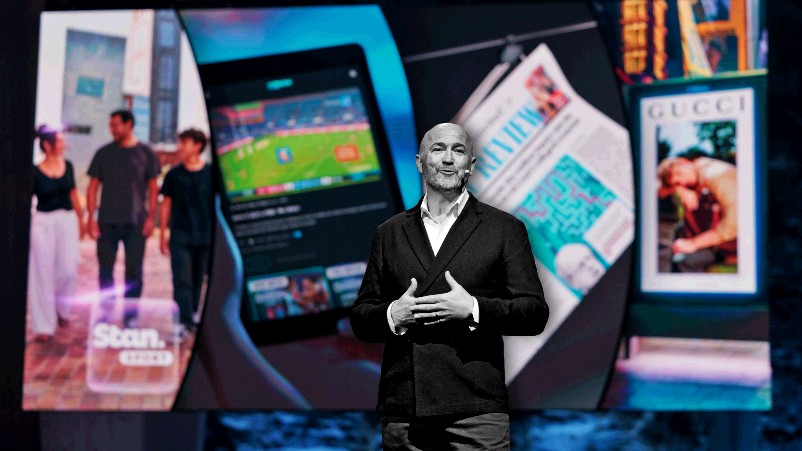
In a distinctly different upfronts show to last year’s executive-heavy line-up, Nine yesterday put forward a confident, high-production showcase led by what it does best: Australian content, talent and connection across sports, entertainment, drama, news and lifestyle. But the ambition behind it is decidedly different. Propelled by its most integrated media offering to date, it also went all-in on a ‘sofa to street’ cross-platform proposition for advertisers, supported by a single media planning and buying platform, and unified audience targeting that extends from screens into physical locations thanks to its new-look $850m Nine Outdoor offering. Having reoriented the business to focus on ‘growth assets’, including outdoor, Stan and premium video, Nine’s showcase didn’t harp on about linear TV versus digital, on-demand or streaming. Instead, it sought to put forward a complementary suite of offerings and strong content slate that would feed every part of the ecosystem. And first impressions from media buyers talking to Mi3 onsite? Finally. While none would go so far as to bet that years of investment being channelled out of local traditional media players into socials and big tech would indeed start flowing back to Nine, its connected media ecosystem, planning and outcomes-based reporting hit all the right notes. At the very least, it stops any questions about why brands should support Nine, they agreed. At best, it heralds a new era of local, cross-media planning, buying and reporting that meets the growing need for outcomes-based marketing.
There was a big promise Nine looked to land yesterday at its decidedly different, immersive upfronts experience: A ‘street to sofa’ go-to-market strategy, or effort to unify premium streaming, broadcast, publishing and digital out-of-home (OOH) under a single commercial engine.
Made possible thanks to its $850m acquisition last year of digital-out-of-home player, QMS – which from January, will be rebranded to Nine Outdoor – Nine is now pitching itself as the only Australian-owned, fully integrated media network with a go-to-market strategy that can connect brands to audiences across their entire day, and from couch viewing at home to walking down the high street.
At upfronts, Nine chief executive, Matt Stanton positioned the strategy as a challenge to global platforms by “delivering unmatched, trusted local scale.”
“When we set about transforming our business we saw a clear opportunity to build a digital-first network that meets audiences wherever they are,” he told attendees. “‘Sofa to Street' represents a landmark shift in national media capability, but it will also transform how our partners buy media. With up to a third of digital video spend in Australia swallowed up by non-transparent tech fees and complex programmatic supply chains, we believe the industry deserves better transparency and real accountability.”
The ultimate goal Stanton described was money flowing directly into the Australian news, sport, and entertainment stack - “to help make Australia a better place to live, work and do business. It’s a cleaner, smarter way to trade that builds a sustainable future for our industry.”
Importantly for media buyers and clients, ‘sofa to street’ as a strategy is coming with one unified planning and trading platform. Dubbed Nine Neo, the one-stop planning and trading engine has its roots in Nine’s multi-year, previous efforts to build out a unified platform, but has been supercharged and prioritised with the arrival of QMS into the stable. QMS Australia will become Nine Outdoor from January 2027, bringing more than 2,000 sites across major cities under the brand.
Nine chief sales officer, Matt James said ownership of those assets would enable closer coordination across channels. “By 2027, we will operate through a single content delivery system, giving us the power to deliver brand messaging simultaneously across our entire ecosystem: Channel 9, 9Now, Stan, mobile, publishing, and digital out-of-home,” he said.
According to Nine, the platform will use AI to turn advertiser briefs into bookable media plans in minutes, balancing audiences, budgets, reach and value. Its Total Trading architecture will also bring metropolitan and regional linear television into a common order management and traffic system.
“It is an Australian-made platform designed around the way our partners want to trade, stripping out administrative back-and-forth so our teams and yours can focus on the strategic thinking that actually grows your business,” James said.
To make this possible, Nine is extending its 9Tribes audience of 22 million and segment clusters into outdoor, to connect digital audience insights with screen locations. During yesterday’s upfronts, Nine executive director of advanced trading and digital commercialisation, Nick Young, told attendees Nine this will allow clients to target the same consumers as they transition from “watching content at home to walking down a high street ready to spend”.
“No other media network in Australia can connect screens to streets like Nine, and this is just stage one,” he said.
And it’s being extended across all tiers of spend. “It’s fair to say historically, local media owners like us have reserved quality, independent outcomes reporting for big budget sponsorships, and to our detriment, left impression-level campaign attribution to the digital platforms,” said Young.
To close the conversion loop, Nine has partnered with CommBank iQ to introduce campaign-level attribution across spend by combining its 22 verified user IDs with transactional data from over 7 million cardholders to track real sales uplift, category spend and share of wallet. It’s also teamed up with Azire for footfall traffic, Adgile for web and app visitation and Brand Metrics, which provides a framework for closed-loop ROI reporting that will be embedded directly into Nine Neo.
Basically, what they’re trying to sell us is what every advertiser now wants, and it’s to prove outcomes. They’re essentially saying, ‘Okay, stop guessing, we will honestly tell you if your advertising has worked or not’. Our team at Innocean would definitely be jumping to test and learn that.
The common response from buyers in the room: Finally. And yes, we’re interested. Many pointed out that unified trading has been a promise made by Nine over the last couple of years. But the combination of Nine Neo engine, rebrand of QMS to Nine Outdoor, and the swift integration into Nine’s go-to-market and sales pitches, plus the power of AI and matching of audience sets across 9Tribes to the physical environment, had most convinced Nine may finally have landed the cross-channel planning and buying proposition they’ve been asking for.
While on stage, Young also took a jab at the 100 per cent success rates many digital platforms claim in campaign reporting to clients. “Sometimes the data will show that a campaign didn't hit expectations or could have performed better. And at Nine, that's where we believe the real value lies,” he said.
“Rather than hiding behind inflated, homogenous metrics, honest data creates immediate opportunities for innovation. Put simply, knowing what worked and, more importantly, what didn't gives your brand a genuine competitive advantage.”
Both the promised integrated approach and the call for honest reporting were welcomed, and multiple agencies were quick to show their interest in hearing more.
“Basically, what they’re trying to sell us is what every advertiser now wants, and it’s to prove outcomes,” Innocean head of investment, Suzanne Mellon, told Mi3. “They’re essentially saying, ‘Okay, stop guessing, we will honestly tell you if your advertising has worked or not’. Our team at Innocean would definitely be jumping to test and learn that. We actually saw the sales director afterwards and said, yes, that would be interesting.
“Now they’re actually showing that additional layer, and showing how it can bring additional benefit to clients because you can actually see the client’s fate.”
For Mellon, the orientation to growth and outcome-based trading therefore “nailed it”. “That’s what advertisers want to hear at the moment because they’re all under scrutiny to then prove out ROI,” she added. “That was on point. That was a good example of how we can use data to drive decisions.”
Involved Media MD, Sarah Keith, also saw Nine’s strategy and Neo platform responding to what Australian media owners really want advertisers to buy into an entire ecosystem.
“It’s not just individual channels, not just individual platforms or programs. They really are looking for that integrated buy. Nine’s underlying message is: We’ve got the assets. Make better use of them,” she said. “It’s not just the size of the individual assets, although Nine certainly have good assets. It’s the ability to connect them.”
Bench Media director of commercial and media operations, Aaron Jansen, equally saw Nine’s upfronts as its biggest play yet to connect the dots. “Everyone’s been talking about connecting the whole ecosystem for a while,” he told Mi3. I think it’s a big step forward, especially the connection from the screen to outdoor. That’s massive … Connecting the couch to the screens outside is really powerful. I didn’t expect it, but I think it’s very impactful.
“Being able to put news content across our outdoor panels and Nine Neo as well are both quite impressive. The AI buying platform allows us to plan selling in minutes, rather than weeks. I think that would be really interesting and great for brands. The main thing is to have it fit into the buying ecosystem with other brands as well and other publishers, just to make sure the system still connects easily.”
Of course the proof will be in the pudding. “Ensuring that the brands get what they need from the buy without the human intervention in the actual media planning capability. I think AI is obviously where everyone’s looking,” commented Jansen. “Will it deliver the same outcomes? And will the brands be able to see what they’re looking for out of the buy? I think that needs to be seen.”
Agencies speaking to Mi3 also shied away from declaring the confident upfronts would significantly change levels of investment. But the consensus was Nine’s proposition just got stronger and an easier sell to clients. Including and expanding the advertising opportunities as well as brand integrations with Stan was another highlight for several.
“This makes Nine probably the strongest of all the major publishers. The connection with the outdoor, print to the digital ecosystem. I think the offering is probably the best in market with all these connections,” added Jansen.
It’s content that matters. There’s obviously culture that resonates. I did laugh, as there was quite a bit of mention of culture – usually that stays just with SBS. It was really about media that takes consumers closer to the action, which I thought was quite a strong message.”
Future buying: Partnership with Seven
Separately, Nine confirmed a plan to launch a joint buying solution with Seven, revealed earlier this year and further teased out at this year’s Future of TV event, is set to arrive in early 2027. The pair have begun working together on a programmatic buying solution for BVOD as a direct response to the $300 million lost annually in Australia’s $1bn BVOD market to non-transparent tech fees and supply chain bloat.
While details of the venture’s fees, operating structure or quantified savings for buyers were scant yesterday, Stanton signalled work was nonetheless underway. The ambition: More dollars going direct to working media, and supercharging BVOD and SVOD investment. The tech solution aims to establish more accountability, deliver a digital-first trading experience and, importantly for Nine and Seven, ensure premium content retains a premium price point. The duo expect to be joined by other partners “shortly”, Stanton added.
“Through our landmark venture with Seven, we are taking direct action to fix the market’s need for greater transparency and effectiveness,” Stanton said. “Do not underestimate the importance of this. We're all in a very privileged position, and the decisions you make about where to put your ad dollars have an impact on our industry and our country.”
We are fundamentally one, connected commercial proposition: Faster and simpler to buy, to ideate, to create; smarter in how we find your audiences; more creative in how we integrate your brands; connected from the content people choose to the point of purchase; and accountable for what happens at the other end. We know that creating growth in a fragmented media world is incredibly tough. We invite you to go big with us, because we have more ways than ever to put the full power of our world to work for your business.
A commitment to Australian content
And to that point, all agreed Nine’s different, high-production approach to its upfronts this year made one thing very clear: A commitment to Australian content and local production. This included the return and extension of well-established favourites, such as The Block, Married At First Site, The Bachelor, The Floor, Tipping Point Australia, Travel Guides, as well as the new Today Show’s hosts reveal. News and current affairs is also getting a transformation via Future News, a pitch to more seamlessly deliver journalism across Channel 9, 9Now, nine.com.au and now Stan.
Also in evidence was a huge commitment to fresh local programming on Stan. The list includes several new takes on these established favourites, along with the return of McLeod’s Daughters, 25 years after its first season debuted. New drama on the list for 2027 includes Slander, starring Rachel Griffiths; Stuck up & Stupid, based on the BookTok bestseller; the arrival of Jacki Weaver to Stan original series Two Birds; the new series, Unskilled Adult, featuring Hamish Blake; and the return of The F Ward.
Global content, meanwhile, includes exclusive rights to the Baywatch reboot; spy thriller, Honey, from the makers of Killing Eve; drama series, The Siege; thriller, The Only Suspect, The Interrogator starring Stephen Fry; Kill Jackie, and eight-part love story, You Are Here.
Then there’s sports, and a mix of free-to-air programming as well as Stan on-demand access, spin-offs, and Stan content. On Stan, exclusive content includes the Premier League, which has been extended through to the end of the 2033/2034 season, the Rugby World Cup, Netball World Cup. Across both Stan and Nine will also be the 2027 Australian Open, Rugby League including the State of Origin, World Athletics Championships, The Ashes cricket series, Netball and Super Netball tournaments, World Athletics Championships, and Australian Open Swimming Championships. Later down the track and across both Nine and Stan will be the 2028 Los Angeles Summer Olympics.
Kaimera trading director, Zoe Amos, applauded the commitment to Australians and Australian content, noting local production looked stronger than ever. She also described a more confident, strategic Nine on show yesterday.
“Across not one, but four pods, a host of talent took us through the new era of Nine; a new platform in Nine Neo, new Today Show talent, a new name for QMS and its biggest-ever investment in sport,” Amos told Mi3. “Then there’s The Block. Back and bigger than ever, with its own spin-off on Stan. But it would be remiss of me not to mention the Olympics. With LA 2028 on the horizon, the road starts now.”
Involved Media’s Keith also had a similar takeout from the event. “It’s content that matters. There’s obviously culture that resonates,” she said. “I did laugh, as there was quite a bit of mention of culture – usually that stays just with SBS. It was really about media that takes consumers closer to the action, which I thought was quite a strong message.”
Innocean’s Mellon believed data would show Nine in an unrivalled position in sport next year. “They don’t have the Olympics, but bloody hell, they have the Rugby World Cup, the home-soil Rugby World Cup, and netball – and netball advertisers love supporting women in sport,” she commented. “Netball is a great grassroots sport and popular with young kids … so those two properties would be a great cultural fit. Then Nine also has the NRL, State of Origin, and the football leagues as well.
“What I’ve heard advertisers are paying to invest in a season, it’s pretty significant to do a partnership on Stan Sport.”
Mellon also pointed out that the upfronts was the first to put forward the least amount of overt linear TV and content. “It feels to me as if they woven linear TV throughout the whole conversation and streams,” she said. “They even started by showing mobile-first … and they brought outdoor in excellently into that as well.”
Summing it up at upfronts, Nine’s James said, “We are fundamentally one, connected commercial proposition: Faster and simpler to buy, to ideate, to create; smarter in how we find your audiences; more creative in how we integrate your brands; connected from the content people choose to the point of purchase, and accountable for what happens at the other end. We know that creating growth in a fragmented media world is incredibly tough. We invite you to go big with us, because we have more ways than ever to put the full power of our world to work for your business.”