Zigging while others zag: Canva flips AI service playbook as predictive, proactive intervention push net retention above 140%; Resolve, don't deflect, says customer chief Rob Giglio
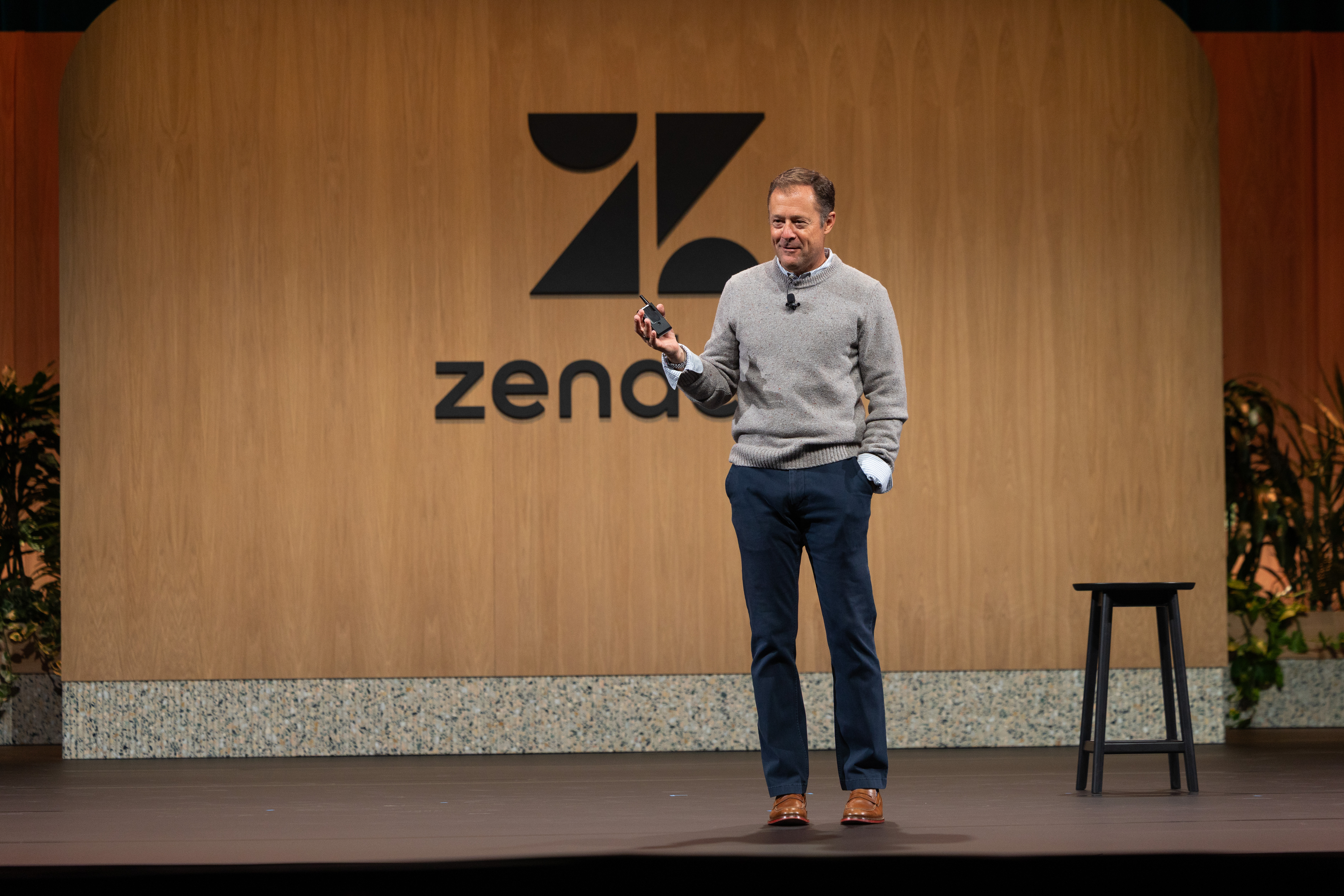
Canva chief customer officer Rob Giglio, delivering a keynoter at Zendesk Relate

The way the customer service industry behaved over the last 20 years tells you clearly how much your problems really mattered to them. First, there was a huge wave of offshoring to low-wage markets. Then came IVRs; next those joy-sucking, highly scripted chatbots trained to redirect, contain and eventually quash any hint of connection, before, god forbid, any expensive human wetware entered the loop. Now, as AI agents flood customer operations at an industrial scale, Canva chief customer officer, Rob Giglio thinks the sector risks wandering into another dangerous place: Support systems optimised to deflect at an agentic scale. He and his team are actively operating against that trend, and that begins with a focus on resolution - and building loyalty - instead of optimised deflections designed primarily to save costs. And a very heavy investment in training.
What you need to know:
- Canva chief customer officer, Rob Giglio has warned the software industry that many AI-powered support systems are still designed primarily to “deflect” customers rather than solve problems.
- Speaking at Zendesk Relate in Las Vegas, Giglio said businesses risk damaging trust and loyalty by optimising AI customer service around cost reduction and ticket closure instead of genuine resolution.
- Giglio argued traditional “deflection” metrics, designed to minimise escalations to human support, no longer align with customer expectations in highly competitive digital markets. Canva is instead restructuring customer operations around predictive AI systems that identify adoption issues, churn risks and expansion opportunities before customers actively seek support.
- The company analyses onboarding data, product usage patterns, feature activation, support interactions and customer sentiment across its 260 million monthly users to proactively trigger interventions.
- Giglio claims the model has more than doubled customer coverage, improved gross retention and lifted net dollar retention above 140% without significant headcount growth.
- He repeatedly framed AI as a tool for augmenting human relationships rather than eliminating them, citing customer service cultures that prioritised problem-solving over efficiency metrics.
- Canva now treats customer service as a revenue and loyalty function rather than operational overhead, using AI-driven customer signals to trigger customer success and expansion activity.
- Giglio said the future of AI-powered service is “not less human, but more human”, with automation surfacing the right conversations at the right moment rather than replacing meaningful customer engagement.
Every interaction, every workflow, it’s either moving someone, our customer, closer to trusting us, or it’s creating distance. And the gap between those two outcomes, that’s the difference between resolution and deflection.
The customer service sector spent two decades encouraging customers to stop calling – after all, service costs money, and they've already taken yours, so what did you expect? Now, the sector that stripped the service out of customer service finds itself deployed to one of the first major battlegrounds that will see consumers directly experience agentic AI at scale.
As Mi3 reported yesterday, a new global Capgemini study found AI agents will compress shopping, weaken loyalty and force brands to compete on emotional trust. In such a world, how much more profit can really be extracted from sucking the last vestiges of joy out of the actual brand experience that matters the most to a customer: When things go wrong?
According to Chiefmartec editor-in-chief Scott Brinker, "We’ve been on a journey for quite some time bringing greater and greater automation to customer experience, and that can be a really good thing or a really crappy thing. In every case, when we are looking at automation and customer experience, I always beg people to think of this through the lens of a two-by-two: is it efficient and good for the company, or is it efficient and good for the customer?"
Brinker, who was speaking at the Progress Martech Next event in Melbourne this morning, said, "We have to be really careful not to over-optimise all of these out, because a lot of them take on the characteristic that they are inefficient for the company in the short game. 'Oh, this particular interaction, this is the less efficient way to do it.' But when taken over the lifetime of that customer, the brand loyalty and love those experiences can create, and the add-on effects of advocacy that can come out of that, mean there are actually cases where it’s worth it."
He warned, "We want to be very careful before we completely optimise those out of the system."
Canva chief customer officer Rob Giglio, is keenly aware of the risk.
Speaking at last week's Zendesk’s Relate conference in Denver, Giglio argued the next-generation winners will not be the firms that automate the most interactions, but the ones that use AI to detect frustration earlier, intervene faster and turn service operations from cost centres into loyalty and revenue engines.
He told delegates Canva's approach has already helped push net dollar retention above 140 per cent. That's a solid proof-point of what is achievable when things go right. But things, as Giglio explained, do not always go right, and the broader implication for the software sector is more confronting – many AI service systems may already be training customers to trust brands less, not more.
Recalling a recent experience of a service call he initiated, he said, "I had a problem with a service that I use. Within about 30 seconds of interacting with this chatbot, I knew immediately what was happening. This agent was really not here to help me, per se. It was basically there to make me close that window and go away.”
The experience escalated across a familiar arc, from chatbot to AI voice assistant, but the same pattern persisted with each new answer nudging him toward self-service content.
“I had a real problem, and I needed some kind of resolution. What unfortunately I was getting was what we would call in the industry deflection," said Giglio.
For years, customer service operations have measured success partly through deflection metrics, which track how effectively companies prevent customers from escalating to expensive human support channels. Giglio argued the economics underpinning that model are beginning to fracture as AI changes both customer expectations and software economics. That's something he is acutely aware of at Canva.
“Every interaction, every workflow, it’s either moving someone, our customer, closer to trusting us, or it’s creating distance,” he said. “And the gap between those two outcomes, that’s the difference between resolution and deflection.”
The company now serves more than 260 million monthly users and processes billions of interactions across customer support, onboarding, product engagement and success workflows. Managing that scale forced Giglio to rethink how customer operations functioned internally.
The bow tie
At the centre of that rethink is a framework Canva calls the “bow tie”. Instead of treating support as a downstream service function, the company models the customer journey as a continuous lifecycle spanning awareness, engagement, onboarding, adoption, growth and loyalty.
“At Canva, we use this model as a way to articulate a customer journey,” Giglio said during a media Q&A following the keynote. “We think about where our customers, every single one of them, are in that journey.”
The framework shapes how the company structures meetings, tooling, workflows and performance measurement. “We use signals that we get from all different kinds of tools. Some are in our product, some are Zendesk, and we use those signals, we combine them, we aggregate them.” Giglio said. “From a customer experience, customer success, customer support standpoint, we try to think about how to move people ever increasingly towards loyalty.”
Canva's customer point-man repeatedly framed customer service less as a support function and more of a commercial operating layer tied directly to retention, adoption and expansion revenue.
“Customer service for us isn’t a cost centre,” Giglio said. “Resolution means the customer is in a better place than when they found you, the problem has been solved, and they trust you more. Deflection means the ticket is closed, the chat has ended, and the customer stopped asking. That’s not resolution.”
Trade-offs
Operationally, it's a philosophy that has forced Canva to redesign large parts of its customer organisation. When pressed during the Q&A about the trade-offs involved, Giglio acknowledged Canva had to abandon many traditional support metrics and operating assumptions.
"The first trade-off we had to make was that we weren’t going to do it the way every other company in the world has done it. Culturally, that was easy for Canva. We really have this – I don’t know what the right expression is – but we like to zig when others zag, and we like to be very purpose-posed. We don’t want to do something just because everyone else has done it."
Giglio said when you start a customer success or customer support organisation from scratch, there is a real temptation to follow existing patterns. "You say, 'Well, here’s what we’re going to care about. We’re going to care about call times. We’re going to care about call resolution.' And call resolution is measured by the customer not calling back, which might not actually be resolution. It might just be that we’ve worn them out."
Understanding what you are really trying to achieve is an important first step in this journey. "If what we’re really after is loyalty, what are we willing to trade off from the old ways of engaging with customers?" Giglio asked.
"We continue to evolve. I don’t think we’re done with this methodology, but one big trade-off was changing KPIs. We focused heavily on metrics that give us a sense of loyalty and product usage."
For example, Canva now measures customer service reps based on things like product usage, product adoption, and the scale of that adoption. "That freaks people out," Giglio told MI3. "In the old days, it was sort of like, 'I don’t know, the salespeople sold it. I’m just here to help them if they have problems.' Now they’re actually measured on whether the customer is really using the product. That was a trade-off.
"The way we think about expenses is different, too. It’s not purely the headcount expense tied to customer support or customer success."
He added, "We also had to add functions, so now we have an implementation team. We use third-party partners to help with implementation. That’s new. That’s a new expense."
Another step was being willing to hand customers off to partners. "That’s actually kind of freaky. You’ve just closed a million-dollar deal with a customer, and now you’re pointing them to a partner instead of retaining it internally. That was a big trade-off," he continued.
The final trade-off Giglio noted is a need to commit to hiring differently. In the past, customer support hiring focused on communicators who could resolve tickets quickly and move on. Now, he said, the emphasis is on discovery-oriented skills, such as asking thoughtful questions rather than simply resolving or deflecting issues.
"You need to have people who are going to be deeply engaged with customers. They have to have those skill sets. You then expect them to be good, and you have to give them a lot of training."
Oh the humanity
Giglio's comments touched on a deeper concern emerging across the AI service sector. Analysts and service executives increasingly worry that widespread automation of simpler customer interactions may inadvertently eliminate the very low-level experience that staff working on the call desks need to develop judgment and intuition.
Last week, Constellation Research VP Principal analyst Liz Miller told Mi3, “The thing that Zendesk, and companies like it, need you to believe is that AI is both experience and expertise."
Expertise is a set of data points and the connections between them. Experience is what it means, how it feels, and the empathy to imagine yourself in the customer's shoes. That will become increasingly hard as front-line staff lose direct access to the bulk of everyday problems that customers encounter.
"I thought it was very telling that Tom [Eggemeier, the Zendesk CEO] kept talking about expertise. ‘This is the expertise we're training'. Yes, your AI models can be trained on lots of expertise, and you [Zendesk] have expertise in ticket management. Congratulations. What they don't have a skill in is the actual knowledge that goes into their customer base," Miller said. "You still need the company, you still need the customers, you still need everyone involved to build that actual knowledge.”
It used to be a customer success, customer support person needed to be just an expert in the product. Now our reps of all kinds need to be experts in all the integration partners that we work with.
Experience deficit
Mi3 asked Giglio whether automating away lower-complexity interactions risked depriving younger service employees of the customer exposure that built that valuable human experience. He first pushed back on the premise that Canva’s systems were primarily designed around deflection.
“The agents for us are as good as a person in the sense that if the agent can help a customer get to the next place, we kind of care who solves it for them,” he said.
But he acknowledged the operational challenge of maintaining the connection to the human experience of being a Canva customer as workflows become increasingly AI-assisted.
Canva's solution: "We do ridiculous amounts of training. What I would say is we have an outsized enablement team. We have tons of playbooks. Canva, as a company, loves to document stuff because we love to work in Canva. We're in Canva Docs, we have sheets, we're in Canva presentations, we're in Canva video, so we create a lot of content," Giglio said.
The company also makes extensive training materials available to employees beginning careers in customer experience roles, including customer support, enablement, customer success, implementation, solution consulting, solution engineering and technical account management.
"We don't actually expect anybody to be awesome the second they show up, so we invest a lot, probably more than most, in making sure they're prepared."
Operational complexity
The expansion of AI integrations is also increasing operational complexity. Canva now integrates with systems including OpenAI, Microsoft Copilot and Google Gemini. That means support teams increasingly need expertise beyond Canva’s own platform, Giglio acknowledged.
“It used to be a customer success, customer support person needed to be just an expert in the product,” he said. “Now reps of all kinds need to be experts in all the integration partners that we work with.”
That's a shift that is reshaping the relationship between support tooling and customer intelligence itself. According to Giglio, Canva had already been collecting behavioural signals of its customer experience before the arrival of large language models. The breakthrough came when generative AI made those signals operationally actionable in real time.
“The thing that’s been most interesting is we actually can use AI to make sense of the data," Giglio commented. "Before, we had to use a lot of data science and data engineering to try to find patterns and visualise the customer experience. We would do it in your classic bubble chart versions, showing the hot spots in a customer’s experience with our product. That was okay, but it was literally a point in time. It was very static, it looked backward, and it didn’t have strong predictive qualities.
"It also didn’t allow us to act on it effectively because it was very serial. We would see something, then build something, then create engagement. Usually, it was a little behind and a little reactive. Now we have all that same data, but we can use AI to drive proactive action in the customer experience."
Anchored in AI
That adjustment also underpins Canva’s broader effort to reposition itself internally around AI. “We shifted to this orientation and said we’re an AI platform that also does design,” Giglio said. “That was a pretty fundamental change in the way we framed ourselves internally.”
Part of the nomenclature of Canva is that the company regards itself as operating at the intersection of productivity and creativity. “We like to think of ourselves as the place where productivity and creativity overlap,” Giglio said.
The AI transition is also reshaping how Canva manages organisational change. Rather than centralising AI experimentation inside specialist teams, the company appears to be encouraging broad workforce participation.
Two weeks before the conference, Canva held what Giglio described as an “AI Discovery Week” involving its entire workforce of more than 5000 employees. “For the entire week, every single employee of Canva spent their whole week in AI discovery,” he said.
The program combined AI literacy training, functional learning paths, workflow experimentation, hackathons and agentic AI prototyping. “We have people in sales vibe coding applications for doing customer experience work, and people in customer success building little agentic workflows,” Giglio said.
The initial experimentation phase, when the approach was to let a thousand flowers bloom (and trying all kinds of tools in the market) is now beginning to consolidate into more formal operating standards.
Giglio repeatedly returned to the idea that AI should ultimately make software experiences feel more personal and contextual rather than more automated. “I think we’re going to find that AI is going to empower a lot more in-product experiences,” he said.
The vision he described increasingly resembles predictive, embedded assistance rather than traditional customer support channels. “We’ve always had the mindset that, 'Just think if you could park somebody next to your customer all day long.' What would you learn, what would you do, how would you help them?”
Historically, that model was economically impossible to deliver. "You just can’t do it. It’s too expensive,” he said.
AI, however, changes that equation according to Giglio, who described a future where systems are capable of observing behaviour, inferring intent and proactively assisting customers before explicit requests are made. “What would be way more powerful is if, in the moment, it saw I was trying to do something, and the application actually recommends a solution to my problem in real time."
Giglio compared the concept to Google Maps proactively surfacing traffic conditions before a user asks for directions. "I go to the same place every Wednesday morning at 6am, and it already knows where I’m going. It gives me a map to the place, even though I don’t actually need directions. What’s useful is that it tells me about traffic and how long it’s going to take. That’s an incredibly proactive, very personal and real-time, in-product experience."
The same philosophy now shapes how Canva approaches product development itself. "Let’s just say I'm using background remover. I’m trying to remove the background in an image, and the application actually recommends a solution to my problem in real time, just like Google Maps does [with directions]."
Closing the loop
Currently, the company runs a system internally called “close the loop,” which clusters customer requests, complaints and behavioural signals before routing them into engineering prioritisation workflows.
“We work off the idea that anything that’s inbound from a customer that does not move them through the customer journey is some kind of problem, or some kind of wish that we can grant,” Giglio said.
That system now operates at massive scale. One example involved Canva’s printing functionality. Historically the company viewed itself as a digital-first product and did not prioritise printing workflows because of its broader orientation toward online publishing. But repeated customer requests forced a rethink.
“The wish came in, and it was like one, and then two, and then 10, and 10,000,” Giglio said. “Our engineers built print.”
Canva now notifies customers when requested capabilities they've raised a hand for are released. “We say, ‘Thank you for giving us this idea. We granted your wish.’”
The biggest operational change was becoming far more specific about customer use cases. “[Previously] We just sort of plopped our software at our customers’ feet and said have fun,” Giglio said, partly joking.
Now, if a customer purchased Canva to standardise presentation creation across sales teams, the company actively monitors whether that behaviour actually occurs. “If they told us they wanted to do this and we’re seeing they’re not doing it, that was a massive signal to us that we need to help this customer,” Giglio said.
That shift also reframed internal ownership structures between sales, support and customer success teams. “In the old days, many sales teams felt like they owned the customer for the entire journey,” Giglio said. “Now we work off this idea that we all own the customer for the entire journey.”
That required redefining responsibilities and incentives internally. “We had to define who does what, who gets measured on what,” Giglio said.
AI as revenue growth, not cost out
Throughout the keynote and subsequent conversations, Giglio repeatedly resisted framing AI primarily as a cost reduction technology. Revenue growth, he argued, emerges downstream from relevance, loyalty and customer outcomes.
“We don’t really start with the idea of getting revenue,” he said. “Revenue is some metric that shows up over here if you do relevance and loyalty and incredible product experience as well.”
Many vendors continue pitching AI primarily through the lens of automation rates and labour savings. Giglio’s argument is more aggressive and potentially more expensive in some cases: The real value of AI may come less from suppressing customer demand than from understanding customer intent deeply enough to strengthen loyalty before friction escalates into churn. That distinction may ultimately become one of the defining strategic fault lines in enterprise AI customer service.
“Getting to a resolution used to mean waiting for a customer to tell us something was wrong,” Giglio said. “Now the intelligent service tells you first, and it tells you often, and that’s what the future of service looks like. Not less human, but more human, and in the moments that really matter.”