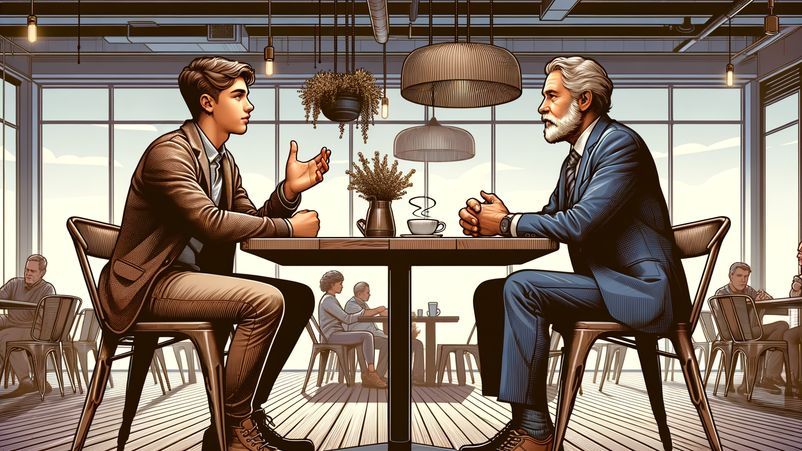
No text, no headline, no logo, no slogan – and why KitKat’s Cannes Lions OOH Grand prix didn’t need them
An Mi3 editorial series brought to you by
QMS

Tennille Burt: Seven brand codes and a six-point checklist for more effective advertising, via Marc Pritchard and Mark Ritson.n.
An Mi3 editorial series brought to you by
QMS
P&G CMO Marc Pritchard, virtual professor Mark Ritson, System1, Analytic Partners and some of the world's top creatives are all saying the same thing: Consistency and craft in applying distinctive brand assets and codes pays off – big time. KitKat's Grand Prix-winning out of home ad provides a master template for Australian brands to follow, says QMS chief marketer, Tennille Burt. Here's how to lift it.
When KitKat’s “Phone Break” campaign by VML Prague won the Outdoor Grand Prix at Cannes Lions 2025 – marking the Czech Republic’s first ever Grand Prix win – it was validation of a marketing truth that’s been staring the industry in the face for decades: magic happens when brand codes work in perfect harmony with emotional insight – preferably on big creative canvasses.
The campaign, which also won a Silver Lion in Print & Publishing, depicted everyday scenes – people waiting for a bus and other time-killing moments which typically turn us to our phones and perpetual scrolling. But instead of a smart phone, the imagery had people looking at a bright red KitKat bar in the same manner - Images only. No text, no headline, no logo, no slogan – nothing but a crystal-clear message of “Put your phone down, take a break, have a KitKat”.
The assumption – and reality – was anyone and everyone would get the brand code shortcuts and immediately know it was KitKat. That is the power of brand codes deployed with surgical precision over decades.
OOH creative masterclass
Asked about the campaign, Outdoor Lions Jury President, Keka Morelle, the Chief Creative Officer at LATAM Ogilvy, said: “[It’s a] Masterclass in outdoor. Without words or logos, it communicates a strong message through a beautifully crafted image. It captures the moment we’re living in, reinforces the brand’s concept, and immediately sparks reflection, holding up a mirror to our screen addiction.”
Beyond the jury room, this year’s Cannes festival delivered some of the most important advertising research in a decade – in Mark Ritson’s typically punchy and entertaining style. He presented System1 and Effie data spanning more than 1,250 campaigns. The research revealed a simple but compelling truth, that “the magic number is seven” when it comes to brand codes in advertising.
“You don’t need seven codes, but you need to use your palette of codes seven times in the ad in order to achieve optimum levels of awareness and recall,” Ritson explained.
“Most of you are strolling in with two or three. Because of that, to use a statistical phrase, you are f@$ked.”

KitKat's "phone break" Grand Prix winner. Enough said.
KitKat – same brand codes for 70 years
The KitKat outdoor campaign perfectly demonstrates this principle. The brand has been so relentlessly consistent with its “Have a break” positioning since the 1950s that the mere visual of people holding chocolate bars instead of phones instantly communicated the entire brand promise. And it was a playful take on the slogan “Have a break, have a KitKat”, that we know and love.
This is what happens when you stick to your codes long enough for them to do the heavy lifting.
P&G’s Chief Brand Officer Marc Pritchard delivered a similar message at Cannes festival this year. “Stay in love with the craft of advertising,” he said. “That is our job… [to use] creativity to compel people to turn towards our brands by attracting attention, informing, persuading, making them laugh, cry … feel… and ultimately take action, like buy. That requires art, science, ideas and craft that is nurtured and revered.”
His six-point back-to-basics checklist provides the perfect framework for brands looking to emulate KitKat’s success:
- Deep consumer insight that matters to people’s everyday lives – tick for KitKat.
- Creative ideas that make emotional connections – tick for KitKat.
- Distinctive brand assets that are consistently applied – tick for KitKat.
- Long-term campaign thinking, not short-term media bursts – tick.
- Craft and quality over quantity and speed – tick.
- Repetition that builds memory, not fatigue – tick.
So, what does this mean for Australian brands? Easy. Start building your own version of KitKat’s consistency.
Ritson: Make fewer ads, run them longer
As Ritson put it: “Make fewer ads, run them longer. Make more money. Listen to the old fat man. Ignore the young, thin, attractive people. They have no idea what the f@$k they’re doing.”
That’s quite a statement to make. But the research is actually there backing this up. And it's compelling. Analytic Partners did a study of 51,232 ads and found that “only 14 of them had worn out ... 51,218 had not”. In other words, most brands are not running campaigns long enough to let them work.
For Out of Home specifically, this means developing campaigns that can quickly capture attention in high-traffic locations while deploying those seven brand codes consistently. The KitKat images were strategically placed in high-traffic outdoor locations where phone use is most visible, like bus stops, and pedestrian zones, turning the medium itself into part of the message. That’s one of the beauties of Out of Home: contextual alignment in the heart of the customers world.
Deceptively simple formula
Ritson’s research shows the difference between a “sh#t ad and the best ad is a 12 times multiplier” in terms of business impact. The formula is deceptively simple: emotion × fluency × time. All three must work together.
KitKat’s Grand Prix win, in part, was about a clever, engaging creative execution. But it was also about a brand that has been ruthlessly consistent with its codes for over 70 years, creating a level of fluency that allowed them to communicate their entire brand promise without saying a word.
KitKat and P&G weren’t the only brands making the case for long-term brand building at Cannes this year. CEOs like Gap Inc’s Richard Dickson are codifying brands to drive business decision‑making, and it’s working. Gap made headlines with its emotionally resonant campaign featuring a stripped-back, black-and-white ad featuring singer Alanis Morissette performing “No Return,” timed with the relaunch of the brand’s iconic logo hoodie. It was a moment of simplicity, restraint, and pure brand code storytelling.
The challenge for Australian marketers, therefore, is having the discipline to stick with the brand codes that work, run them long enough to build memory, and resist the siren call of constant change. It’s no longer just about simply finding the next big creative idea but ensuring brand building reclaims its rightful place in the heart of the marketing mix.
As the KitKat campaign so perfectly demonstrates, sometimes the most powerful thing you can say is nothing at all. But only if you’ve spent decades earning the right to that silence.