Wrong tools, wrong training, wrong industry: CMO Council’s martech stack analysis exposes how spending more money can deliver laggard stacks; Amazon rocks retail, CommBank lags in fin services

For two decades, martech buyers has assumed (or at least prayed) that more features and higher maturity would separate leaders from laggards. A study by the CMO Council, whose audience controls nearly US$1 trillion dollars in marketing spend, and MartechTribe of nearly a thousand stacks across seven industries finds that this is not reliably true. In some categories, outperformers use broader functionality; in others, they use less and run it more skilfully; in customer data platforms they do neither. Retail outperformers show 23.3 per cent less CDP feature breadth and 22 per cent lower maturity than lower-performing peers. The authors report an association with revenue-per-employee rank, not proof that the stack caused the result. The practical risk they flag is simpler: CMOs copying generic best practices may be diligently building the wrong stack.
What you need to know:
- A study into martech maturity by the global CMO Council, whose audience controls a trillion dollars in marketing spend, reveals that retail and consumer-goods outperformers extract more value from narrower email platforms by operating them with substantially greater maturity.
- Banking outperformers follow a different pattern, using 17.3% more marketing automation functionality despite operating it 17.3% less maturely.
- Customer data platforms deliver the starkest warning: outperformers use fewer CDP features and record lower maturity across every industry studied.
- Amazon achieved the highest score among the public retail stacks examined, while Commonwealth Bank ranked 58th in banking, finance and insurance.
- The findings suggest businesses should diagnose whether they need more functionality, better execution or simplification instead of copying competitors or automatically upgrading platforms.
- AI raises the stakes because emerging agents depend on the quality and alignment of the data, software, permissions and workflows beneath them.
This is the biggest conclusion, and I think the most shocking one: A martech investment in one industry can be disastrous in another one.
It turns out the answer to better martech is not more martech. In fact, that may be the problem. Retail and consumer-goods outperformers use comparatively fewer email-marketing features, but operate them with greater maturity. Banking outperformers show the opposite pattern in marketing automation: Broader functionality, despite lower operating maturity.
The findings come from a new study of nearly 1,000 enterprise marketing technology stacks undertaken by the CMO Council and MartechTribe’s Apex Martech Matrix 2026. To do this, they compared feature breadth and organisational maturity across 988 marketing technology stacks in seven industries. The CMO Council engages with over 16,000 chief marketing officers in over 10,000 companies, across 120 countries, who collectively control US$1 trillion in marketing spend.
Earlier this year, Mi3 reported some preliminary data which suggested across seven industries, outperformers consistently used fewer programmatic advertising features and had less mature programmatic technology stacks than their weaker-performing peers. The new report is based on the same model and data, but is much more expansive and covers the full sweep of technologies.
The report's central finding challenges a two-decade technology procurement orthodoxy: More functionality and greater maturity do not reliably separate financial leaders from laggards. Put another way, the answer to the problems is martech is not simply "more martech."
For example, in retail email marketing, outperformers use 10.4 per cent fewer features but operate them 42.8 per cent more maturely. Consumer-goods outperformers use 8.9 per cent fewer email features while recording 43.7 per cent greater maturity, the strongest email maturity signal in the study. The pattern reverses in banking, financial services and insurance, where outperformers use 17.3 per cent more marketing automation functionality despite operating it 17.3 per cent less maturely.
Frans Riemersma, founder of MartechTribe and one of the model’s architects, said the results expose the risks of treating platforms or management practices as universally applicable.
“This is the biggest conclusion, and I think the most shocking one: A martech investment in one industry can be disastrous in another one,” Riemersma told Mi3. He gave the example of Salesforce Marketing Cloud vs Marketo, where the latter is very well equipped for B2B customers but may not be the best option in B2C markets.
The research divides martech into four investment conditions. Broader features distinguish outperformers in categories including marketing automation platforms and customer data warehouses. Higher maturity matters more in email and search engine optimisation. CRM, dashboards and collaboration generally require both.
About those CDPs
Customer data platforms, which until LLMs stole the limelight, were the undisputed belles of the martech ball briefly. And they produced one of the study’s starkest findings. Across all seven industries, revenue outperformers used narrower CDP functionality and operated the category with lower maturity than laggards. The pattern cuts against the habit of treating a broader CDP as default best practice.
The divide was particularly pronounced in retail, where outperformers recorded 23.3 per cent less CDP feature breadth and 22 per cent lower operating maturity. Consumer-goods leaders used 17.2 per cent fewer features and operated them 16.2 per cent less maturely. The figures represent differences in the model’s feature and maturity scores rather than equivalent reductions in spending.
“Buy a bigger customer data platform because everyone says you need one, and you've just copied the losers,” Riemersma commented. “In retail, the winners invest less in CDP than the laggards do, on features and on skill.”
The authors suggested one explanation for this, drawn from earlier MartechTribe/chiefmartec research: Customer data warehouses may be taking on more of the data-management job, with CDPs shifting toward engagement. Either way, it's further evidence of the importance of a clearly defined use case ahead of adding features, training or another platform to their data stack.
In addition to CDPs, areas such as programmatic advertising, governance and privacy showed neither additional features nor greater maturity consistently separates leaders from laggards.
That distinction could alter how executives respond when a technology investment disappoints. Another platform upgrade may add complexity when the underlying problem is execution, while more training may fail to help when employees already possess sufficient skills but lack the necessary functionality.
“In fact, outperformers invest less; less in the sense of more focus,” Riemersma said. “That is what practitioners feel for 20 or 30 years already. I think we need to get past that point in the market where we say, let’s go into a phase where we also include the business lens, not just the technology lens.”
The model used in the research supplements the traditional technology lens, which assesses engineering quality, integrations, security and features, with evidence about how companies in an industry actually invest. The study and model behind it draws on approximately 1,300 capabilities across 49 martech categories. That includes an analysis based on documentation from 15,505 software products.
Most stacks were submitted by participating organisations and verified against financial data. In other cases, publicly identified stacks were triangulated through three technology-detection sources, cross-validated by an AI agent and subjected to human approval.
CMO Council chief content officer, Tom Kaneshige said conventional research has struggled to capture that practitioner perspective at scale.
A former technology journalist then Forrester analyst himself, Kaneshige told Mi3, "When you evaluate martech, there’s been a consistent blind spot over the last 20 years, and that blind spot is the practitioner’s point of view in terms of where they’re purchasing. Now we’ve tried to overfill that blind spot. As journalists, in particular, we write feature stories, go into companies, and find out what they’re doing. But it’s very anecdotal, right? And it’s not data-based, and confirmation is tough.
"Analysts will look at vendor customers, but that’s a little bit difficult as well because you know those customers are cherry picked, right, and they are coached."
While stressing he was not disparaging the work of journalists or analysts, Kaneshige said, "It’s very difficult to get the truth of what was happening at the practitioner side. That’s the blind spot we’re filling. Are we filling it completely? No, but we are coming really close to it, and it’s going to highly impact how you look at your martech investments," he said.
Companies in the top 30 per cent for revenue per employee within their industry were classified as revenue outperformers in the study. The measure allows comparisons among companies facing broadly similar market conditions, although the report acknowledges that pricing power, geography, product mix, acquisitions, operating efficiency and business models also influence financial results. It does not claim that martech caused stronger performance.
Stacks are classified as Powerhouse, Precision, Overbuilt or Underbuilt, based on functionality and the organisation’s ability to use it, and the model produces an Apex score for each stack measuring how closely a company’s investment pattern resembles those associated with leaders in its industry.
In the public-record firms, Amazon’s retail stack scored 75 out of 100 – the highest in that set, falling into the model's top-tier “Apex Stack” band.
As the chart below demonstrates, it's daylight second in the category.
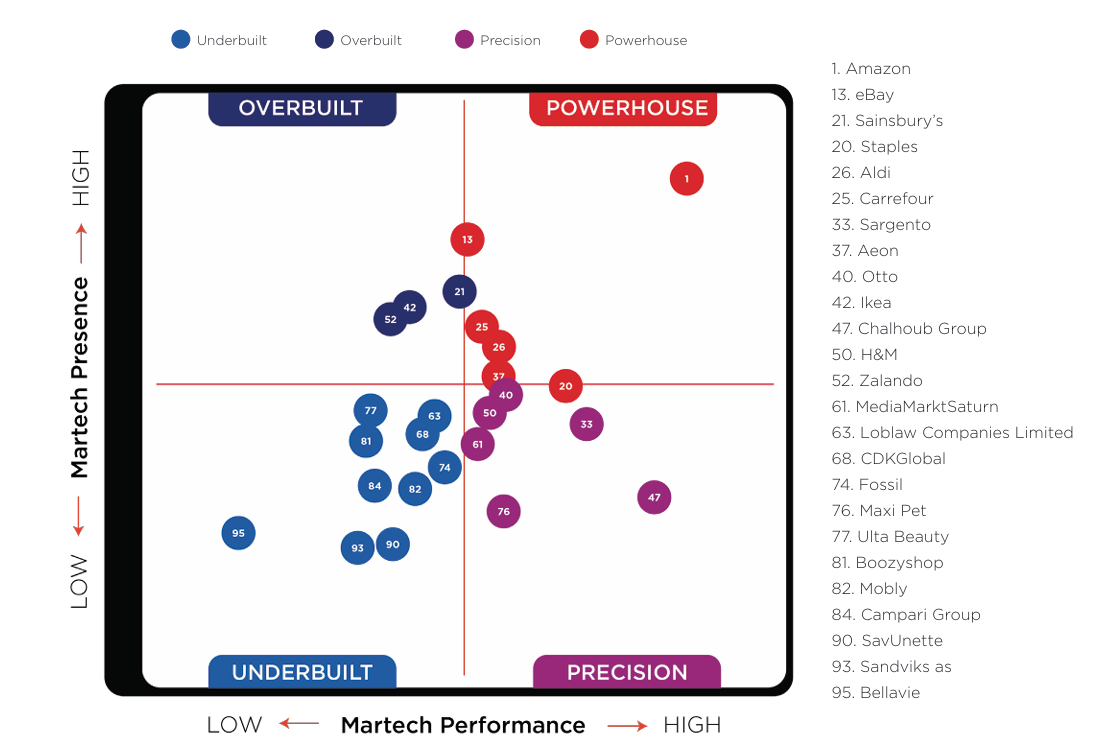
In banking, finance and Insurance, Brazil’s Itaú led the sample at 65, the industry maximum, but was still below the model's top tier. Australia's Commonwealth Bank is a long way back in 58th place, by comparison. The report places it in the 'Precision' quadrant, which is categorised by strong technical maturity, but limited functionality. That suggests one of Australia's most highly rated tech stacks is somewhat under-equipped in martech, but not overskilled.
According to Riesmersma, "Commonwealth Bank's [Score 48/100] organisational capabilities outweigh the breadth of its martech functionality, pointing to selective expansion rather than large-scale investment, closer to the industry baseline on features than to the outperformers."
The good news for CommBank's marketing team? The model suggests the bank's execution capability exceeds the technology available to apply it. Performance review, anyone?
Model motives
The model is intended to help executives identify whether a gap requires additional functionality, improved execution, both or simplification. It can also compare a company with a selected group of peers, allowing boards to account for differences in geography, scale and business model instead of copying the largest organisation in the sector.
"Basically, what we’re telling you is where you have gaps compared to outperformers. This is where your current tools are subpar, and this is where your tools are overlapping. Now, don’t start to slash and burn and destroy. Treat it like the start of the conversation," said Riesmersa.
Per Kaneshige, “If you are able to compare through data, not anecdotally, what your competitors are doing, and every board member will know every company that you’re talking about, that’s a powerful tool that marketers didn’t have before."
The framework could also expose whether a stack supports a company’s declared strategy. Riemersma cited a separate airline example he had previously encountered where technology concentrated on transactions and ticketing.
"An airliner said, 'Can you compare us to some of the others?' We validated, triangulated, and found some other stacks. And it was shocking because often we say in this research, stack follows strategy. True. But it’s even more the case stack reveals your strategy."
What Riemersma found was airlines were using the simple capabilities included in the passenger systems, rather than solutions that were fit for purpose. Highly transactional business, they were starting with a passenger service system, which has ERP and transactional stuff and ticketing, and reusing functionality to undertake customer experience and marketing use cases.
"That is like trying to go on a racetrack with a slow truck," he argued. "There are no customer experience. If I ask those airliners, they said, 'Yes, we send out emails'. But when I looked at their stack, they hardly have marketing automation tools or email systems. They said, 'But Frans, you don’t understand. We just add loyalty to it, so they don’t walk away' ... That’s what marketing does.
"It’s like a schizophrenic stack, and this is how the boardroom has been thinking ... it’s one quick fix after another, with no customer experience whatsoever."
AI imperatives
Artificial intelligence increases the urgency because emerging systems depend on the software, data and workflows beneath them. Kaneshige described marketing as one of the enterprise functions at the frontier of AI adoption, increasing the consequences of poor choices.
“AI doesn’t work well unless you have a good foundation,” Kaneshige said. “So your martech investments need to be a lot better and more sound.”
The CMO Council plans deeper reports for each of the seven industries, along with commercialising audits and advisory services around the framework.
Benchmarking can inform a business case, but it cannot replace customer evidence, financial modelling, technical due diligence or agreement about the strategy technology is supposed to serve, according to Riemersma.
“There’s no such thing as 'best martech.' Only best-aligned martech, and buying the wrong pattern is how good money turns into a laggard’s stack,” he added.