'The most important advertising thinking in 10 years': Ritson says System1-Effies database fusion cracks code on 12x profit multiplier from running distinctive, emotional ads longer
An Mi3 editorial series brought to you by
QMS

Ritson: Make ads emotional, make them good – pull multiyear budget forward if required – and then run them for a long time. But pack them full of distinct brand codes, or it's wasted. “Do I see seven codes in this ad? If yes, make it. If not, don't”.
An Mi3 editorial series brought to you by
QMS
"Avoid the pornography of change" was virtual Professor Mark Ritson's take on research by System1's Andrew Tindall that he thinks deserves a place in the marketing effectiveness pantheon of greats – because it spells out to marketers how to make great ads that drive a 12x profit multiplier over "shit" ads. Based on overlaying the Effies database with System1's ad testing data, it's a simple formula: Go back to basics with tight positioning, charge ads with emotion, pack them with brand codes – seven is the "magic number" – and run them for years. "You're taking your cakes out of the oven too early. Leave them in. Let the emotion work, let the codes work. Save money on creative, put it into working capital, make more money from your advertising." Here's the data to prove it, what good looks like – and what's so bad it deserves a "brown Lion" as Ritson underlines a back-to-basics theme running deep through a Cannes festival stalked by AI's impacts.
What you need to know:
- Virtual professor Mark Ritson unpacked deep ad effectiveness research from System1’s Andrew Tindall that lays out a very simple formula to drive up to a 12x profit multiplier by systemising creative within advertising.
- Tindall overlaid the vast Effies database of ads with System1’s own trove of creative testing data to show the key factors influencing advertising’s ROI and profit contribution – and which attributes consistently set apart higher profit and brand effects versus lower contributors.
- The winning formula in short: Emotion x distinctive assets x time.
- Ritson suggests the implications for marketers and agencies are profound. Ignore the AI doomsayers, per Ritson, accept brand purpose is a busted flush, and go back to basics on positioning, brand codes and building ads that drive an emotional response. Then do nothing for years – and watch the money roll in.
If you [run ads] past six months – a place where none of you have been before – you get a 5x multiple. If we go way out into the vast future – three years – the multiple rises to 7.5x, My message is different from every other fucker here: Change less … Make fewer ads. Run them longer. Make more money.
Compound interest
“Andrew Tindall has created, in my opinion, the most important thinking on advertising of the last 10 years,” Ritson told a Cannes theatre packed to the rafters. “He calls it 'compound creativity'.”
The short version of Ritson’s take on Tindall’s research: Be more like Grand Prix winning KitKat, less like “brown Lion” Squarespace; go back to basics on brand positioning, make emotionally-driven, fluent and distinctive ads packed with brand codes, then run them for years. All of which, working in tandem, delivers massive ROI, growth and profit according to Tindall’s work combining thousands of ads over multiple years across both the System1 and Effies databases.
The one-liner for marketers? Do much less, better, and grow much more.
“You're taking your cakes out of the oven too early. Leave them in. Let the emotion work, let the codes work. Save money on creative, put it into working capital, make more money from your advertising,” said Ritson.
When you take all the companies Tindall’s analysed, and you put them in a quartile, the top quartile – the fattest, the slowest, the most boring, unchanging – all the way through to the bottom quartile, the ones that change all the time, what you find is that boring, fat, unchanging wins the day … But you've got to be more consistent. You've got to leave the cakes in for longer. Take more time.
Adpocalypse not now
Ritson warmly greeted delegates with a nod to the late, great, Barry Humphries (“hello, fuckers”) before telling marketers to place faith in marketing science fundamentals and not to be swayed by those prophesying advertising’s imminent apocalypse.
“All these fuckers out there talking about AI: ‘The world has never been more different! The consumer has less attention than ever before!’ They've all got a book, have you noticed? The book's going, ‘Let’s scare the fuck out of you on the future and then sell you my book.’ I make no money from this message: It's not changing that much; calm the fuck down, have a cigar,” said Ritson.
“The problem we face in Cannes, same as everywhere else in marketing, is the pornography of change. There's money in worrying you that you have to change. Don't change. Slow down. AI will change a lot of things, but not in an amazing, hurried way.
“Have a joint. Have a bath. Seriously. What you find is things get better, your advertising gets better.”
“Make fewer ads, run them longer, make more money. Listen to the old fat man. Ignore the young, thin, attractive people. They have no idea what the fuck they're doing.”
Ritson repeated the message – stuffed with emotion and Ritson brand codes – to underline the notion that advertising wear-out is a fallacy.
“Don’t go for a jog. Sit on your arse. Look out the window, go for a bath, have a cigar. Look at me – I’m old and fat, yes, but very successful,” he said.
“When you take all the companies Tindall’s analysed, and you put them in a quartile, the top quartile – the fattest, the slowest, the most boring, unchanging – all the way through to the bottom quartile, the ones that change all the time, what you find is that boring, fat, unchanging wins the day … But you've got to be more consistent. You've got to leave the cakes in for longer. Take more time.”
12x profit multiplier, mapped
Per Ritson, Tindall’s work builds on the corpus of marketing fundamentals from Ehrenberg-Bass, through John Philip Jones’ work on excess share of voice (ESOV), David Aaker’s Brand Relationship Spectrum, Binet & Field’s Long and Short, Kevin Keller’s model of Customer-Based Brand Equity, Jerome McCarthy’s four Ps, and particularly Paul Dyson’s work on advertising profitability.
Dyson, like other marketing effectiveness heavyweights, found that the biggest factor in advertising profitability was size – the bigger a brand is, the more its advertising works, because they get the network effects of scale. As such, Dyson calculated that size accounts for a 20x multiplier. But he also found that quality of creative is the next biggest factor – at 12x – first by spending a year analysing Aldi ads, and then by analysing hundreds of ads in the broader market. Dyson’s research suggests, “the only one within our control is creativity,” per Ritson, which should “fill the hearts of Cannes attendees with joy”.
“What he discovered was the biggest range was 12 times. It's not an average – but the difference between a shit ad and the best ad is a 12 times multiplier.”
The problem is, Dyson’s work doesn’t tell marketers how to make an ad that delivers a 12x multiplier – but Tindall’s work does. Ritson distilled the equation to emotion x fluency x time – and all three have to work in tandem to get the maximum profit multiplier.
Emotion: The cornerstone
Ritson kicked off with emotion. He showed an ad from casino firm Bellagio that won a silver lion in 2022 – and scored highly for emotion via System1’s consumer testing. That’s a win, because across the System1-Effie sample of 1,200 ads, the high emotion ads deliver far higher brand effects than low emotion ads, which means “more increases in consideration, more increases in preference and so on,” per Ritson.
The same applies to business effects – like market share and profit growth.
“We see low emotion campaigns perform poorly, and there is a massive split for the top quartile of campaigns that make consumers feel something. Making them feel something is a profitable route, and it works all over the world.” Per Ritson,

Source: The Creative Dividend – System1/Andrew Tindall/Effies
So what does this mean? It means unfortunately, again, Ehrenberg-Bass are correct, What Ehrenberg-Bass has demonstrated clearly ... is ... you want to target everyone in the category, and you want to target them with highly emotional ads ... but also fluency with distinctive brand assets … You have got to own every fucking pixel from beginning to end.
Emotion, then reach everyone
Tindall’s research also underlines the principle of going broad and reaching as many people as possible with ads: Over a three year period, ads rich in emotion and broadly targeted far outperformed those going narrow on a profit basis. Broad and emotional, per Ritson is therefore “the sweet spot”.
“So what does this mean? It means unfortunately, again, Ehrenberg-Bass are correct,” whereas the “Kotlerian paradigm” of segmenting the market and targeting those segments “is almost a complete waste of time”, per Ritson. “What Ehrenberg-Bass has demonstrated clearly in a massive paradigm shift in marketing, which will surely take hold over the next 25 years, is you don't want to do that anymore. What you want to do is do what we call sophisticated mass marketing. You want to target everyone in the category, and you want to target them with highly emotional ads.”
That said, Ritson backed simultaneously running performance marketing to target “small, agile groups all the time with animated, culturally appropriate, activating media. Don't stay in the middle, go to the two extremes, two speeds. This is how we will build brands going forward.
“But for the high emotional brand-building stuff, go broad.”

Source: The Creative Dividend – System1/Andrew Tindall/Effies
Fluency = distinctive assets
While the Bellagio ad scored well for emotion, Ritson pointed out it lacked branding and therefore lost out on profit multipliers.
“If it's not branded, I lose more than I gain because nobody knows it's me. The obvious implication of this is we want emotion, but we also want fluent emotion.”
Fluency is basically another word for distinctive assets or codification of the brand. Put fluency and emotion together, and the profit multiplier increases significantly. Ritson said the likes of Mars are nailing that combination with Twix. “Behold a better ad,” said Ritson. “Emotion … but also fluency with distinctive brand assets … You have got to own every fucking pixel from beginning to end.”
Positioning, not purpose, begets fluency
To get to fluency, marketers must first nail positioning on a single page, per Ritson. Yet for most brands he has worked with, “positioning is a shit show.” Never knowingly underselling an opportunity to reorientate marketers mistaking brand purpose for brand positioning, Ritson duly took aim.
“This brand purpose business? It's over. Someone's going to send you the memo.”
Upon returning home, he urged Cannes delegates to open the fridge and gaze upon its contents. “I want you to ask yourself a very difficult but very important question: How many of these products did I buy because of the purpose or values? And as you stand naked before the refrigerator, the white light leaking in your face, you have your epiphany. Nobody cares what the sardine company’s opinion is on global warming.”
Time to return to fundamentals, he suggested. “We position our brands tightly, realistically, back to basics like it's 1972. … You need to position tightly on a page with what the brand stands for and then [nail] your distinctive brand assets. If you need more than a page, you are failing. That's what Twix are doing well here.”
He also settled another long-running debate: “Distinctiveness is more important than differentiation. I hate that, but it's true.”
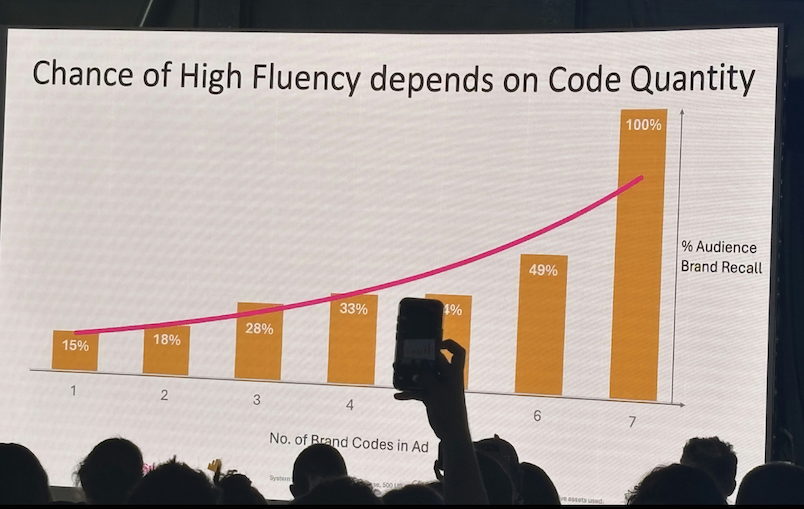
If you look at the number of brand codes in an ad, and you look at the percentage of the audience who can recall at the end of the ad, the brand … It tells you something so fucking simple and so important, it's off the charts: The magic number is seven ... Most of you are strolling in two or three.
Brand codes: The magic number
Ritson urged marketers to heed the wisdom of Adam&Eve DDB strategist chief Sarah Carter. "Every one of you should have a post-it note on your desk that says, 'Consumers don't give a shit’. Because they don’t.”
Ritson argued from this realisation comes better advertising – driving marketers to embed more codes into their ads to catch the half asleep punter that doesn’t really care about whatever product is being pushed. “We call that market orientation. It is the most important theory in marketing. You are not the consumer. You will never be the consumer.”
Tindall’s mapping of System1 and Effie data suggests a magic number for brand codes – logo, brand character, slogans, celebrity, product shape, colour palette, jingle/audio, typeface etc. – appearing in any one ad. But crucially, they do not all have to be different codes, some can be repeated, and probably should be.
“Here's something no one's ever shown before … The chance of achieving high fluency comes from using those codes a certain number of times. If you look at the number of brand codes in an ad, and you look at the percentage of the audience who can recall at the end of the ad, the brand … It tells you something so fucking simple and so important, it's off the charts: The magic number is seven,” per Ritson.
“You don't need seven codes, but you need to use your palette of codes seven times in the ad in order to achieve optimum levels of awareness and recall.
“Most of you are strolling in two or three. Because of that, to use a statistical phrase, you are fucked.” He advised Cannes delegates to study Ehrenberg-Bass Associate Director Jenni Romaniuk’s fame/uniqueness grid to work out what their distinctive assets should be, citing a fresh paper in the Journal of Brand Management which used Romaniuk’s grid to suggest most brands are “using codes which are not fit for purpose” and that “brand managers overestimate the fame of these distinctive assets”.
What emerges, per Ritson, is a paradox: when positioning, too many codes in the palette is as bad as too few. “You must be distinct, you must be tight”. He advises clients to go for “brand logo plus three, maybe four … But when it comes to application of codes in your ads, it’s completely different: repetitive, incessant, playful; you can’t overdo it.”
In short: “Do I see seven codes in this ad? If yes, make it. If not, don't”.
Source: The Creative Dividend – System1/Andrew Tindall/Effies/Mark Ritson
The wear-out fallacy: Don’t change a thing
Per Tindall’s research, 45 per cent of ads across the sample nailing emotion and fluency (distinctiveness) drove incremental profit – at least those left to run for at least three years – which Ritson hammered home as the third crucial factor of the effectiveness equation.
He urged Cannes delegates to look at the difference between the red bottom line “of just nothing” in the chart below, and the green top line, representing emotional, well-codified ads.
“If you go past six months – a place where none of you have been before – you get a 5x multiple. If we go way out into the vast future – three years – the multiple rises to 7.5x,” said Ritson.
“My message is different from every other fucker here: Change less … Make fewer ads, run them longer. Make more money. Listen to the old fat man. Ignore the young, thin, attractive people. They have no idea what the fuck they're doing.”
The theory of ad wear-out, per Ritson, and Tindall’s data, appears to be “total bollocks”. Ritson also cited an Analytic Partners study that suggested of 51,232 Australian ads, “only 14 of them had worn out … 51,218 had not. So repeat it a few times: ‘Old ads better than new ads’.
There is a caveat, however. “If you have a shit ad, it stays a shit ad. But if you have a good ad, quit and run it again because it will work better and more efficiently with more working capital and more power.”

Source: The Creative Dividend – System1/Andrew Tindall/Effies/Mark Ritson
Amortise the ad budget
For brands working out how to afford to make and place a really powerful ad they can leave to run as broadly as possible and watch the profits roll in, Ritson suggested copying LVMH-owned whisky brand Glenmorangie, which this year hired Harrison Ford to move the needle.
“How have Glenmorangie, not even a top ten whisky brand, managed to afford to get enough money to afford Han Solo?
“They've done it because they're smart, and they understand marketing science ... They took seven years of money, pulled it into last year and they spent it on Harrison Ford, knowing they'll now run those ads for seven years, because good ads keep working.”
Ritson duly reiterated the stick to the recipe messaging.
“You're taking your cakes out of the oven too early. Leave them in. Let the emotion work, let the codes work. Save money on creative, put it into working capital, make more money from your advertising.”
Equally, stick with creative partners for longer (something P&G CMO Marc Pritchard also advised in a similarly back to basics Cannes session). Ritson cited Nestlé’s 90-year relationship with the same agency (JWT through to what is now VML) and decades-long ‘have a break’ positioning as a standout template.
Brown lion
On the flipside, Ritson cited Sqarespace’s 2023 Super Bowl ad using Adam Driver as deserving of “brown lion” at Cannes.
“Terrifyingly bad," per Ritson. "No emotion, zero fluency, completely short-term, made for one day in Super Bowl. Behold, everything I am opposed to in 30 seconds:
Bringing home the presentation, Ritson urged the Cannes audience – and everybody else – to get back to basics and adopt a simple formula:
“How do you get good creative, how do you get a 12, not a one? Emotion, a superpower for advertising; multiplied by fluency, codification, and distinctive brand assets; multiplied by time.”
For the evidence, download Andrew Tindall and System1’s research here. Or watch Ritson repeat the session here.