
News v influencers: Digital News Report 2025 shows more Australians get their news fix on social as young Australians lose faith, Meta’s bargaining code arguments busted

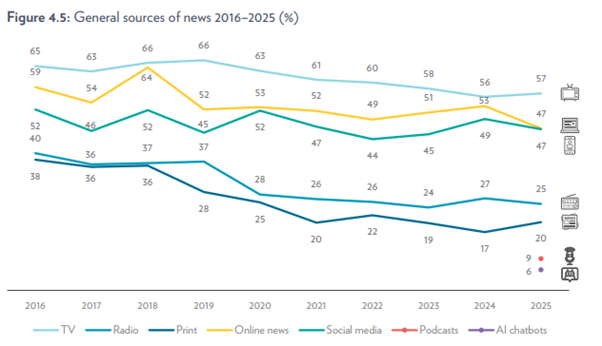
Social media has toppled online mastheads as the preferred news source of 26 per cent of Australians, with TV the last standing legacy channel standing between platforms' news domination. It's one of raft of shifts outlined in the University of Canberra's 2025 Digital News Report, and contradicts Meta's long held claims that audiences aren't seeking news on its platforms – in fact, Facebook was the top pick of the bunch. Traditional TV still dominates (37 per cent), but the generational shift is clear: younger audiences favour social-first content, drawn to creators seen as authentic alternatives to legacy media. It's fuelling rising tensions between old and new players over questions of credibility, transparency and access, not to mention payment. However, trust and interest in news remain stable, suggesting room for publishers to at least stabilise, if not grow.
What you need to know:
-
The University of Canberra’s 2025 Digital News Report has revealed that, for the first time, more Australians are looking to social media (26 per cent) as their primary news source than online news outlets (23 per cent), while TV (37 per cent) remains top of the pile overall.
-
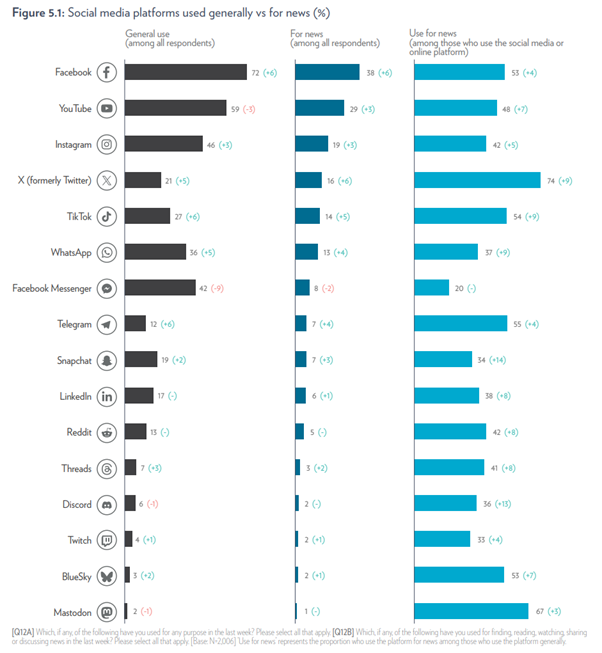
Facebook topped the list of social media news sources – and it's growing, defying Meta's claim that people don't go to the app for "news and political content", and its reason for jettisoning News Media Braining Code commitments.
-
While the point of access has changed, traditional news outlets have remained the top source of news on social media platforms, though alternative media and influencers are playing a growing role – and Australia's political class have taken notice.
-
It's characterised growing tensions between old and new players, with many from the legacy media cohort reserving "resentment and concern" for newcomers' potential lack of "professional training in journalism", according to academic and co-author of the report, Caroline Fisher.
-
However, outlets like Missing Perspectives push back on the conflation of new media and 'influencers' label, arguing the label is reductive, gendered, and overlooks their journalistic standards and editorial independence.
-
Regardless, Fisher says it's the perceived divergence from the traditional journalistic approach that underpins the appeal of these creators in the first place, with younger audiences gravitating towards their authenticity and transparency, versus what they perceive as a "false balance” projected by the mainstream media.
-
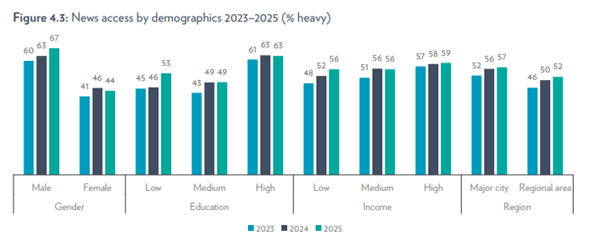
The generational divide sits alongside a growing gender gap, with 67 per cent of men now considered 'heavy' news consumers, versus only 44 per cent of women.
-
While consumption trends are changing, publishers are upbeat on the outlook – welcoming stability in Australian's interest, trust and willingness to pay for news, even as news avoidance remains high.
-
And just as the growth of social brings risk for traditional news media, Guardian Australia managing director Rebecca Costello says it also "opens up space to innovate".
Meta has argued black and blue that “people don’t come to Facebook for news and political content”, but the findings of latest Digital News Report appear to hole its justification for culling publisher payments under Australia’s News Media Bargaining Code.
The platform, which also owns Instagram and WhatsApp, has claimed since 2023 that news makes up less than 3 per cent of the content that appears on Facebook feeds globally.
It sits against the annual report’s latest finding that Australians are accessing more of their news through social media (26 per cent) than through traditional online news sites (23 per cent) – and Facebook is the platform of choice. Though TV has continued to reign supreme, ranking as the top news source for 37 per cent of Australia – it's largely driven by very high levels of use among older generations.
Published by the University of Canberra’s News and Media Research centre, the report offers a broad exploration of the shifting trends in Australia’s news media consumption, shedding light on the hotly fought battle between new and old players for the fragmented attention of the modern news consumer.
Tensions seemed to come to a head only several months back, when Australia’s establishment media was thrown into a frenzy at the Albanese Government’s invitation of so-called social media ‘influencer’ into the historically exclusive Federal budget lock-up.
Similar fervour surfaced in response the social media and podcast-led earned media strategies tapped by Labour and the Greens in their 2025 election campaigns, with party leaders and key spokespeople scrutinised for taking the mic alongside ‘friendly’ influencer-types. Those on the receiving end of the critiques have pushed back on the influencer label and cite their success as a result of establishment media’s failings.
But the shift to social isn't all bad for traditional news publishers – and the new generation of news outlets and commentators likely don't pose the threat to the landscape that some claim.
As Guardian Australia managing director Rebecca Costello puts it, "there are risks, but also opportunities".
"The shift towards social media as a primary news source highlights how fractured the media ecosystem has become. People now get their news not just from traditional outlets, but from TikTok, Instagram, YouTube, podcasts, and even group chats. That decentralisation creates obvious risks around misinformation, echo chambers and source reliability," she told. Mi3.
"This shift also opens up space to innovate, both in how we tell stories and how we deliver them. At the Guardian, our opportunity is to meet audiences where they are with trusted, high-quality journalism, across formats and platforms that align with how they live and consume content today."
Source: Digital News Report, News and Media Research Centre, University of Canberra 2025
New vs old guard
Deputy director of the University of Canberra’s News and Media Research Centre and co-author of the Digital News Report, Caroline Fisher, described a “real tension” emerging between the “traditional institution” that is the mainstream media, and these “emerging alternative information” sources online.
“At a professional level I think there’s resentment and concern that a lot of these social media influencers, or content producers, don't have any professional training in journalism,” she told Mi3.
She said the concern for much of the establishment media lies in that newer players don’t necessarily abide by the same “norms, ethics and standards” that have “underpinned trust in mainstream media” – i.e. verification, independence, and transparency around conflicts of interest.
In many cases they’re valid concerns, though for some, like Missing Perspectives founder Phoebe Saintilan, lumping new media in with influencers feels like an unfair appraisal.
The publication was invited to the Budget lockup alongside Women’s Agenda and a host of largely female podcasters, influencers and news commentators. They jumped at the opportunity, but unlike some others in their cohort, turned down the Labor party’s offer to pay travel and accommodation expenses on the basis that it would “compromise editorial integrity”.
Per Saintilan, Missing Perspectives operates as a newsroom, with experienced journalists and ethics and guidelines comparable to that of the mainstream media. Thus, she reckons the “influencer” label is misplaced – and likely sexist.
“I think it was definitely gendered and definitely because we were a group of young women operating on social media,” she told Mi3.
Saintilan also pointed to the wilful misrepresentation of the publication’s work by the likes of the ABC’s Media Watch – splicing and dicing video content to “deliberately undermine” their coverage and paint it as frivolous.
“They were ridiculing the kinds of editorial approaches we were taking. But then the next week, the ABC was doing the exact same thing on their own account. They try to criticise us and then adopt the strategies for their own use, because I think they realise that's how you cut through to the audience.”
Even when it comes to the growing role of actual influencer content in the social media news mix, Fisher suggested the risks may be overplayed.
“I think what's happening with a lot of these online influencers, they're simply expressing an opinion… I think that's just simply replaced the role of the traditional newspaper columnist. I don't think that's actually very different. It's just a social media version.”
She says the nuance is in the varying degrees of expertise that might inform opinion-led content on socials – though argues many are genuine “experts in their field” who “just happen to use social media as a way to connect with young people”.
Change in a declining news landscape
Social media’s expanding influence on Australia’s news media landscape sits against a decade of overall decline in news access across all platforms, with online news having dropped six percentage points in 2025 alone – the steepest fall of any medium. Meanwhile, print and TV managed to buck their long-term downturn in 2025 – albeit marginally.
Podcasts and AI chatbots were also reported on for the first time this year, with a growing number of Australians (21 per cent) now comfortable with news primarily produced by AI. More people were at ease (43 per cent), when news was primarily produced by journalists with the assistance of AI.
Despite Meta’s claims to the contrary, Facebook is not only the top social media platform used for news, but it’s still growing – up 6 points in 2025 to 38 per cent. Instagram (19 per cent) also ranked high, ranking in third place behind Google’s YouTube (29 per cent).
Source: Digital News Report, News and Media Research Centre, University of Canberra 2025
Generational divide
As ever, it’s the younger generations that are driving the gradual shift to social media, foreshadowing long-lasting implications for the fate of Australia’s news media landscape.
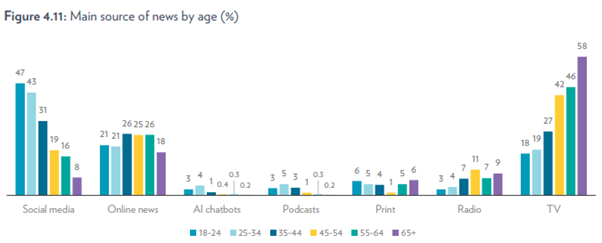
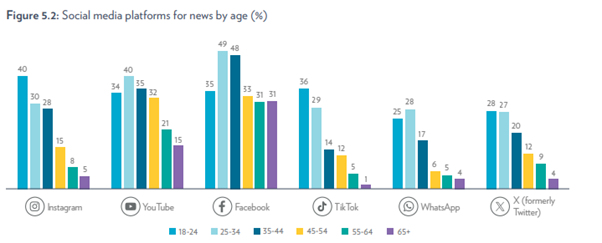
Per the report, forty-seven per cent of 18–24-year-olds and 43 per cent of 25-34-year-olds are using social media as their main source of news, while those 45 and older over-indexed in TV. Online news consumption was more consistent across the board, though under 34s and over 65s were least likely to use it as their primary news source.
Source: Digital News Report, News and Media Research Centre, University of Canberra 2025
Source: Digital News Report, News and Media Research Centre, University of Canberra 2025
Reassuringly for legacy media, traditional news media and journalists are doing well in reaching their audiences on social, though monetisation is another matter.
These outlets remain the dominant type of news source accessed by Australians on social media – and that’s consistent across all top platforms including X (53 per cent), Facebook (52 per cent), Snapchat (47 per cent), Instagram (46 per cent), TikTok (45 per cent), and YouTube (43 per cent).
For ThinkNewsBrands, the news media marketing body backed by News Corp Australia, Seven West Media and Nine Entertainment, it’s welcome evidence of the enduring relevance of legacy media in social realm.
“Social media may be where people experience a pathway to news headlines and overviews, but the news content itself is overwhelmingly consumed from trusted, traditional sources,” CEO Vanessa Lyons told Mi3.
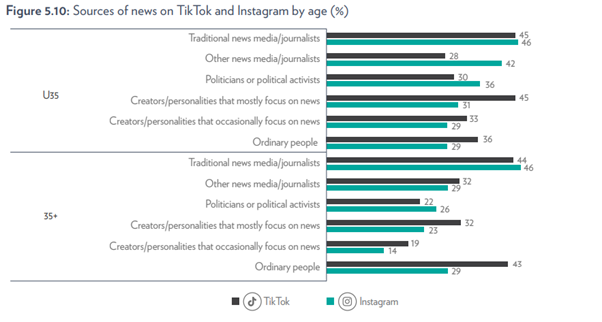
However, creators and ordinary users are gaining traction on news platforms, like TikTok, where they earn attention from a respective 39 and 40 per cent of users – nearing the 45 per cent who look to traditional media (45 per cent).
It’s a trend that’s seen more broadly with younger Australians. Though traditional outlets remain their top choice for news on social media, growing distrust and skepticism of the mainstream media is fuelling interest in a broad range of alternative sources on their platforms of choice.
Source: Digital News Report, News and Media Research Centre, University of Canberra 2025
For under 35s, TikTok creators with a focus on news are equally as popular as traditional outlets (45 per cent) on the app, while on Instagram, alternative news media outlets (42 per cent) are closing in on their mainstream counterparts (46 per cent). Across both platforms, younger Australians are also much more likely to go to politicians or political activists and other creators for news content than those over 35.
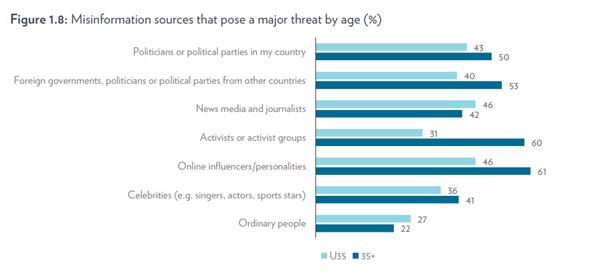
It comes alongside differing generational views on misinformation – while the Australian population as a whole would consider influencers as the greatest threat of misinformation online (57 per cent), under 35s were equally skeptical of news media and journalists.
Impartiality vs transparency
According to Canberra University's Fisher, the generational divide can be attributed to younger people’s gravitation towards authenticity – translating to a stylistic preference for content that has a clear and transparent bent.
“What we’re seeing is that younger generations are actually less wedded to ideas of impartiality and objectivity. In fact, they quite like their journalism, or their content, to have a point of view – that for them is more trustworthy because they don't think that there is such a thing as objectivity,” she told Mi3.
Per Fisher, the preference is even more acute for certain issues that young people feel the mainstream media is failing to cover impartially. She gave the example of the Israel’s war on Palestine.
“There's real anger amongst many young people about the way the mainstream media has covered that issue – that it's been very biased and pro-Israeli, and really not given Palestinians an equal voice… So, they feel they have to go outside of the mainstream media to get more honest coverage about what's happening on the ground in Palestine, because it hasn't been well represented.”
Fisher said alternative news sources on social media are thus “filling a void” for “where the mainstream media is perceived to be lacking” – and particularly on matters where certain cohorts feel there is a “false balance” or “false equivalence” given to both perspectives.
“In the same way, there's kind of acceptance around that false equivalence argument in relation to climate change, and that you don't need to give the opposite [argument]… given the scientific weight behind it,” she explained.
“That argument's been won in relation to climate change, but I think for many young people, that's also the case with this particular conflict and a range of other issues.”
Gender gap widening
It’s not just a case of generational divergence – the University of Canberra’s latest report found that news media consumption is increasingly split along gender lines as well.
In 2025, the historical gendered gap between men and women widened further. The proportion of men counted as heavy news consumers lifted 6 points to 67 per cent, while for women, it fell 2 points to 44 per cent.
It aligns with a steady decline in women’s interest in news since 2016, from 60 per cent to just 45 per cent reporting with a ‘high interest’ today. It puts them well behind male counterparts, for whom the majority (65 per cent) remain highly interested – down only three points from 2016 (68 per cent).
Source: Digital News Report, News and Media Research Centre, University of Canberra 2025
For younger women in particular, Fisher explained there is a strong sentiment that they are “underrepresented by the mainstream media”.
“Either they're not visible, or when they are represented, they're not represented fairly,” she said.
Per Fisher, it’s just another factor contributing to the growing popularity of influencer content among this group – and for Missing Perspectives’ Saintilan, catering to that underserved market is the key to success.
“Our unique advantage is that no one is really catering to the audience we're catering to … No one is really doing what we're doing with sports news, reporting for Gen Z and millennial women,” she explained.
“We're operating in a genuine gap, and our two fastest growing verticals [politics and sport] are two of the beats with the lowest female representation”, she added, referencing the latest Women in Media Gender Scorecard.
Trust and interest in the news remains stable
Despite the evolving challenges at hand, the mainstream media has continued to project an upbeat outlook on digital news market – and there’s some good reason for it.
First, the level of trust in news in Australia (43 per cent) sits comfortably above the global average of 39 per cent (and 30 per cent in the US). The ABC (60 per cent) was the most trusted news brand, followed by SBS (59 per cent), local newspapers (58 per cent), and BBC News (57 per cent), with The Sydney Morning Herald (47 per cent), News.com.au (47 per cent), the Herald Sun (45 per cent), and The Daily Telegraph (44 per cent) sitting bottom of the pile.
Meanwhile, interest is news has held after a decade of decline, lifting one point to 55 per cent – though still well below the 2016 rate of 64 per cent. In particular, Australian’s interest in local news is growing, now a 51 per cent versus 45 per cent in 2020.
At the same time, the rate of ‘heavy’ news consumption has returned to its long-term low 50s average, with 53 per cent of Australians accessed news more than once a day – up five points since 2023.
And while levels of news avoidance remain high, they have steadied. Per the latest report, 69 per cent ‘often’, ‘sometimes’ or ‘occasionally’ avoid the news – just below the global average of 71 per cent. The top reasons for news avoidance included negative mood effects (46 per cent), the belief news was untrustworthy or biased (37 per cent), news exhaustion (32 per cent), and too much coverage of conflict (31 per cent) or politics (28 per cent).
“If you look at the data holistically, what emerges is a clear picture of growing interest, strong engagement and rising trust in professionally produced news,” said ThinkNewsBrands’ Lyons of the report’s findings.
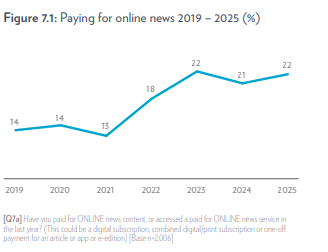
She also welcomed the fact that the percentage of Australians who pay for news had lifted one point to 22 per cent – particularly in the context of the ongoing cost of living crisis. Again, Australia sits above the global average here (18 per cent), however levels of news payment are broadly thought to have hit their ceiling.
Source: Digital News Report, News and Media Research Centre, University of Canberra 2025
Amid the vast array of commercial challenges currently facing the news industry, the Guardian Australian is one of a growing number of publications dependent on a paying audience – particularly with platforms like Meta's near impossible for news outlets to monetise.
Per managing director Costello, reader subscriptions and voluntary contributions now account for around 64 per cent of the publisher’s revenue – reflecting “a strong vote of confidence in the Guardian’s mission and journalism” in her books.
"The risk [of social media's growing role in the news landscape] increases when access to reliable, accurate information is locked behind paywalls. Quality journalism is costly to produce, but our reader-funded model keeps theguardian.com open and accessible, ensuring that anyone, anywhere, can access trusted reporting."
It's just one example of the broader diversification of revenue sources publishers have been forced to pursue as traffic moves to social – without advertiser dollars following. More on that next week.
