"Not making any money is problematic": Nat Harvey on Seven Media Group's audience strategy, integration ambition, selling off-network - plus how audio helped deliver record MKR ratings
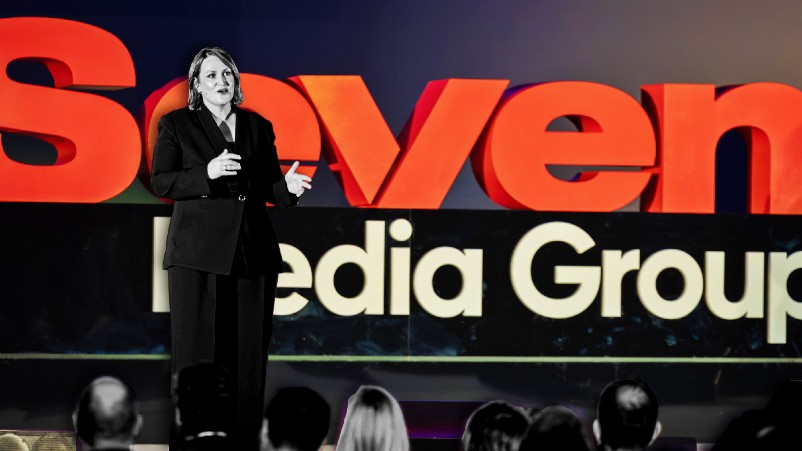
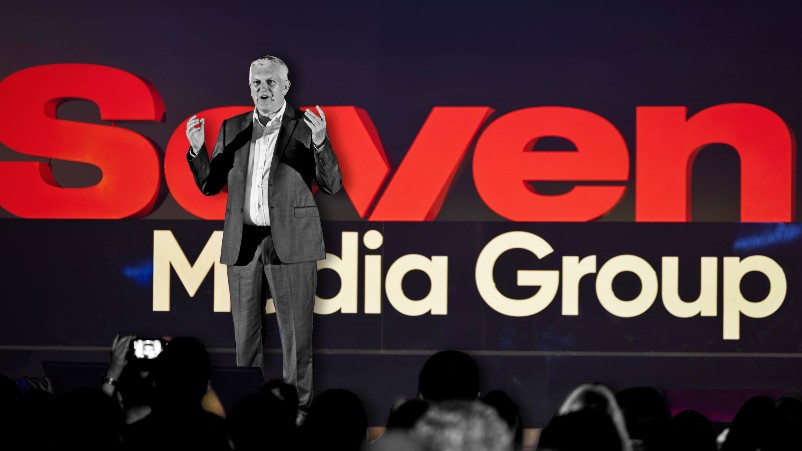
Nat Harvey at Seven Media group's upfronts 2026
Record ratings, serious momentum for change, integration in play across data, tech, talent and an audience-first strategy to boot: Six weeks back in the fold, Seven Media Group chief revenue officer, Nat Harvey, says she’s returned to a very different group with fresh appetite to win. Even if that does mean following audiences off network and retaining multiple ways for clients to trade and buy. Media buyers are liking the story they are hearing. But with integration still mainly a promise rather than a given, they’re looking for proof points. And as Harvey admits, for all that serious momentum, “it would just be great if the ad market was a little bit more positive”. Here, Mi3 catches up with the revenue chief alongside last week’s upfronts to get her personal take on what a modern media company has to do to find growth.
What you need to know:
- Six weeks into her return to Seven Media Group and fresh off the upfronts stage, revenue chief Nat Harvey is bullish about the business and its appetite for change, highlighting integration across data, tech, talent and audiences as central to its growth strategy.
- Cross-pollination is already paying off, she claims: She anecdotally attributes My Kitchen Rules having its best launch audience since 2019 to cross-promotion across Seven’s TV and SCA’s Hit Network and Triple M audio assets.
- With just 14 per cent of advertisers currently buying across Seven and SCA, there’s clearly significant room to grow cross-platform sales.
- To do this, Seven Media Group is pushing unified audience IDs, connected buying and reporting, and integrated advertiser solutions. For example, Seven plans to extend its Phoenix trading platform into audio, with Phoenix Audio enabling buying across radio, streaming and podcasts. Phoenix Exchange, a self-service platform designed to support agentic media buying, is slated for October 2027.
- An audience-first strategy will also see Seven lean further into third-party, off-network platforms such as YouTube and TikTok, where audiences are incremental to its owned channels. For example, 90 per cent of 7News YouTube viewers are unique to Seven’s owned platforms, while its TikTok audience has reached 3 million.
- But ultimately, a fragmented TV and streaming ecosystem of ad-supported services requires easier local media trading. Harvey said Seven’s proposed joint venture with Nine to improve BVOD ad buying efficiency is still on the cards, but hasn’t further progressed beyond evaluating providers, as both networks look to reduce supply-chain costs and return more value to advertisers.
- And even while commanding a leading viewership and audience position, Harvey admits “it would be great if the ad market was a little bit more positive”.
She might not have the exact MMM data to prove it, but Seven Media Group chief revenue officer, Nat Harvey, is convinced it was the power of cross-promoting this season’s My Kitchen Rules series via its now-owned Hit Network and Triple M audio assets that gave the show its biggest audience uplift in seven years.
The data Harvey is referring to: My Kitchen Rules had its best launch audience this year since 2019, up 17 per cent to 1.85 million, and recorded a 22 per cent year-on-year viewing increase. The first elimination episode also averaged 1.73m, making it the highest-rating episode since the 2019 grand final. Harvey’s adamant one of the only major changes to its pre-show promotion was using those SCA audio assets to promote the show.
“We took something like 200,000 viewers off The Block on launch night,” she told Mi3. “The show is great, but to get people to turn up on day one? Why else would we get such a big turnout?”
The concerted efforts Seven Media Group is making to integrate its TV and audio assets post-merger – from peppering TV talent on the airwaves, to unified customer solutions, one audience ID, and connected buying, trading and reporting whatever the channel – was the narrative it strived to land at this year’s upfronts. The group pointed to work bringing Seven, The West Australian, The Nightly and SCA’s audio assets together, with one of the first places it’s evident being sports and news. And judging from the feedback from media buyers in the room speaking to Mi3, it mainly succeeded.
But it’s still early in the integration play, and demonstrable proof of what this cross-channel pollination can do for advertisers – and how easy it’ll be to do it – remains the rub. What is clear is this is a commercial imperative: As Harvey told Mi3, only 14 per cent of advertisers overlap across the traditional Seven and SCA assets right now.
New company momentum
For Harvey, who’s only been back at Seven Media Group for six weeks after nearly three years as revenue chief then CEO of Mamamia, momentum within the business to act differently is palpable. She told Mi3 the group “feels like a new business”, and said being thrown in the deep end with upfronts so early on has been helpful in “creating the plan and moving forward, telling everyone about it”.
“It’s absolutely not the business I left nearly three years ago,” she commented. “I just want customers to be seeing it that way too. We’ve got to show up in that way at the same time. That’s why having the strategy piece, the data and the tech that enables us to act as a group is really important.”
The top-line strategy Seven Media Group is pushing is of “meeting Australians where they are, wherever they are”. It’s an audience-first strategy with co-opetition embedded in its foundations and, importantly, being ok with audiences not always sitting in owned platforms.
“You’ll see more embracing of global platforms because we’re going audience-first on all of our strategy,” said Harvey. “If you’re creating a piece of content, you can’t expect everyone to come to you. You’ve got to be where they are. That’s quite a new approach from the business.”
As an example, Harvey pointed to the group’s YouTube channel – Seven is now selling its own inventory on YouTube – to extend its sports coverage and connection. The first test was in the lead-up to the Rugby League World Cup grand final in November with brand partner, Toyota.
“We didn’t make a big song and dance about it because we just wanted to suss it out first, but it worked really well, so we’re doubling down on Rugby League World Cup,” said Harvey. “Audiences are there, but it’s complementary to the broadcast.”
This incrementality is even starker on news: During upfronts, Seven Media Group noted 90 per cent of YouTube audiences for 7news are completely unique to those engaging on owned platforms. It’s also built a 3 million-strong audience on TikTok.
You’ll see more embracing of global platforms because we’re going audience-first on all of our strategy. If you’re creating a piece of content, you can’t expect everyone to come to you. You’ve got to be where they are.
The backbone: Data, tech, unified audience IDs and connected trading systems
As revenue chief, Harvey’s task is to translate that into something that means more for a media buyer and customer.
The data, tech and audience integration is critical here, and during last week’s upfronts, it was Harvey’s job to put forward a slew of announcements and a 12-month roadmap promising everything from an extension of Seven’s Phoenix trading platform into audio and multiple ways of buying inventory, to a unified Seven iD across the ecosystem and group solutions team, Studio Seven.
Harvey admitted take-up of Phoenix, first announced before she moved to Mamamia three years ago, had been slow. “The market hasn’t quite caught up to our capability, so we’re going to put more inventory in that,” she said.
Harvey attributed that to how hard it is to change industry. “Driving change is hard because you have to manage so many pieces – we’ve had to change billing splits. We had a technical issue on billing that made it harder. If you add more steps to the process, or you behave in a different way to your competitors, it’s very hard to get anyone to jump on board. But we’re putting more inventory in there, we have sorted out the billing, and we should see more. If I just wanted to buy an audience, I would use this, hands down – there’s no way I’d be sitting there doing fixed placement. You don’t do that on video, so why would you here?”
Adding in audio into the one trading platform is another step forward. Per Harvey, one of the things that “blew her away” upon rejoining the group was SCA’s development of new tech.
“They’d created a product called Atmosphere, which is only internal at the moment, but it’s where the team gets a brief and in minutes, pulls a response covering 10s of radio stations. That’s going to be branded as Phoenix Audio, and will enable people to buy audio across streaming podcasts and linear,” she explained.
Phoenix Exchange will then debut next October, a self-service platform that will also enable agentic media buying.
“All the holdcos are building tools that will enable them to do agentic buying. We’ll have the pipes connected,” said Harvey. “So it comes down to the audience strategy, the insights, the capability to target them, and then being able to execute them across the whole group.”
But as Harvey stressed on stage, Seven Media Group won’t dictate one way of buying. “We have a lot of regional markets where there’s a very established way of trading and that works for these brands, so we’re not going to change that,” she said. “We’re not going to make anyone move into one way of working. It means more work for us because we’ve got to build lots of different ways in, but we’ve now got technology that allows us to move a lot quicker than we used to be able to.”
Brand displays
Demonstrations of brands stretching programs across the whole group and from TV to radio were scant during last week’s upfronts. The one example pitched up was a Vanguard campaign which saw the financial services firm sponsoring the 6 pm news ‘Money Talks’ finance segment, taking up customised billboards on the national news, and extending to an eight-part video podcast series with recut episodes across social channels, all with a CTA to engage in Vanguard’s Smart Retire Quiz.
Harvey said more will go live in the next couple of months, and pointed to “good Triple M footy examples” plus a similar Commsec deal in the works. The sales teams have also started to gain traction with a cross buy.
“We won a really good deal last week that was 100 per cent audio, but the team saw there was an opportunity to add value through television,” she said. “It gives us an unfair advantage versus our competitors because if we’re approaching things as a whole business, there’s more we can do that people might not have thought about.
“One of the things the team are looking at, for example, is how do we surprise clients with maybe some unexpected thinking. Because if we’re in on an audio brief and we’re up against ARN or Nova, there are pretty significant limitations to what they can do that we don’t have. So it’s about how we try and find more ways to add value to our clients.”
We have a lot of regional markets where there’s a very established way of trading, and that works for these brands, so we’re not going to change that. We’re not going to make anyone move into one way of working. It means more work for us because we’ve got to build lots of different ways in, but we’ve now got technology that allows us to move a lot quicker than we used to be able to.
Sustainability against the digital, streaming juggernauts
But as Seven’s extension to YouTube makes plain, Australia’s TV and media companies are increasingly competing for dollars in a fragmented ecosystem dominated by global digital platforms and now a growing swathe of ad-supported streaming services. Ultimately, gains are only going to come if the local networks work better together.
As revealed earlier this year at the Future of TV and nominally noted during the recent Nine upfronts, Nine and Seven have struck a JV to work on an ad buying solution for BVOD to try and claw back the $300m per annum lost in Australia’s $1bn BVOD market to non-transparent tech fees and supply chain bloat. Progress and details remain in short supply, and Seven did not mention the work despite expectations it might during last week’s upfronts.
Harvey told Mi3 it hadn’t progressed any further and “we’re still evaluating different providers”. “The reason for that is there hasn’t really been an evolution of how all that inventory is traded,” she said.
“There’s a lot of wastage that happens … we saw this as an opportunity to solve it as an industry and provide more value back to our customers and to our own businesses. We have to make sure our products are not being devalued or eroded, and that also means we can be more competitive too.”
Lessons from Mamamia
Outside of her TV chops, what Harvey also now brings to the business is three years inside an audio-first Australian media company. She pointed to “making sure decisions are made around audiences as well as commercial, not just commercial only”, as a lesson learned during this time. What she’s also benefitted from is direct exposure to how off-network platforms, from Spotify and Apple to social media, mean to a modern media business.
“Being able to understand the value of owned assets versus when you're sitting in something you don't own and how you work within those ecosystems is absolutely key to where we're sitting now, and in terms of the YouTube channel,” she said. “Seven News is also the number one news platform on TikTok in Australia. So we know the audience wants our content, but we've got to come up with strong growth and revenue strategies that align with that. Because having plenty of views on TikTok is nice, but it not making any money is problematic.”
It’s here Harvey also pointed to the News Bargaining Incentive and her frustration on how slow it’s moving. “It’s taken years, and still businesses are sitting here going, ‘well, what is this actually going to look like? Are people going to want to partner? Is it just going to be pay up and move on? ’ And how much data can be done to the industry every day while all this is happening? Hopefully we can get some movement on this stuff because it’s crippling.”
Harvey also doesn’t shy away from growing debate on the importance of local media investment. She pointed to the recent WA telethon on Seven, which raised $101 million, along with its work across local communities as ongoing programming that’s valuable to Australian culture and connection.
“People can call us with a challenge, and we’ll work with them. Not every media company / platform has that,” Harvey said. “That’s a strength of ours, and we’re going to lean into it … We talk more about the value of what we do for brands, versus simply saying you should do more with us.”
Harvey agreed it starts with government themselves, and demonstrating commitment. “Government has to put the dollars where they should go in the first place,” she commented.
“But we are positioned as a good place to invest your money because not only is this local and building trust with audiences, but we deliver great results.”
An example Harvey pointed to is Australian Red Cross Lifeblood’s integration with Home & Away to encourage blood donation sign-ups, which she said “got an extraordinary number of sign-ups straight off the back” of the work.
During upfronts, Seven noted it had leveraged transactional data from 12 million Westpac customers via its Data X partnership to analyse brand campaigns against $230m in customer transactions across five category spending areas: Entertainment, insurance, QSR, travel and retail. It found that, in insurance, overall market spend grew +7.5 per cent, while exposed customers spent +20 per cent per person more. In QSR, overall spend was up +0.8 per cent, but exposed 7Plus audiences were up +26 per cent per person.
“We're not begging for people to support us. Yes, it’s important. However, we know we can deliver the results as well,” Harvey added. “We've got huge momentum in audience; look at the television numbers. From the start of the fiscal year, we had the biggest lead of any network in the history of ratings … in radio audiences, we’ve been number one for 42 consecutive surveys. Everything's pointing in the right direction.
“It would just be great if the ad market was a little bit more positive.”