Divided attention: As marketing effectiveness debate heats up, Tourism Australia backs attentive reach for $130m next phase of ‘Come and say G’day’

Tourism Australia's Sarah Gallon and UM's Michael Mellington

Amid emerging market fractures around attention, Tourism Australia is mapping out its own models of whether more attention leads to growth. Three years in, the signs are positive. An early adopter of drafting attention into its media planning process, TA in 2022 began working with agency UM to craft a unique ‘attentive reach’ CPM that could help inform the way it planned for its post-Covid breakthrough campaign, ‘Come and say G’day’. They say it has delivered several percentage point increases in consideration, the key business outcome Tourism Australia looks to achieve. With the arrival of the $130m, chapter two campaign this month, the destination bureau’s head of media, Sarah Gallon, says attentive reach and the TA CPM is now firmly embedded into its media planning – informing how to take its latest emotive creative and storytelling to the world. But UM planning chief Michael Mellington there's still a broad reach balance to be struck.
What you need to know:
- Three years after first piloting attentive reach within its media planning mix, Tourism Australia and UM have fully embedded the methodology and the ‘TA CPM’ into their efforts to find incremental effectiveness gains with chapter two of the $130m ‘Come and say G’day’ campaign.
- To do this, the pair have worked closely with Dr Karen Nelson-Field and Amplified Intelligence both on evolving data sets and insights that can provide inputs into understanding media quality and attention first of all. But secondly and importantly, they then validated and reported on how chapter one efforts to better harness attentive-baked media, or channels where high-yield travellers would exhibit more attention, in its key market of the US.
- With consideration the key business outcome TA is working towards, the pair found during chapter one of the work that media spend and attentive reach didn’t have a huge amount of interrelationship or correlation with consideration.
- Going deeper, UM's Michael Mellington said the agency then investigated attentive decay, looking at how quickly does engagement decrease, and what are the active number of seconds that each asset gets? "How do we really tap into that to get an understanding of what channels do and how that impacts the mix? That had really strong correlation to consideration," he says.
- Attentive reach is now embedded as a key lever in how Tourism Australia has planned and will optimise chapter two of its 'Come and say G'day' campaign which kicked off from this month.
- But don't expect a story of ditching one channel for another, or completely throwing out raw reach with the bathwater. Optimisation is the name of the game, and the combination of reach, frequency, creative quality, distinctive brand assets, key client outcomes, category, emotive stories, MMM, full funnel models and more are all feeding into how this attentive reach approach plays out.
Does Dr Karen Nelson-Field’s analysis that 2.5 seconds of active attention as the minimum threshold advertisers need to start building memory structures hold true three years on? Or is Analytic Partners VP, Dr Grace Kite’s claims at Cannes this year that “lot of little bits of attention” are a decent substitute and can achieve the same brand ends more realistic? Or is P&G CMO, Marc Pritchard, right? He told Cannes that “building memory requires attention for 10-30 seconds or more to encode important information about the brand”. Then there is Professor Byron Sharp's view that "fleeting" exposures are okay, and shelling out for longer attention levels may be a waste of money.
There’s no shortage of debate around how much passive and/or active attention is required to really claim your advertising is effective, and how much attention suffices to build mental availability. But while the theorists, researchers and classical marketers duke it out, Tourism Australia and media agency partner, UM, have spent the past three years building out their own attentive reach media planning and measurement mechanisms to tweak and find incremental gains. The ‘Tourism Australia CPM’ is now wholeheartedly being applied to the latest chapter two, $130 million, two-year ‘Come and say G’Day’ campaign, which kicked off globally this month.
Why TA went for attentive reach
Tourism Australia GM of brand, creative and media, Sarah Gallon, says the decision to lean heavily into attention within its media planning mix as TA built out chapter 1 of ‘Come and say G’day’, stemmed from a broader operating philosophy around finding incremental, marginal gains that lift effectiveness of its marketing efforts.
“At any stage where we can drive incremental outcomes, we’re there,” she tells Mi3. “We’ve always had a philosophy of how we build associations and mental availability through emotional storytelling and quality media. I think a lot of clients have intuitively been on that journey. But it wasn’t something that had much of a label before.”
Facing intense competition as destinations opened up post-Covid lockdowns, Australia needed a leg up. As well as extensive creative testing through System 1 of a new animated character and tagline that could resonate with international travellers, there was also a desire to maximise media spend and further embed quality and effectiveness into where Ruby the kangaroo hopped.
“From a media context, the question became this: How do we make sure every single dollar we’re spending is connecting with the right people, but connecting also with them when they’re not always leaning in, but are paying attention, or where there is a higher attention to what we’re saying out to the world at that time?” Gallon asks. “How do we value that from a destination point of view, then how do we then try and use that to optimise? Quality was already our essence but this was about how we try and optimise further. ”
TA started tapping local and global data, consumer journey insights and other indicators of elements that drive consideration. “We did so many scenarios to see how we can improve and move from that raw reach to more attentive reach space,” Gallon says. “We did it across all of our brand plans at the time, with the hope we’re getting more high-yield travellers in that state.”
In late 2022, attention as a media planning and measurement concept was clearly in its infancy. Practical application of the wisdom of Dr Nelson-Field and her rigour around attention via Amplified Intelligence API feeds into media agency planning tools was still new. Today there’s eight or more players in the global attention space, from homegrown Amplified Intelligence to Lumen, Kantar, Analytic Partners and Adelaide.
But there’s planning, practical application, then understanding if it works. Having built out its own ‘attentive reach’ foundation for media planning with UM, TA then did a piece with Dr Nelson-Field to try and validate it, using one of its core markets – the US – to see whether the approach had changed or helped against outcomes. In TA’s case, the big business outcome it aligns to is consideration, long seen as a key marker and early indicator of driving arrivals, market share growth and ultimately expenditure for the tourism body.
Validation also included looking at different quadrants based on campaign objectives, the size of the brand / business and category, and places potentially worth leaning more into.
“We looked at it from a competitive point of view as well, share of voice versus share of attention,” explains Gallon. “And we looked to see if there is anything from that destination marketing point of view we could take and learn from. It was a really good process to have something we were already doing, optimise it, then be able to validate it before we continued on this journey. But it all started with having a quality lens to what we are doing.”
Off the back of chapter 1 campaigning, consideration for Australia was up 2-3 percentage points between 2022 and 2023 across the seven key markets, equating to 18 per cent lift. In UK, US and China, it’s up 5 percentage points. In addition, brand perceptions about Australia being ‘welcoming’ are up 15 percentage points among those exposed to the campaign, and forward bookings also increased.
We looked at it from a competitive point of view as well, share of voice versus share of attention. And we looked to see if there is anything from that destination marketing point of view we could take and learn from. It was a really good process to have something we were already doing, optimise it, then be able to validate it before we continued on this journey.
Attention-baked media
UM head of media planning, Michael Mellington, points to the skew TA already had for “high attentive baked media” well before its TA CPM became a thing – billboards in New York’s Times Square, a Super Bowl ad, and the complementary ‘Dundee: The son of a legend’ cinematic effort.
“With chapter one of ‘Come and say G’day’, this is where we started to have a look at the new methodology, bringing that into our planning tools so we can have a look at the way compositions and that interrelation between attention and attentive reach can pull through. That’s where we developed our ‘TA CPM’ – or the Tourism Australia cost per thousand,” he says. “It was a way for us to put indices or a coefficient into the way we look at CPM based on numerous quality factors. That’s so we could make sure we’re looking at the reach and frequency impact, but that we’ve also got a really nice calibration to still getting scale, and doing scale more meaningfully with attention and quality metrics built into it.”
The definition Mellington posits for attention is the number of people who receive an advertising message and actively pay attention to it. The TA CPM is geared to active attention and consideration as the desired outcome.
“Historically, a lot of people have looked at maximising reach. In some cases, that favours low CPM, high-reach channels ... But from that attentive component and the quality, some have found it difficult to a look at the interrelationship between those to be able to value what a better media composition looks like,” he says.
Gallon wouldn’t be drawn on whether TA has made a clear call to over or underindex spend in one media channel off the back of the attentive reach work from chapter 1 for chapter 2 of ‘Come and say G’day’. What she does points to is how TA is really leaning into out-of-home (OOH), out-of-home activations and showing up in places with that sort of attentive impact.
“It’s using our storytelling in really interesting ways, in those formats, and how we think about context and ignition moments,” she says. “You would have seen our work recently with the British & Irish Lions that were here in Australia, or with cricket for example, or how we look at really important media properties, which is something we have always done. Take the late Queen’s annual Christmas Day address and speech, our ‘Matesong’ ad campaign [in the UK], or the Super Bowl with the Son of Dundee. So it’s all these things we’re trying to keep improving as we go. And like everyone, we’re learning and optimising along the way.”
Mellington goes further, noting optimisations for chapter two include testing CTV AI targeting capabilities to align driver assets with relevant moments, such as Culinary moments, plus the choice of immersive and multi-sensorial formats like entertainment precinct, Outernet in the UK.
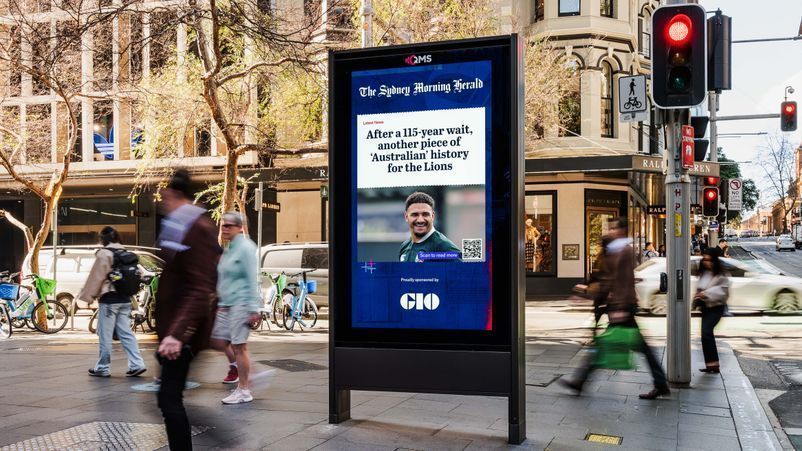
As previously reported by Mi3 last year, a world-first out-of-home advertising study conducted by QMS with Amplified Intelligence on attention challenged assumptions that OOH is a ‘glance-only’ medium. The two-year study found ads captured an average of 12 seconds of total attention, with 90 per cent of QMS sites tested securing more than 2.5 seconds of active attention. OOH was also found to be 5.9 times more likely to deliver above the attention memory threshold than other digital channels.
Gallon also points to the symbiotic nature of choosing media with impact, aiming for perpetual scale and “sweating the storytelling”. “That’s really important, because you need to have that emotional storytelling,” she says. “There are a lot of decisions we’ve been making to try and eke out everything we can, that we think is the right thing to make the most of everything we’re doing.”
What we actually found was that the media spend and attentive reach didn’t have a huge amount of interrelationship or correlation with consideration. We then started to go a bit deeper to look at things like attentive decay: How quickly does engagement decrease, and what are the active number of seconds that each asset go? And how do we really tap into that to get an understanding of what channels do and how that impacts the mix? That had really strong correlation to consideration. We know consideration is one of the greatest drivers towards business outcomes for TA, so that was something we could measure towards.
Media spend and reach versus attention decay
UM meanwhile, looked for the interrelationship between media spend, attentive reach and then consideration.
“What we actually found was that the media spend and attentive reach didn’t have a huge amount of interrelationship or correlation with consideration,” Mellington says. “We then started to go a bit deeper to look at things like attentive decay: How quickly does engagement decrease, and what are the active number of seconds that each asset go? And how do we really tap into that to get an understanding of what channels do and how that impacts the mix? That had really strong correlation to consideration.
“We know consideration is one of the greatest drivers towards business outcomes for TA, so that was something we could measure towards. And it helped us identify where the opportunity of quality and attention were coming in to make deliberate decisions based on where we saw the engagement of decay decrease or the attention decade, and also the number of active viewers per second. Those things were really important.”
Happily for UM, validation work showed 87 per cent of the media mix it put forward for TA was well-correlated for consideration.
“It meant there was 13 per cent [left over that wasn't consideration-correlated] we had then to look to optimise and make more effective,” Mellington reports. “On the one hand, it was great the theory was validated through this. The other part for us was saying great, it’s not 100 per cent perfect, so what did the other 13 per cent look like? And how do we make sure we make deliberate choices in our mix to close the gap on that?”
That doesn’t mean raw reach just gets downgraded either. “Even when you’re having a look at attentive reach, that’s having a look at the selection to quality based on that adjustment in the CPM,” Mellington explains.
“But when you actually need to trade on that media as well, raw reach is still critical to look at, because that’s going to be the total number of exposures. With the total number of people reached versus attentive reach, there’s going to be an element in there that either has passive or low attention based on total reach. So what we’re doing is closing that gap. But we still need to look at both.
“While attentive reach is the understanding of the quality that goes into the media and media decisions, raw reach is still a function of understanding where scale is going to come from – that total audience reach. We would still share both with the client; we would be very, very clear on saying, 'we have optimised on attention, these are the quality metrics we put into it in order to understand that. Therefore your composition looks like this, and it’ll be different to a standard reach-based buy'. But you still trade on both because those numbers are not mutually exclusive and do interconnect.”
The complexity of trading and media mixing
As Gallon and Mellington keep stressing, attentive reach isn’t as simple as just gleaning a media mix that’s based on raw reach levers, versus a different one generated by attentive reach factors. Put simply: There is no silver bullet, magic number or even comparable number to anyone else, judging from what they say.
It’s not just channel doing all the attention legwork, but how everything comes together, says Gallon. Nelson-Field has previously argued there are inherent patterns of behaviour underpinning different media channels before any creative has a chance of gaining attention, passive, active or otherwise. Add in category nuance, spend, frequency, the fact distinctive brand assets are playing a critical role in existing or building mental availability, creative storytelling and emotion, and you have a heady mix of factors for the impact ‘attention’ is going to have for a specific brand or organisation.
“The role of each of the different channels, the synergies between the different channels and how they help as well makes it a tricky one to answer,” Gallon says. “But it’s about how can we make sure we’re thinking about the context, that we’re thinking about the storytelling of all of the channels, and how we can garner any more sustained attention in any place through storytelling as well.”
Pile on top of that market mix modelling (MMM), full funnel models (FFM), IAS and other category data points and you quickly wind-up with output that’s very different – even if the methodology is the same for different brands, Mellington says.
The theorists are additionally talking about passive attention being okay in some cases. “That might be true if you are this huge brand with really easily identified brand codes and consumers just instantly go into system 1 thinking, and know what it means,” responds Mellington. “Therefore, passive attention is enough to prompt an action because of all the inherent equity you’ve already built in that brands. Brands that don’t have as much equity would need active attention – if there’s more complexity in the message, or more need to embed brand codes.”
Data evolution
For ‘Come and say G’day’ chapter two, Gallon is seeing comparisons of raw versus attentive reach in the tools, then owned learnings around what TA has been doing and performance across a range of metrics. Yet even with all this maths, data and modelling, there haven’t been any major surprises for Gallon and the team, nor a channel play or frequency that that clearly stood as a win – or a less-favourable option.
Further progress is coming is in the data sets. A couple of years ago, attention methodology and the data available was largely around screens, and some countries had more data available than others. That’s a notable factor given TA has five core markets it targets – the US, UK, China, India and Japan – and went into 15 international markets with its first ‘Come and say G’day’ campaign play.
“There’s more and more data becoming available and we’re able to update and replenish these data sources and what we do,” Gallon comments. “We looked at a whole range of things, such as stuff like viewability, things we could use as proxies for mental availability, or short-term sales, or how consumer journey and destination influence channels across the journey.”
UM is also putting out bespoke research out on the total channel ecosystem so “we don’t limit ourselves to one screen or another, one channel or another”. “It’s broadening that to a total channel mix, which is really important for clients,” Mellington says.
Just take the work by Felipe Thomaz at Oxford said Design School, which stresses there’s no silver bullet that’s going to be applicable to all brands or media efforts. In a recent interview with Mi3 on his work, based on analyses of 1,000-plus campaigns and a further study looking at a million customer journeys via Wavemaker and Kantar data, Thomaz notes there is layer upon layer of nuance to consider across channel and category beyond reach and possibly frequency too.
“In some cases, marketers or even agencies are looking for what is the right answer for everything all the time and I don’t know if that exists,” Mellington says. “Everything we’re doing is creating a propensity or indices for something to be more effective than another decision.”
All this explains why Mellington doesn’t see attention in any way as a complete project either and says metrics and data sets continue to evolve. “At the moment, we’re testing some new methodologies as well in this space to make sure we’re continuing to be at the forefront of what quality and attention means,” he says.
But thanks to early adopters like TA, and investment into these methodologies, attention is at least becoming a quality check in media planning.
“Inherently we know anyone can buy cheap reach, but is that going to be effective? There’s a bit of a misnomer sometimes that effectiveness and efficiency of the same thing. They're definitely not,” adds Mellington. “When we talk about trying to be more effective through attentive-based media, and we've got ways and methodology ensure we're moving more in that attention space in a really well validated way, it’s not a difficult sell.”