Nine to decide in ‘next few weeks’ on ad tier for Stan; CEO Matt Stanton says $50m slated for unified consumer tech platform and AI as free-to-air TV revenues set for ‘low single digital decline’


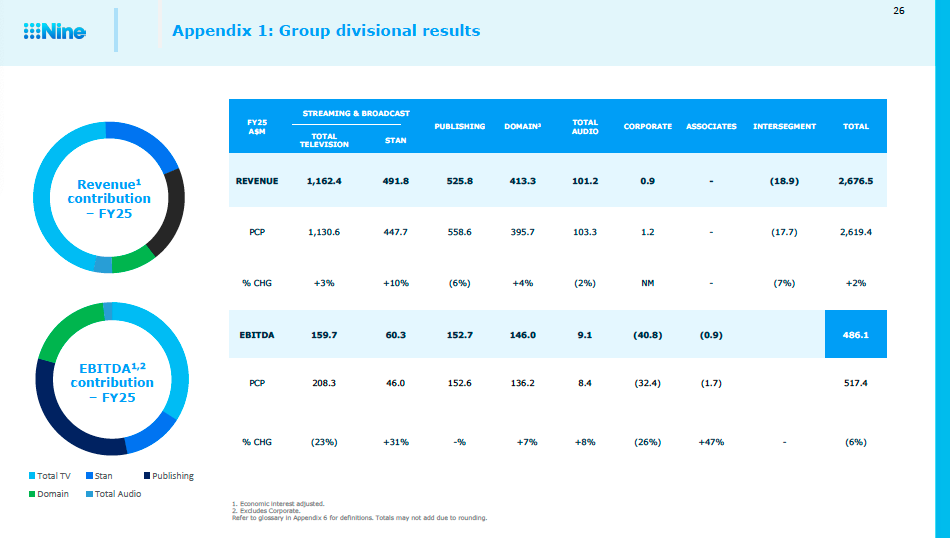
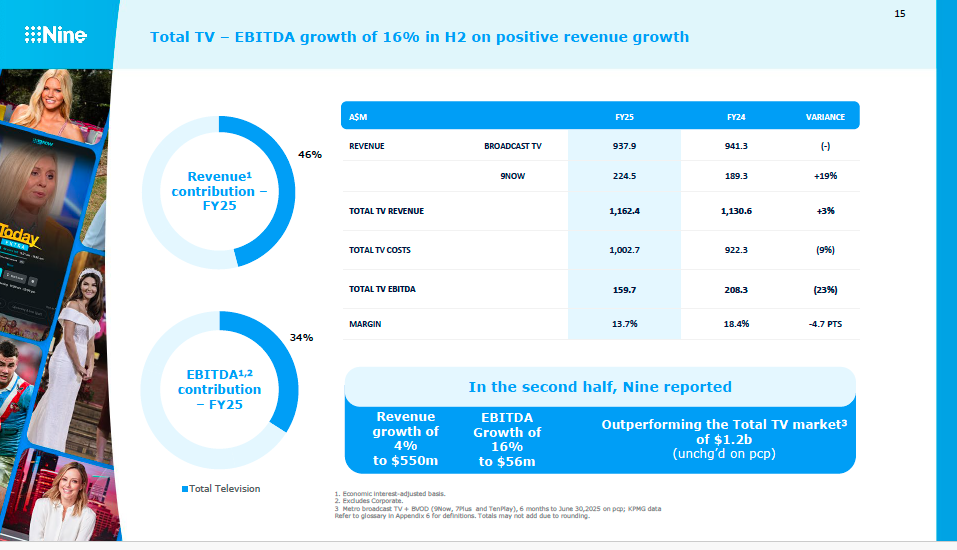
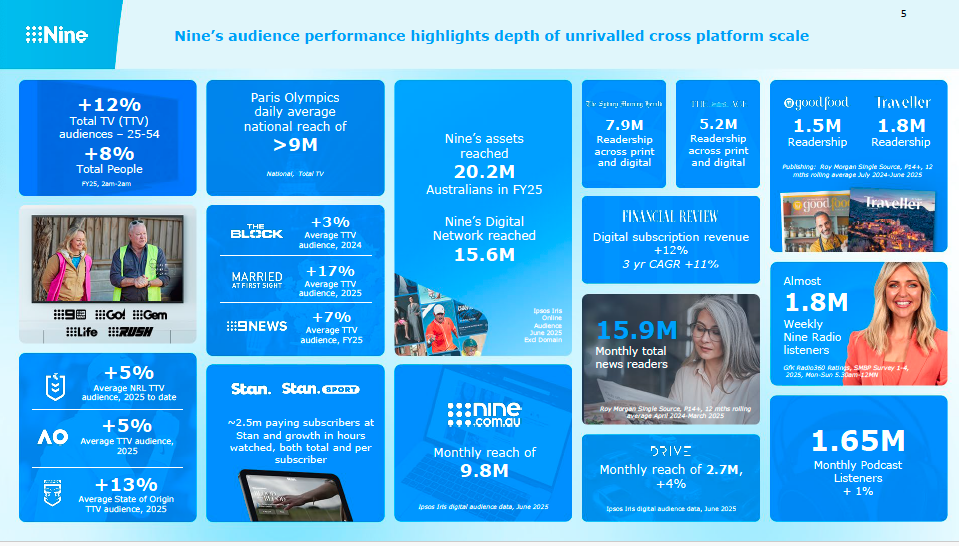
Amid sober signals from a leading media agency group set to revise down its ad market forecast from 2-3 per cent growth to a likely decline in the coming year, new Nine CEO Matt Stanton fronted his first annual earnings results yesterday. Nine's group revenues increased by 2 per cent to $2.7bn for the 12 months to June while net profit was down 10 per cent to $194.4m on the previous year. Stanton told Mi3 after a robust result for streaming service Stan – many commentators have predicted for years it would be the first scalp in a crowded subscription streaming sector – that a decision would be made in “the next few weeks, or month” on following global rivals to launch an advertising tier beyond Stan Sport, which it is testing. Stanton said Nine’s 42.5 per cent share of metro broadcast TV revenues for FY25 was an “all time high for any network” and Nine now accounted for a third of all content viewed on a TV set in the 25-54 age segment – including streamers, according to OzTam Streamscape data.
Share price jump
Nine shares jumped nearly 8 per cent yesterday to a 12 month high after CEO Matt Stanton fronted his first annual results announcement to investment analysts and told markets what they wanted to hear – an ongoing cost out program, a special 49c dividend from the sale of its Domain stake and diversification away from advertising markets – nearly 40 per cent of group revenues were now generated from activities outside of ads.
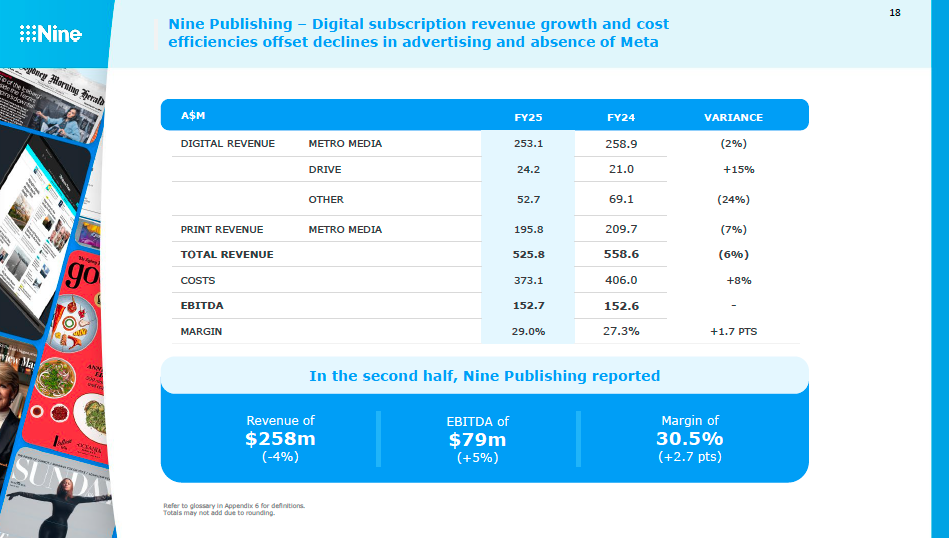
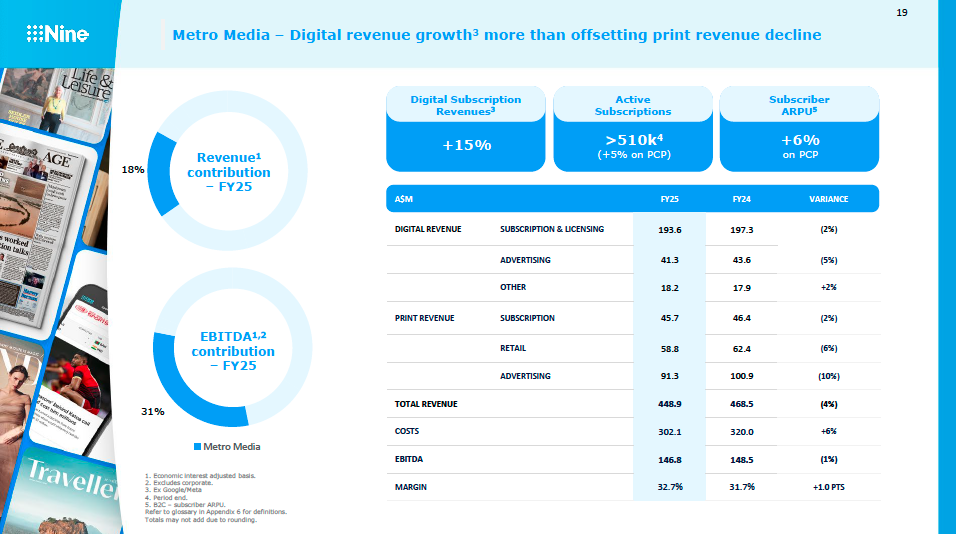
Subscriptions across Stan and publishing were at record levels – masthead subscription revenues were now offsetting declines in print advertising – and Stan was generating record audiences with its expanding sports assets including the English premier League and experimentation with entertainment shows from Nine’s ad-supported platforms like Love Island UK.
Like Seven earlier this month, Nine clocked a rise in TV advertising market share among commercial broadcasters to a "record 42.5 per cent", meaning Paramount’s Ten network is under sustained pressure. Paramount is said to be considering a material shake-up of its advertising operations.
Stanton pitched a solid growth story for the group for the current financial year – digital ad revenues, total TV audience growth and non-advertising revenue diversification were offsetting declines in free-to-air TV – but he was sober on the short-term advertising outlook.
Advertiser spending "back massively"
The sentiment was shared by the CEO of a leading media buying group who said advertisers from automotive to FMCG were holding back to such an extent they did not expect any “course correction” would be strong enough to counter spending declines in July, August and likely September.
“A lot of our client’s [advertising] billings are massively back,” the executive told Mi3 on the condition of anonymity. “The [market] growth we forecast won’t happen – it will be lineball, maybe back a bit. I just did budgets, I could have listed 30 clients who are back on billings. Money is tight.”
Stanton nodded to July and August for Nine which was “down a lot” in advertising revenues but primarily because of comparables on the same period last year in which Nine had the Paris Olympics. September for Nine would be a clean window without any of the “silly stuff going on, if you like, on comparables”, Stanton said.
Still, Brian Wieser, a US-based specialist media, advertising and marketing services holding company analyst at Madison and Wall, said while Nine’s results were solid, broadcast peers in the US, were “freaking out” because global platforms like Amazon, Google and Meta and retail media were posting big increases in their annual advertising take – in other words, broadcasters were losing marketshare in the overall TV and video advertising sector.
Double hit
“What we can say with some degree of certainty is certainly in the US, the overall TV advertising market is down a little. The incumbents [broadcasters] are down by a lot,” Wieser told Mi3. “Television, including anything that we would call TV, so not including YouTube but including Amazon Prime, Netflix and so-on, those ad markets are flat to down around the world, including the upstarts [global subscription streaming services that have launched ad businesses]. The upstarts grow and take share and the problem is the incumbents [broadcasters] are losing a lot of share.”
Wieser said established broadcasters, even with digital streaming assets, were facing a double hit – global streaming platforms were taking share in the TV sector and in the broader ad market beyond TV and video, where growth was in the “high single digits” was going elsewhere.
“It’s going to the digital platforms full stop.” Wieser said. “But also retail media is doing really well inside of it. It's not just Google, Meta and Amazon, TikTok, Reddit and Pinterest - maybe not Snap right now - it's the common thread. It's not that they're monopolists or duopolists – that narrative has been incorrect for quite a while - but global platforms become the one stop-shops and they’re just in a better position to capture share of markets and wallets.”
Freaking out
The response from US broadcasters then? “They’re mostly freaking out,” says Wieser. “They fear for the future of the business because their owners typically are not making meaningful enough investments in the businesses and there's no strategic direction. I think you could point to some degree that’s for everyone who's got traditional TV assets. The individuals in charge of the advertising businesses are doing what they can to grow incrementally but no one's doing anything to easily change the dynamic among the incumbents. It’s not that the businesses go away at all, and in most cases, they can have viable businesses. It's just the growth has to come from non-advertising sources and maybe the profit margins aren’t as good as they used to be.”
In Australia, short of a radical overhaul which some say should include a unified broadcaster content and sales platform to take out costs and build sector-wide scale, Stanton yesterday said Nine was going for scale in its own right across multiple media categories to stay competitive.
Integrated consumer platform
Conjecture over possible acquisitions of Southern Cross Austereo or QMS were batted off as Stanton said Nine would continue to invest in a single tech platform that housed logged in audiences across publishing, streaming and audio.
“We are expediting the investment in our integrated consumer platform, aiming to bring all of our users together with one single sign-on, one consumer data platform,” Stanton told analysts yesterday. “We are upskilling our analytics capability and our AI deployment both of which are expected to create opportunities across content and advertising across a year. Nine will increase its focus on organic investment opportunities, focusing on further accelerating Nine's group strategy using the power of the Nine group to deepen our connection with audiences and advertisers. Nine is in a great position to capitalise on our assets, whether it be additional growth assets of the AFR, The Age SMH and Stan, or our total TV assets, which have which have growing audiences.”
But he said “we continue to have to remind the market that across streaming and broadcast, Stan and Nine continue to command more TV screen viewing than any of the international streamers and free video channels. We are Australia's leading content provider across multiple platforms and have a great opportunity ahead of us. We own the preeminent content assets in Australian media, which are increasingly working together in ways that no one can replicate…we will continue to make and distribute the content which shapes Australia's culture and society.”
Stan ad tier
On plans for an ad tier on Stan beyond Stan Sport, Stanton told Mi3 former Foxtel exec and managing director of Nine’s streaming and broadcast unit, Amanda Laing, was “doing the work as we speak around that over the next few weeks or month or so and then we’ll make a call on doing it.”
Timing, Stanton said “if we were to do it” was more an issue around technology readiness. “There’s a bit of tech work to be done” and would be an “FY 26” ambition if it proceeded, he said.