Power of positive emotion on changing behaviour: SafeWork NSW switches compliance-led comms for who matters most; shrinks wear out, lifts consumer actions and saves $8.25m
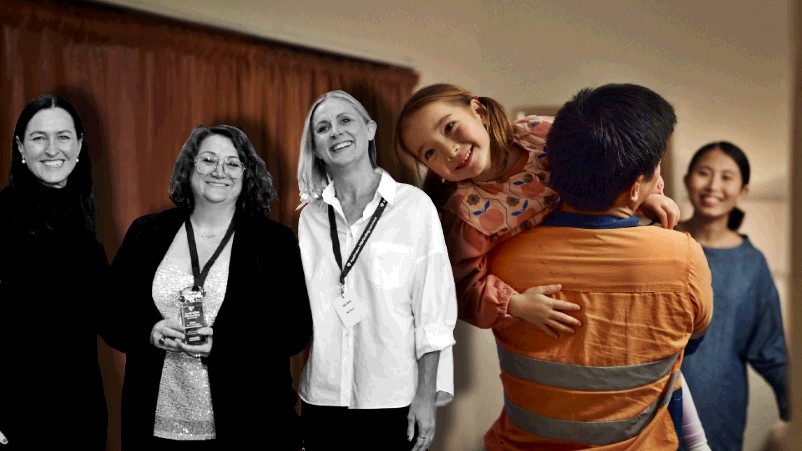
Department of Customer Service NSW's Taline Megerditchian (centre) and Melissa Scully (right) with AMI acting CEO, Kathryn Illy (left)
Rethinking the compliance narrative of safety communications, and channelling the power of positive emotion instead, has given SafeWork NSW one of its best-performing campaigns – and lowest creative wear out – to date. The $3.8m campaign investment is part of a multi-year platform that leverages emotion rather than fear to connect with Australian workers, while addressing both the rise in physical workplace injury as well as growing instances of psychosocial harms. It’s already paid dividends through the funnel, from 50 per cent reach to digital engagement lift, behaviour change and an estimated multi-million-dollar reduction in serious workplace claims. Having won two gongs at the recent Australian Marketing Institute Excellence Awards, including Marketing Campaign of the Year >$1m, the marketing and media team at Department of Customer Service NSW share the evidence-driven approach taken to bring the creative and communications to life.
Audience fatigue around compliance-led messaging, plus a surging list of workplace safety challenges, have proven powerful incentives for SafeWork NSW to emotionally recharge its campaign approach.
The resulting $3.8 million ‘SafeWork NSW Irreplaceable Advertising Campaign’ has been both a commercially sound and industry respected investment. Twelve months on, it’s paid back big dividends, from campaign recognition and record-low creative wear out through to engagement and web session increases, a rise in consumers taking positive action, and an expected $8.25 million in lifetime savings via reduced serious safety claims. These results also saw the Department of Customer Service NSW team score two gongs at this year’s Australian Marketing Institute Excellence Awards: Marketing Campaign of the Year >$1m, and Data & Insight Driven Marketing Campaign of the Year.
As SafeWork NSW manager for communications and media, Brooke Newstead explained it, the campaign came out of growing workplace safety challenges in NSW. “While awareness of workplace safety obligations was already reasonably high, workplace fatalities, serious injury claims and psychosocial harms were continuing to rise,” she told Mi3.
In 2024, 48 workers in NSW lost their lives, and the average number of fatalities reported in NSW over the past three years hit 52. Mental health-related claims have equally been steadily ticking up. It’s prompted the NSW Minns Labor Government to outlay $127.7m investment between 2025 – 2029 in order to address psychosocial hazards and compliance and enforcement of safe work practices. The Government also last year established a SafeWork Commissioner to give SafeWork NSW more executive agency.
Evidence revealed it wasn’t necessarily a lack of knowledge that was the culprit, but a “lack of motivation to consistently act safely”, Newstead said. But the Department of Customer Service NSW team had also become all too aware that audiences have become increasingly fatigued by compliance-led messaging – arguably, taken to record heights during the Covid-19 pandemic.
“People have understood the rules, but workplace pressures, cultural norms, time constraints and a belief that ‘it won’t happen to me’ meant unsafe behaviours continued,” commented Newstead. “At the same time, psychosocial risks such as bullying, harassment, stress and burnout were often normalised or left unaddressed.”
Research pointed in one clear direction: “The strongest motivator wasn’t regulation or enforcement. It was the desire to be there for the people who matter most,” said Newstead.
From fear to emotional attachment
That insight was the catalyst for the ‘SafeWork NSW Irreplaceable Advertising Campaign’, running in two major bursts across 2025 (29 June – 6 September then 19 October – 20 December 2025).
Department of Customer Service manager of marketing and strategic communications, Jacqueline Stuban, said extensive qualitative and quantitative research was the first port of call and encompassed workers, employers, CALD communities, First Nations audiences and different occupational groups.
“One of the most powerful findings came from in-depth interviews where participants were asked to imagine not being there for their loved ones because of a workplace incident or psychological harm. The emotional response was immediate and consistent across audience groups,” she said. “Behavioural research also showed workplace safety is often undermined because the rewards of taking shortcuts are immediate, while the consequences feel distant or unlikely. We knew we needed to make those consequences feel personal, relevant and emotionally salient in the moment decisions are made.”
Notably, SafeWork’s latest work broadened the aperture to mental and psychosocial harms that have not been as defined in terms of workplace safety issues historically. The campaign’s narrative arc became centred in the idea that while work is important, what people value most exists beyond work.
“The people waiting for them at home became the emotional anchor for behaviour change,” said Stuban. “Our strategy deliberately brought physical safety and mental wellbeing together under a single platform.”
The ‘SafeWork NSW Irreplaceable Advertising Campaign’ was crafted in partnership with agency partner 303 (formerly 303 MullenLowe), and emphasises absence over injury. OMD was the media partner. It’s been designed as a large-scale, integrated behaviour change platform, with year one focused on motivation and emotional storytelling to build salience.
The first tranche ran across TV, cinema, online video, YouTube and radio – prioritised as channels “because they allowed audiences to experience the full emotional power of the creative”, said Department of Customer Service director of customer marketing, Taline Megerditchian.
“From an investment perspective, the campaign represented one of SafeWork NSW’s most significant behaviour change initiatives. More than $3.8 million was invested across creative and media between June and December 2025, reflecting the scale required to reach all the workers and employers across NSW and elevate psychosocial safety alongside physical safety,” she said.
The campaign is also SafeWork NSW’s most diverse campaign to date, with 56 assets and tailored content created to connect with Aboriginal and Torres Strait islander audiences as well as Hindi, Arabic, Thai, Vietnamese, Mandarin, Cantonese and Korean-speaking communities. To help, SafeWork tapped Multicultural NSW and Aboriginal Affairs NSW to ensure authenticity in its messaging.
It’s clearly a marked departure creatively from traditional workplace safety advertising, which has heavily focused on compliance, enforcement, rules, physical injury consequences and fear-based messaging.
“We opened in eerily empty workplaces, creating a sense that something wasn’t quite right,” continued Stuban. “Viewers were left wondering what had happened. The tension built until we revealed workers returning home safely to the people who love them. That shift from uncertainty to relief creates a powerful emotional moment.”
Choosing a haunting rendition of well-known song, ‘You are My Sunshine’, also proved effective in delivering both emotional tension and warmth. “What makes the campaign different is that it doesn’t rely on shock, graphic injury or fear. Instead, it positions workplace safety as an act of care,” said Stuban. “That’s a much more enduring and personally meaningful motivation.”
One of the biggest learnings was the power of positive emotion in behaviour change. Safety communications have traditionally relied on risk and fear, but this campaign demonstrated that hope, care, connection and responsibility can be equally, if not more, effective motivators.
Campaign impact: Reach, believability, action and savings
That resonance has shown up in the campaign tracking and performance data. Nearly 90 per cent of audiences found the campaign easy to understand, 86 per cent said it was believable, and 79 per cent felt it to be personally relevant. Wear out was just 7 per cent, a very low score, which the team said demonstrates the strength and sustainability of the creative platform.
Reach was another key priority, and the workplace campaign reached 50 per cent, more than double the benchmark of 21 per cent, placing the campaign in the top quartile of social and government campaigns. Recognition was higher with workers (56 per cent) and rose to 75 per cent across First Nations audiences.
For Stuban and her team, what was even more encouraging was the behaviour change evident around things like safety behaviours, prioritising wellbeing, speaking to others about workplace safety and looking for additional information. Notably, the proportion of workers and employers who reported taking action towards safety lifted from 76 per cent pre-campaign to 81 per cent post-campaign. And agreement that workplace safety is everybody’s responsibility reached over 90 per cent.
Digitally, website sessions increased from about 86,000 to more than 232,000, and mental health-related visits grew from just seven prior to campaign launch to almost 4000 during the campaign period. An independent economic assessment by Inform Economics estimates the campaign long-term could generate $1.70 in social return for every $1 spent. Based on projected reductions in serious workplace claims, this equates to about $8.25m in lifetime savings and prevention of about 25 serious safety claims, said Stuban.
“We learned that audiences are ready for a more contemporary definition of workplace safety,” she said. “One of the biggest learnings was the power of positive emotion in behaviour change. Safety communications have traditionally relied on risk and fear, but this campaign demonstrated that hope, care, connection and responsibility can be equally, if not more, effective motivators.”
Most importantly, this isn’t a one-off campaign but a strong long-term behaviour change platform, said Stuban. The plan now is to apply learnings more broadly across public sector communications, and as SafeWork NSW focuses on capability, compliance and workplace action.
“Lead with human truth, build emotional relevance first, and then connect audiences to the action you want them to take,” said Stuban.
For the whole team, it’s clearly been a rewarding exercise to work on a campaign that has such real-world benefits and meaning.
“We’re incredibly proud of what has been achieved so far and are committed to building on this momentum, continuing to evolve the platform and drive lasting change that helps create safer, healthier workplaces across NSW,” Stuban added.