
A brand blessing and a curse: Reinventing what going on Contiki means for Gen Z – and why they needed their own micro-drama to earn the right kind of attention
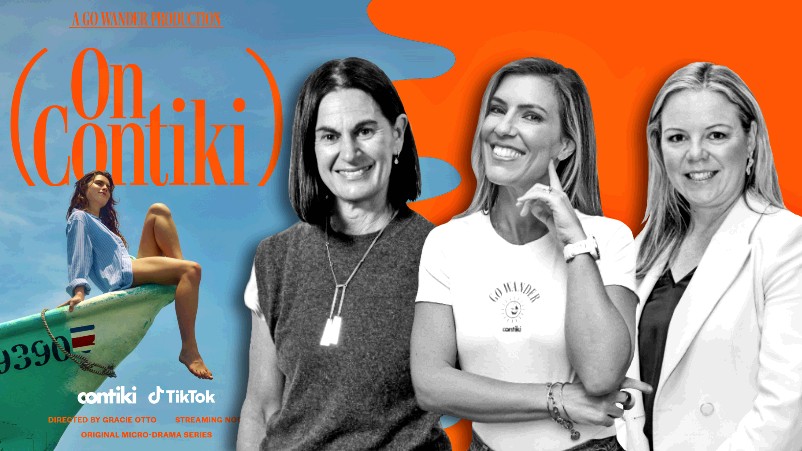
From left: Publicis' Simone Waugh, Contiki's Toni Ambler and Havas Media's Kate O'Ryan-Roeder
“It’s both a blessing and a curse”: Going on a Contiki European jaunt in that well-branded bus has been a rite of passage for young Aussies for decades. But confronted by a fresh-faced Gen Z batch of travellers exhibiting distinctly different preferences, brand awareness levels and changing tastes, the now private-equity-owned business has kick-started a complete reinvention to shake off its Single-track spirit, stretching from rebuilding products and experiences it serves up to new brand stories. Cue an owned micro-drama series, 76 reimagined or new trips, eight newly constructed travel worlds to encourage repeat touring, a revamped website experience that takes Netflix personalisation as its model, and a whole new brand story under the moniker Go Wander.
When you’re consistently chalking up +94 or +95 on customer satisfaction surveys, you could be forgiven for thinking you don’t have a problem delivering experiences consumers want.
But the burning platform for Contiki was there. With only four years left before millennials “age out” of its 18-35-year-old customer target market, and a fresh generation of Gen Z travellers with decidedly different preferences to win over, The Travel Corporation Oceania MD and chief customer officer of Contiki, Toni Ambler, knew it was time to rethink the brand, products and services to better match the next generation.
“Contiki has very high brand awareness, particularly in Australia, which is both a blessing and a curse,” Ambler tells Mi3.
Being known for that “won and done”, multi-European city party bus is a hard reputation to shake, she admits. But shake it, Contiki must.
“We are known for a very one-dimensional way of travelling, which is that Europe, multi-country trip; it’s quite fast paced and there’s a lot happening. That’s a good time for some, but not for everybody. The question became: How do we break that perception of what we’re known for?” she asks.
“Because we have seen it organically evolving in the last five to 10 years. We’ve launched Asia, we launched Latin America trips. Asia has had 40 per cent growth in the last couple of years for us. Organically, our travellers have been self-selecting other modes of transportation or how they want to see the world, group size or destinations.
“This was a really pivotal moment to take stock of what our product offering is.”
We have seen it organically evolving in the last five to 10 years. We’ve launched Asia, we launched Latin America trips. Asia has had 40 per cent growth in the last couple of years for us. Organically, our travellers have been self-selecting other modes of transportation or how they want to see the world, group size or destinations. This was a really pivotal moment to take stock of what is our product offering.
Go Wander
The business and brand transformation Contiki is debuting in market this week is the largest in its 64-year history and comes after parent company, The Travel Corporation, was picked up by private equity firm Apollo Global Management, two years ago. In all, 18 brands were acquired, including Contiki, Trafalgar, Insight Vacations and Boutique River Cruises. Terms of the deal weren’t made public.
The comprehensive relaunch strategy was informed by an extensive research project conducted by The Lab involving a mix of proprietary qualitative and quantitative research across Australian Gen Z and millennial respondents. It included those who have travelled overseas or are considering travelling within the next two years.
Among the key findings: Three in four Australians aged 18-34 are planning their next overseas trip in the next two years, with 88 per cent driven by the escape and freedom promised. In addition, 75 per cent travel for growth and perspective. In a positive sign for Contiki, 71 per cent of young travellers think positively about group travel and the ability to connect in real life, with deepening friendships more important than ever. Tapping further points of insight, the same themes emerged of escape, freedom, personal growth, new perspectives and discovery.
“One of the big things that came out of the research was that this generation [Gen Z] are really well travelled; they grew up with their parents going on holidays, they’ve done a lot of short haul to New Zealand or Asia,” Ambler comments. “Travel is very much about defining who they are as a person, and they want to do as much as humanly possible. We as a brand needed to evolve to meet the needs of the changing demographic.”
Yet even with Contiki’s 18-year target window, there are distinct differences. While those under 25 are driven more by self-discovery as they explore the world, over 25s are looking for escapism from their growing list of responsibilities.
This age versus generational nuance was raised by Visa principal economist for Asia-Pacific, Dr Simon Baptist, during a recent event presentation for The Trade Desk clients and agency partners. While travellers show similar wants and needs across age demographics (younger travellers are more adventurous and might bungee jump, for example, while older travellers commonly prefer to lounge by the pool with a cocktail), there are also different drivers, interests and fundamental beliefs influencing how generations view and want to experience travel over the youth that came before them. The big ones are social media and hobbies: “When Gen X was young, social media was not a driver of whole interest; that is a fundamental shift over time,” Baptist told attendees.
Contiki and its agency partners, Publicis Australia and Havas Media, describe it “as a travel generation of two truths”. Gen Z are budget conscious but prioritise experiences; they’re balancing living for now with planning for the future; and they’re hustling hard but prioritising mental wellbeing.
“On the one hand, they want all of the freedom in the world to travel, and obviously, it's all about exploring new, discovering themselves and having that freedom,” Publicis Australia MD, Simone Waugh, says. “But then at the same time, it's having that structured freedom that really still does appeal to them, and also the social connection. They want all of this individuality and discovery, but then what they're missing in life: Connection. They've come through an era where they're so connected but so disconnected. As we know, travel is so human. These [guided trips] enable them to form new connections and be with people. That obviously cuts across categories, but it’s really relevant to this group as well.
“As you grow up, you go into the workforce, you start getting responsibility, and your travel needs change. We termed it this way: From 18 and into your early 20s, you're trying to discover yourself, and you're ‘becoming’. As you move up and through, travel is more about trying to get back to yourself; you're ‘unbecoming’.”
The new positioning
In response, Contiki’s new brand positioning, ‘Go Wander’ is being leveraged not just for go-to-market messaging, but also for its product portfolio and customer experience strategy. In all, 76 trips across Contiki’s total 254 products have been either overhauled or introduced, seeing Contiki expand itineraries across Asia, Africa and the Americas while also stepping into new destinations such as Fiji and the Maldives.
Eight new experience-led ‘Travel Worlds’ have also been imagined, oriented around the motivations and travel styles preferred by younger travellers. The category list includes smaller group-led experiences (‘Local’), active adventures (‘Outdoors’), tropical escapes (‘Islands’) festival going (‘Festivals’), a luxury travel style (‘Luxe’), and bucket-list experiences (‘Highlights’).
It’s also a product play that helps drive repeatability. “As you evolve your travel as well as your interests, you can go from travel world to travel world – you might do an outdoors trip, then you might next go to another destination on a local trip,” says Waugh.
A further influencer Ambler points to is the rise of Airbnb as well as the commoditisation of travel experiences and digitisation – all of which have convoluted Contiki’s competitive set. “We are now competing with the DIY traveller and fighting to earn back their attention and their share of wallet when they’re choosing to do travel,” she comments.
Positioning Contiki as a company that’s ‘humanising’ travel is therefore another key piece for Ambler. “Technology is a big part of this brand transformation, but we see it as a way to make the brand and travel experience easier and more accessible. But human is the part of travel that will always be extraordinary, and that’s what our focus is: Bringing people together, and still having those trip leaders as that point of difference.”
Micro-dramas and campaigning
To kick off the launch marketing campaign, Contiki has created its own vertical micro-drama, On Contiki directed by AACTA Award-winning Australian filmmaker, Gracie Otto. Set in Costa Rica, the eight-part series follows four travellers in Contiki’s sweet spot age brackets as they build friendships, tackle adventures and discover more about themselves.
It’s a deliberate manifestation of the spirit of ‘Go Wander’ for Ambler. It’s also clearly a social-first entertainment format that’s designed to interrupt audiences and grab their attention, while also sidestep the traditional tropes of travel marketing.
“The series was built from that true consumer insight that when you are on a trip, there is drama; there are people that get to know each other; there are very different people,” says Waugh. “There might be love triangles and relationships – I’m not saying that's always what's happening, but on trips things happen. It became so natural that this is what we would do to become part of entertainment.
“As we go forward, we’ll look at partnerships, plus how we become part of culture versus trying to interrupt it in terms of talking at people. We hope to just become part of it. That's the unlock for us for growth.”
In complement, Havas Media has built out a globally integrated media strategy oriented around youth culture that factors in paid, owned and earned. The earned-first communication strategy was built out by Herd MSL. Havas Media ANZ CEO, Kate O’Ryan-Roeder, says its partnerships with TikTok and Google opened access to global and category firsts and blur the border of offline and digital media in its quest to convert young travellers.
“The micro-drama is such a beautiful way to gain and seek their [Gen Z’s] attention in a way that provides them something, but then sparks inspiration and discoverability,” O’Ryan-Roeder says. “It then starts them on that journey to reappraise or rethink what they had known about Contiki previously.”
Ambler points out Contiki retains strong brand awareness in Australia, particularly with a millennial audience, but that’s progressively being challenged with Gen Z.
“First and foremost, it’s about intercepting that audience in a more compelling way than anyone else can do in the travel category. But perception and consideration are the big ones for us,” she says.
“The brand is known and loved: We have a 94 per cent NPS score, but only a 20 per cent repeat score. So there's a real disconnect for us to bring people back into the funnel. We'll use Travel Worlds for that in many instances, but I also think On Contiki will position the brand in a way that people who are probably non-considerers might actually start to consider it.
“What's really special about this series for me is that it is true to the product. When the guys put it in front of me of the script, I said, oh my god, this is exactly Contiki … We're just bringing it to life with Gracie and this amazing cast.”
Underpinning all of this is a major measurement plan. “Once the campaign goes live, it will be daily monitoring to understand what messaging, what tactics, and what channels that we will need to optimise on a daily basis to get to the optimal point,” O’Ryan-Roeder says. “Again, the best thing about being a digitally native campaign, and having access to the whole ecosystem of owned and earned, is the number of data points we have and the wealth of information. It means we can make sure we are curating the best possible journey for each consumer.”
The plan is to spend the rest of the year talking about Go Wander, taking advantage of Black Friday / Cyber Monday to further drive product sales. During Q1 next year, the focus turns to bringing the Travel Worlds to life from a paid, owned, and earned perspective. During the 35-day shoot for the campaign, 35,000 pieces of footage were captured globally that will further help reimagine the brand, says Ambler. A series two of its micro-drama is also envisaged, provided series one lands as hoped.
Digital transformation
It wouldn’t be a business transformation without technology either. Ambler points to a two-year digital overhaul that’s also been underway. Working with Publicis, it’s designed a library of page templates and individual reusable components, then used to design and build 750 pages for the new website launch, covering content, individual trip pages and activity and campaign assets. Per Google Analytics data, Contiki is engaging about 1.5 million monthly active users and delivering over 2.8 million monthly page views.
A new design system and a new user experience has been created to eliminate the friction points, from inspiration through to booking. “We can understand more about the consumers as well as they engage on the site,” says Waugh. “We call the new site the ‘Netflix of travel’, as it will learn … from you, it will be useful back to you, and it will help you through the journey.”
Buy-in and impetus
The beauty of the program of work Ambler and her agency partners embarked on was that it had the backing of Contiki’s new owners from the outset.
“We’ve been on this transformation journey with them about how we significantly grow the business, because again, there was the fact base to suggest that young people travelling the world and their social environment is definitely relevant,” continues Ambler. “Even though we’re going through this generation of ‘AI-fication’, the brand remains incredibly important to how young people want to see the world.”
One challenge she faced was operational teams seeing the strong CSAT results and thinking all is well. “When you’re looking at it from an operational or delivery lens, you’re thinking, ‘hold on a second, nothing’s broken, so why would we change it?’ But the team at the forefront of listening to potential customers, not current customers, knew something had to change,” she says.
Winning internal buy-in has been about bringing those teams closer to the customer through insights, and explaining that while Contiki might have one core customer base it’s serving, it needs to think and act differently if it wants to grow and deliver on growth expectations.
“Working with the Publicis teams to really understand who the customer is, what they want, how they’re changing and playing that back to the organisation helped – you can’t argue with what the customer is saying,” Ambler says. “I just think we had such a successful business model for so long, that maybe we lost focus.”
Ambler also points to her agency village as a huge help.
“It’s very rare you get to work on a true end-to-end transformation,” adds O’Ryan-Roeder. “It’s not just a marketing transformation. Secondly, it’s going to sound a little naff, but it’s collaboration right? From the outset, Toni and her team have run integrated agency briefings. We know from the get-go that we all hear the same information. We all then do an agency scrum afterwards and work out what’s going to be our approach. We’ve moved fast, and we’ve moved a hell of a lot to get to launch point, but we got there because of the integration.”
O’Ryan-Roeder believes it’s also allowed her team to work in a much richer way with publishers and media owners. “We haven't just bought the spots and dots. Most of what you will see when it comes to market is new innovative formats and first to markets we've co-developed with not just the publishers but with Simone’s and Toni’s teams … And paid is one part of that whole ecosystem with owned and earned. It was about how to stitch up the whole ecosystem to really build that journey.
“We’re bringing the data and the insights we have to Simone's team and connecting to the beautiful work that they've done, so we can really match media to make sure it's audience fit-for-purpose, but also content and format fit-for-purpose.”
Waugh agrees it does not matter that the teams are from different agency groups. “We are heavily invested in its success, even from a commercial standpoint – every week, we know where the sales are shifting and heading, what source markets are doing. We're in that, and we're ready to respond to that as a team. That's what Toni needs us to do.”
Adding to this was the solid fact base that sat behind landing ‘Go Wander’, says Ambler. “We were having these conversations around AI-fication and what does that mean for our business long term, then one of the strategists on Simone's team said, ‘Well, the only way to truly wander free is with someone who knows the way’. I jumped at that,” she says.
“It came together so seamlessly, so that when we sold it into Apollo, it was a slam dunk.”
