Australia’s power trio retailers chase same prize: AI to cut costs, loyalty to lock in spend, media to boost margins; Cartology and Coles 360 nudge $1bn in retail media as Wesfarmers makes move
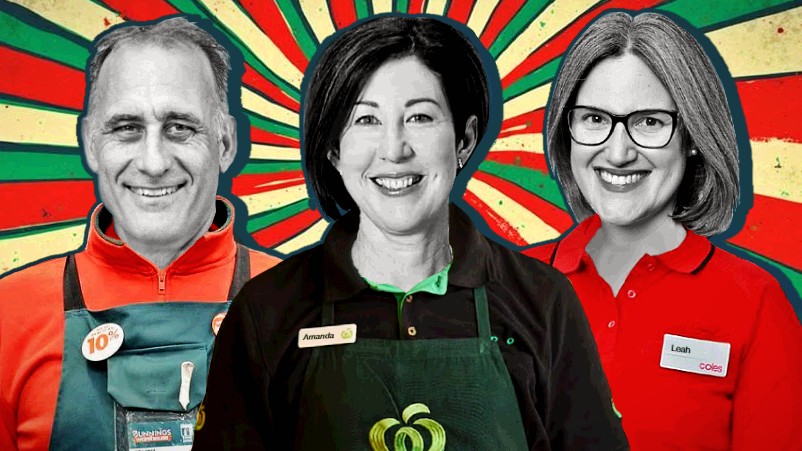
Wesfarners Rob Scott, Woolworths Amanda Bardwell, and LColes Leah Weckert

Scouring the FY25 earnings reports and analyst calls from Coles, Woolworths and Wesfarmers suggests they are executing the same transformation playbook: automate the logistics, industrialise the data, weaponise loyalty, and turn shopper attention into a high margin media asset – with Coles and Woolworths now likely writing $1bn in ad revenue combined. Wesfarmers is playing catch-up on media, but is beginning to execute a group-wide plan in earnest.
What you need to know:
-
Coles, Woolworths and Wesfarmers are morphing from grocers into data platforms. All three retail giants are investing heavily in AI, automation, loyalty and retail media to lift margins as traditional supermarket growth flattens.
-
Per financials, Coles delivered modest topline growth but strong efficiencies. FY25 group revenue rose 3.6 per cent to $44.4bn, but underlying EBITDA climbed 10.7 per cent on the back of $327m in cost savings driven by machine learning and automation.
-
AI is driving Coles’ cost-cutting and shelf decisions. Advanced analytics now inform rostering, markdowns, call centre ops and store-specific product ranging, lifting relevance and stripping complexity from aisles.
-
Retail media has become core to Coles’ strategy. Coles 360 posted 13.5 per cent growth as brands shift spend beyond shelf space to pixels. Media margins are proving more lucrative than groceries.
-
Subscriptions and loyalty are tightening Coles' grip on customers. Flybuys active users hit 9.9m, with Coles Plus membership more than doubling, boosting swipe and redemption rates.
-
Woolworths is in a reset after a profit slump. NPAT fell 17.1 per cent to $1.38bn, with BIG W and core supermarkets under pressure. Shareholders took a 21 per cent dividend hit as new CEO Amanda Bardwell pledged a return to growth.
-
Automation and AI remain central to Woolworths’ rebound. Over the last year, new fulfilment centres came online, while machine learning is now embedded across scheduling, picking and logistics, with digital barcodes enhancing stock control.
-
Retail media unit Cartology saw revenues surge, jumping 19.5 per cent, with 20,000 in-store point of sales screens and app video ads turning Woollies into a serious media player. It now reports directly to the CEO as loyalty, insights, and media converge.
-
Everyday Rewards is proving a critical profit engine. 70 per cent of food sales are now linked to loyalty accounts, with data being leveraged across pets, travel, EVs and financial services. Analysts say Woolies is “becoming a more pixelated business.”
-
At Wesfarmers, FY25 net profit rose 14.4 per cent to $2.93bn, helped by solid Bunnings, Kmart and Priceline performances. Behind the scenes, it's pouring cash into OnePass, OneData and Hammer Media.
-
Hammer Media is Wesfarmers’ belated retail media play. By leveraging in-store screens and loyalty data across Bunnings, Kmart, Priceline and Officeworks, the group aims to rival Cartology and Coles 360 for FMCG ad spend.
-
OnePass, meanwhile, is emerging as Wesfarmers’ flywheel. The cross-banner loyalty and subscription program is driving digital sales and setting the foundation for unified customer targeting across a diverse retail empire.
-
Strategic convergence is clear. Wrap is all together and Wesfarmers has the building blocks of super-app that stitches together an otherwise disparate consumer ecosystem.
-
All three players are chasing the same prize: AI to cut costs, media to boost margins, loyalty to lock in spend.
A common theme, which supported a lot of [our cost savings], was the use of AI and other technology automation to improve the effectiveness and efficiency of processes. Our focus on continuous improvement and cost control has been a muscle that we have built now over many years, and I would say it is certainly embedded in the way in which we operate.
Shoppers may think they are simply opening their wallets and divvying up their hard earned between Coles, Woolworths and Wesfarmers. In truth, they are choosing between algorithms. Australia’s retail titans still stack shelves and sell beans, but their earnings calls reveal a deeper convergence: each is racing to rewire itself as a data platform, an AI laboratory and a high margin media business.
Inflation, flat wages and fickle customers have dulled grocery growth. Yet margins are being propped up not by higher prices, but by machines.
Coles boasts of automated distribution centres and record savings from algorithms that decide when to roster staff or mark down produce. Woolworths, bruised by weak supermarket profits and a misfiring discount chain, is leaning just as heavily on automation. That includes robotic fulfilment centres, machine-guided picking and AI-optimised transport routes. Wesfarmers, more famous for weekend sausage sizzles at Bunnings, is pumping millions into OnePass loyalty, OneData analytics and group-wide retail media venture.
Each firm insists it is still a retailer, but their numbers suggest they are becoming software firms with supermarkets (in the broader sense of the word) attached.
The high margin money lies not in groceries but in pixels. Woolworths’ Cartology is morphing into a media operator with ad screens in stores and on apps. Coles’ 360 unit is reporting double-digit growth as brands pay for targeted reach. Wesfarmers, belatedly, is selling Hammer Media to advertisers, hoping the data exhaust from Kmart, Priceline and Officeworks will look as enticing as grocery baskets. The strategic bet is clear: profit from retail media and loyalty data are far juicier than shifting frozen peas.
Despite stylistic differences – Coles emphasises thrift, Woolworths speaks of “reset,” Wesfarmers dresses it up as omnichannel ambition – the strategic hymn-sheet is strikingly similar. All three are betting that AI can strip cost and complexity from supply chains, that digital subscriptions and loyalty schemes can secure customer wallets, and that media spin-offs can capture an increasing share of advertising budgets, both from existing suppliers, and new advertisers that don't sell directly through their stores.
In effect, Australia’s trio of retail giants are converging into the same platform model. Whether investors see three distinct champions or a single herd following the same scent is another question.
Space in our stores is a scarce resource. And … we are using advanced analytics to ensure we have the right range and the right space for the demographic of every store, which is a good outcome for our customers and a good outcome for Coles.
No price gouging, and fewer ciggies
Coles has delivered a modest but telling set of numbers. Group sales revenue for the year rose 3.6 per cent on a normalised basis to $44.4 billion. Earnings growth was stronger: underlying EBITDA rose 10.7 per cent and EBIT 6.8 per cent. Net profit after tax edged up 3.1 per cent to $1.18 billion. In a grocery market dulled by inflation, rising costs and consumer caution, that is more than just a defensive performance.
While it may be a popular idea amongst cash-constrained consumers, the uplift was driven not by price gouging, according to Weckert, who said the ACCC’s inquiry earlier this year cleared the majors of that charge. Instead, she attributed increases to volume growth, tighter promotions and relentless focus on value. Coles claims shoppers responded to fewer but deeper discounts and an expanded range of everyday low price lines. Tobacco, once a fat margin contributor, has been in structural decline and now accounts for less than 3 per cent of supermarket sales, down from 8 per cent in 2019. Partly this is due to the impact new legislation around tobacco sales, and partly due to the increased competition from "illicit sellers". The bottom has apparently fallen out of the nicotine game.
The result: supermarkets earnings rose 8.3 per cent on an underlying basis, lifting EBIT margins by 22 basis points. Liquor was more subdued, up just 1.1 per cent in sales, though Coles is betting its “Simply Liquorland” simplification will eventually lift returns.
For investors, dividends rose slightly to 69 cents per share. Not stellar, but steady.
Automation arms race
The real story lies beyond the tills. Coles is wagering heavily that automation, AI and a rebuilt supply chain will protect margins and create new engines of growth. Its “Simplify and Save to Invest” program banked a record $327 million in cost savings in FY25, largely through machine learning and analytics. Algorithms now handle rostering, markdowns and call-centre automation. Coles is shooting for a billion in savings from Simplify and Save to Invest, as CFO Sharbel Raymond Elias reminded analysts on the call.
"It was a four-year program where we were targeting $1 billion over the four years. We generally target about $250 million a year. Some years we do a little bit better, and FY '25 was a great case in point where we delivered $327 million, but other years a little lower, " he said, noting that at the halfway points, the savings tally hit $560 million of benefits.
"We'll obviously look to do more where we can – we see $1 billion as a bit of a floor, not a cap. But I would also just caution that $327 million was a fantastic result. And yes, it would be ambitious to think we can deliver that again in '26."
Per Raymond Elias, "That doesn't mean we aren't going to try, but I would be generally working towards a target of more than $250 million or thereabouts."
More visibly, Coles has transitioned fully into its new automated distribution centres (ADCs) at Redbank in Queensland and Kemps Creek in New South Wales. A new centre at Truganina in Victoria, is under construction. These robot-stacked hangars have delivered 20 per cent higher in-store availability in their catchments than in states reliant on manual warehouses. And the Customer Fulfilment Centre's (CFC) are also delivering return, according to Weckert who said CFCs are now contributing to strong growth in ecommerce sales.
"During the year, CFC fulfilled sales growth exceeded the already strong growth in our overall e-commerce channel. Perfect order rates were more than double the national home delivery rate. The range in our CFCs is already 33 per cent larger than our average in-store range and includes new SKU in nonfood, Global Cuisines and Big Pack Value categories."
She added, "We also have over 2,500 SKUs where we offer a minimum life so that customers can be confident to afford purchase for the week. And all of this has led to a significant uplift in customer satisfaction."
And customers are evidently happier said Weckert, "We have seen improvements in store level NPS (net prompter scores) in CFC catchment areas as a result of less congestion in store."
Automation is not just about penny-pinching. Severe weather and competitor supply-chain disruptions tested Coles’ network; the ADCs allowed rapid recovery, demonstrating resilience as well as thrift. Cost per carton benefits are “in line with business case”, according to management. In short: robots are becoming the backbone.
Taming complexity
Supermarkets created their own monster: SKU bloat, endless promotions, and store congestion. Now they are turning to AI to tame it. Coles has rolled out store-specific ranging across more than 40 categories, guided by advanced analytics. That means different shelves in Toorak and Townsville, reflecting local tastes.
Weckert explained: “Space in our stores is a scarce resource. And … we are using advanced analytics to ensure we have the right range and the right space for the demographic of every store, which is a good outcome for our customers and a good outcome for Coles”.
The aim is fewer duplicated products and more relevance. Range optimisation in categories such as soaps and body wash removed clutter, simplified Coles’ own-brand offering, and boosted sales. It is a quiet but profound shift: supermarkets are using AI not to dazzle, but to restore simplicity to aisles groaning under excess choice.
Changes made during a tough economic autumn also promise more upside when the green shoots of spring return. As interest rates ease and, hopefully consumer sentiment perks up, the ability to align range, price and promotions with neighbourhood demographics may prove decisive.
From grocer to media empire
Retail media has become a core strategy. Coles 360, its in-house network, increased income by 13.5 per cent. Brands now pay Coles for pixels, not just shelf space.
The economics are compelling. Retail media commands the kind of high double digit margins that supermarket beans never will while CMOs like the targeting, agencies like the promise of closed-loop attribution. The big two grocers are fast becoming chunky media businesses, as well as monetising shopper data and high-intent audiences outside of their own physical and digital walls. Fully connecting shopper and loyalty data to power advertising both on-network across its businesses and off-network (i.e. for targeting on YouTube or broadcasters' BVOD platforms) offers the prospect of significant further growth.
Like rival Woolworths, Coles does not break out the dollar contribution of retail media, though analysts like Morgan Stanley have suggested in 2023 its revenues were circa $250m. If that's correct, and assuming low double digit growth since, Coles 360 added north of $300m in media revenue during FY25.
Either way, Weckert sees "a big opportunity for us in the year ahead" from Coles 360 – despite key executives like Paul Brooks exiting the business, alongside Sam Hegg leaving to head retail media at Wesfarmers-owned Bunnings. Since then, specialist agency Retail MediaWorks' Redworks team has been brought fully in-house, effective as of this week, while Coles has embarked on a sweeping overhaul to bring instore retail, Coles 360 retail media, digital – including online commerce – and customer together under former Coles Liquor CEO Michael Courtney.
"We are looking to bring on more assets and improve some of our measurement and reporting capabilities this year," said Weckert, "which we think is going to continue to support really good growth in that space."
Taming supply chains
Coles’ rhetoric of “strategic partnerships” with suppliers masks a harder truth: greater transparency often means greater control. Private-label ranges now exceed 970 products in supermarkets and 196 in liquor. Coles Finest grew revenue 13.6 per cent, a result Anna Croft, Coles Chief Commercial & Sustainability Officer, described as a "standout result, " and further suggesting that, "we've got a significant amount of headroom going forward to grow the brand."
Suppliers may welcome long-term contracts and grants from Coles’ Nurture Fund, but they also face tougher terms and tighter oversight. The balance of power is shifting. In an era of data-driven demand forecasting and automated warehouses, the question is whether Coles’ suppliers will share in efficiency gains, or simply feed a margin machine.
Subscriptions, loyalty, and the Netflix effect
If automation is Coles’ muscle, loyalty is its wallet. Flybuys active members rose 4.4 per cent to 9.9 million, with swipe rates up 6 per cent and point redemption up 13.3 per cent The Coles Plus and Coles Plus Saver subscriptions more than doubled.
Weckert told analysts: “Through our Coles Plus and Coles Plus Saver subscriptions, membership more than doubled and we saw a 6 per cent increase in Flybuys swipe rate and a 13 per cent increase in customers redeeming Flybuys points through a Coles supermarket”.
Subscriptions are a subtle play. At one level they lock in spend through delivery perks and discounts. At another, they provide recurring revenue, the holy grail of retailers seeking to emulate Amazon Prime. As more customers shift their grocery budget into subscription ecosystems, Coles is inching toward what might be called the Netflixification of groceries.
It is early days. But should subscriptions become habitual, Coles will own not just baskets but wallets, smoothing volatility and lifting margins. That is a strategic shift CMOs and strategists will watch closely: loyalty programs are evolving from promotions to platforms.
The more a member engages with us, the higher the advocacy and loyalty to our retail banners. This delivers more value back to our members, and they reward us by spending more on their food budget with us.
Grinding the gears
Woolworths generated $69.1 billion in sales, up 3.6 per cent on a normalised basis, and with sales growth in all operating segments. But strip out the effect of PetStock which Woolworths acquired in January 2024, and the result is a little more parsimonious, with growth dropping to 2.9 per cent. Overall, EBIT slid 12.6 per cent to $2.75 billion and NPAT fell 17.1 per cent to $1.38 billion. The main culprits were Australian Food and Big W, which delivered lower EBIT.
According to CFO Stephen Harrison, "This result includes a number of one-off impacts."
So what went wrong at Australian Food and BIG W? The former battled industrial action, wage inflation and rising support costs. The latter slipped into loss, weighed down by clearance stock and a misfiring apparel offer.
Impairment charges also tell the story. A $346 million impairment on BIG W sat atop $17 million for Healthylife and $52 million for MyDeal’s closure. Restructuring costs added $146 million.
Normalise these impacts, and group EBIT was down approximately 8 per cent, meaning shareholders took about a 20 per cent haircut on the dividend. That triggered trading that dropped Woolworths share price by almost 16 per cent. Management insists FY26 will deliver a return to growth. For now, Australia’s largest retailer is in reset mode: cutting costs, reshaping its portfolio, leaning hard on data, automation and retail media to offset pressure in its core supermarkets.
Amanda Bardwell, CEO since February, put it bluntly: “A number of challenges during the year resulted in a financial performance that was well below our expectations and those of our shareholders”.
There were bright spots. New Zealand food delivered a 40.6 per cent EBIT surge as rebranding to Woolworths and fresh-focused transformation gained traction. PFD’s wholesale arm and PC+, the group’s logistics service, both posted double-digit earnings growth. Everyday Rewards, Cartology, Mobile and Insurance now account for an increasingly material share of group profit. In a year where the main course disappointed, these sides carried the family meal.
Algorithmic grocer
If last year was about blunt cost-out, this year is about smarter efficiency. Machine learning models shortened personal shoppers’ picking paths in stores by 15 per cent, per the firm. Algorithms now determine transport windows and crate fill, trimming logistics costs. Digital date code management is improving stockflow by using 2D barcodes and dynamic inputs.
That's good news for Woolworths' ecommerce business. According to Bardwell, "We do believe that we can continue to improve the profitability of our eCommerce business with a number of different things. Of course, it's scale, but it's also the opportunity that we have to continue to optimise the way in which we pick and pack and deliver our orders for customers."
She noted that in the past year, the company made substantial improvements in picking paths across its network, following the introduction of additional algorithms.
Automation is scaling too. The Auburn customer fulfilment centre (CFC) in Sydney opened in May, capable of handling 60,000 orders a week. Moorebank’s vast automated distribution centre came online earlier, with a chilled and fresh facility at Eastern Creek in train. A new automated Melbourne North CFC is planned.
AI is not being hyped as a shiny side project but embedded into Woolworths’ retail grind: scheduling, routing, picking, pricing. The pitch to investors is pragmatic, algorithms as tools to sharpen execution rather than headline-grabbing moonshots.
Retail media: Cartology’s clickable empire
Cartology, Woolworths’ in-house media arm, has become a significant media business in its own right. Revenue jumped 19.5 per cent and Bardwell called it "a highlight." The rollout of 20,000 in-store screens, coupled with video ad inventory on the Woolworths app and homepage, gives FMCG suppliers closed-loop targeting from trolleys to touchscreens.
That level of growth is significant, because Cartology dipped to 9 per cent revenue growth in FY24 amid increasing competition from the likes of Coles and Amazon, with the latter's ad business blasting past $240m for the 2024 calendar year.
If Morgan Stanley's estimates that Cartology was booking circa $550m in 2023, are correct, that suggests the business is now closer to $750m in revenue.
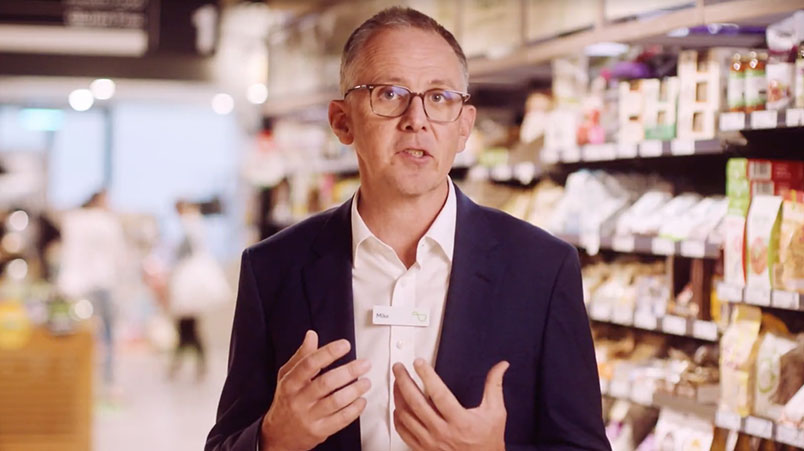
Mike Tyquin, now not only running Cartology but also overseeing insights, media and loyalty monetisation across the group, has been elevated to report directly to Bardwell. That signals that Woolworths wants to fuse data, media and rewards into a single commercial front door for brands.
Cartology’s positioning is delicate (just as it is for all retailers piling into media): To suppliers, it must look like a partner offering premium media and customer connection rather than imposing a mandatory toll. For Woolworths, it is already one of the fastest-growing profit engines, and a hedge against squeezed supermarket margins. If Tyquin and the business can fully join the dots between the data, the media, the stores and the business silos, it could be a billion dollar business sooner rather than later.
Loyalty and data: The real profit driver
Everyday Rewards continues to expand, with half a million new members added in FY25 and more than 70 per cent of food sales now linked to loyalty accounts. Per Bardwell, that linkage is gold, "The more a member engages with us, the higher the advocacy and loyalty to our retail banners. This delivers more value back to our members, and they reward us by spending more on their food budget with us."
Or put simply: higher engagement delivers higher advocacy, higher spend and, crucially, more monetisable data with recency baked-in.
The program is also broadening: partnerships in pets, financial services, travel and even EV charging. Campaigns like “Boost Your Budget” delivered $8 million in member value, while 750,000 members banked almost $90 million to spend at Christmas, per the firm.
For Bardwell, the message is clear, loyalty is the the cornerstone of customer strategy. Everyday Rewards, coupled with Cartology’s media arm, is becoming a flywheel that drives both sales and supplier spend.
Deadwood
Woolworths has begun cutting underperformers, MyDeal gone, Healthylife repositioned, ReFresh shuttered. BIG W will shift to its own tech stack. Above-store support office costs are being slashed, with $400 million in savings targeted by end-2025. Redundancies have already bitten, part of what Bardwell called a “discipline of making every dollar count”.
For customers, the narrative is more cheerful: lower shelf prices on 500 staples, deeper specials, and clearer ticketing. Food inflation has moderated and average prices have now declined year-on-year for six consecutive quarters.
Still, customer trust is not yet fully restored. As Bardwell admitted, “current trading remains below our ambition”.
Supply chain transformation
Meanwhile, the supply chain overhaul is reaching its crescendo. Auburn and Moorebank mark the completion of a $2 billion-plus investment in automated fulfilment. Eastern Creek’s semi-automated fresh DC and the planned Melbourne North CFC will add chilled and rapid capacity.
These are not just steel and robots; they underpin Woolworths’ promise of sub-60-minute deliveries and more resilient availability. Already, over 40 per cent of delivery orders are fulfilled within two hours, and sub-60-minute e-commerce sales tripled year-on-year. That plays directly to Woolworths’ claim on convenience and on the new competitive battleground of ultra-fast grocery.
But the transformation comes at a cost: $110 million of dual-running expenses in FY25, with a similar slug expected in FY26. The payoff is forecast for FY28, when double-digit returns on the automated network are expected. Until then, investors will have to accept thinner margins in exchange for future productivity.
Outlook: trust, tech, and tradeoffs
FY26 will be transitional. Australian Food is expected to return to mid- to high-single-digit EBIT growth, supported by cost savings and cycling of one-offs. New Zealand should continue its rebound. BIG W is forecast to scrape back into positive EBIT.
The strategic question is less whether Woolworths can stabilise, most analysts assume it can, than how far it can push into higher-margin, capital-light businesses. Retail media and loyalty are scaling fast. Automation will deliver productivity gains. But the heart of the business remains the weekly shop, apron strings and all.
Like its duopolistic rival, Woolworths is increasingly less about stacking shelves, more about stacking data. The risk is that in chasing new profit pools, the company dilutes its focus on price, range and service, the basics that win or lose the family meal.
For now, Bardwell’s Woolworths is trying to hold both truths: supermarket as service, and supermarket as platform.
Wesfarmers continued to enhance its omnichannel assets and capabilities during the year. The divisions increased their use of data analytics and AI to digitise their operations, which supported growth and operating efficiency.
Tidy top line
Wesfarmers, the $45.7 billion conglomerate that owns Bunnings, Kmart, Officeworks and Priceline, delivered full-year net profit of $2.93 billion, up 14.4 per cent on last year. The statutory uplift, fattened by asset sales, masked a more modest 3.8 per cent gain in underlying profit. Yet the result underscores how a business better known for sausage sizzles in car parks and hardware aisles is quietly positioning itself as a digital and data player.
Behind the weekend barbecue smoke, Wesfarmers is building OnePass, OneData and Hammer Media. That's the scaffolding that may one day resemble a super-app.
Managing director Rob Scott put it plainly: “Wesfarmers’ earnings growth in challenging trading conditions is a credit to our team members”. Revenues rose 3.4 per cent to $45.7 billion, earnings before interest and tax grew almost 12 per cent to $4.465 billion, and shareholders will collect $3.56 per share in dividends and capital returns.
The retail stalwarts pulled their weight. Bunnings sales rose 3.3 per cent, with earnings up 3.8 per cent. Demand for home repair and necessity products was resilient, while new tool shop formats rolled out to 175 stores. Kmart Group’s revenues climbed 2.9 per cent, but earnings surged 9.2 per cent thanks to system integration, supply chain digitisation and relentless cost control. Its app doubled monthly active users to 1.3 million, signalling a shift towards digital engagement.
Officeworks grew modestly (3.8 per cent sales, 1.9 per cent earnings), while Priceline’s parent, Wesfarmers Health, grew earnings by 28 per cent. The industrial arms struggled: WesCEF profits fell 9.3 per cent on weaker commodity prices; Industrial & Safety dipped 4.6 per cent, though Blackwoods’ reset is starting to stabilise.
One Pass, one reach?
Wesfarmers long-held strategy to build out a group-wide data, loyalty and retail media play is moving to the next phase of execution with a new leader at the helm. Leanne Balter is now leading the all-brand loyalty, digital and data division, OneDigital, after Nicole Sheffield last month stepped down.
The plan is to use group loyalty play OnePass to both drive more sales and cross-sell across the group, and then connect all that data in the back-end, (OneData) which can then be used within media plays by the likes of Bunnings, Officeworks, Target, Kmart and Priceline under a group-wide ‘OneReach’ umbrella – while also generating some revenue in its own right, at $40 per year per OnePass member.
Wesfarmers this year launched the Hammer Media network, with Bunnings first to go live, and other group companies set to plug-in.
Bunnings base layer
Meanwhile, Bunnings is no longer just a hardware shed but a matchmaker between householders and tradies – and that marketplace is growing.
In its filing, the company noted: "Strong digital sales growth across Bunnings’ online and app platforms reflected ongoing investment to improve the omnichannel customer offer. Bunnings’ marketplace continued to deliver double-digit sales growth and at the end of the second half, Bunnings launched a services marketplace connecting its customers to trades. The OnePass, Flybuys and PowerPass loyalty and membership programs continued to drive incremental sales, with Bunnings increasingly leveraging data and analytics to enhance the customer experience."
Bunnings MD Michael Schneider declined to directly answer an analyst question of whether the marketplace now represents a $100m revenue business, but said “the growth on it is spectacular.”
He indicated the model could potentially be integrated into other parts of the business.
“Where it makes sense to the business, we’re open to collaboration – we've seen that with OnePath, we're having similar conversations around retail media. So where things make sense then we do [collaborate] and where we need to compete with one another we do as well. And I think that's really makes Wesfarmers such a strong business at a group level. Our marketplace is performing exceptionally well,” said Schneider.
“I think we're uniquely positioned to optimise the incredible volume of traffic that goes through the Bunnings websites to drive that offer to customers. We launched our services marketplace recently, which is connecting trade customers with consumers to help them – and we think that that's going to be a great opportunity going forward.
“It's still not at materiality point, but certainly when we look at the market and then look at our performance, we're pretty satisfied with the growth and the contribution that marketplace is making.”
Invisible accelerant
Wesfarmers invested $63 million this year in OnePass, OneData and retail media.
But Hammer will need to prove that Wesfarmers’ audiences are as “shoppable” as grocery baskets. If the conglomerate can target a beauty shopper, a trade professional and a parent in a single ecosystem, it could credibly rival Cartology. But there are risks. A Bunnings trade buyer, a Priceline beauty shopper and a Kmart bargain hunter are very different customers. But if OnePass can stitch them together, it could hone Wesfarmers’ competitive edge in both commerce and media. But versus Coles and Woolworths, it's starting the race a long way back.
Dropped catch
Catch, the failed e-commerce acquisition, is gone. But its infrastructure lives on. Fulfilment centres have been folded into Kmart, enabling faster East Coast delivery. The costly misstep may yet become an asset, feeding Kmart’s upcoming curated third-party marketplace. The difference: where Catch was a volume free-for-all, Kmart’s new play emphasises trust, logistics and brand equity.
Officeworks also leaned into supply chain resilience, refreshing store layouts to highlight tech and print services. And Bunnings’ omnichannel investments boosted digital sales growth. The message is consistent: supply chains are not back-office operations but front-line competitive weapons.
Disciplined, but quietly audacious
The company expects cost pressures, labour, energy, logistics, to persist. Its answer remains productivity, automation and digitisation. The balance sheet is strong, capital discipline intact, dividends flowing and CEO Rob Scott sees some signs of a “modest pickup” in consumer sentiment and spending.
“We are more positive about the consumer outlook than we were six months ago. There's definitely some improvement there, but it's still early days,” he told analysts.
But the B2B market, he said, remains tough. Which is bad news for a big chunk of the broader media and marketing industry.
“The cost of doing business is still a challenge … We have over 1.5 million B2B customers across the group – whether its Officeworks, Bunnings, Blackwoods and even Kmart has a number of B2B customers – and B2B demand is still pretty soft …. But on the consumer side at least, we’re seeing some positive trends.”