
From hype to hard numbers: Wharton generative AI ROI study finds banking, tech and telco landing big wins, but retail, manufacturing – and marketers – are laggards

So, marketers, about that ROI
A landmark global benchmark from Wharton and GBK Collective finds 72 per cent of enterprises are formally measuring ROI from GenAI. The verdict? It's no longer about playing with prompts, it's about proving impact. Across sectors, the shift is seismic. AI has graduated from the CIO’s innovation playground to the CFO’s performance dashboard. From banking to telco, HR to marketing, the technology that once dazzled in demos is now being held to account in spreadsheets. And those sheets are turning green: 74 per cent of companies report positive ROI, especially smaller, faster firms. But larger firms are lagging – and across functions, marketing appears to be falling behind on AI versus the likes of finance, HR and operations.
What you need to know:
-
Generative AI hits ROI reality check with 72 per cent of enterprises now formally tracking ROI on GenAI projects. Of those, 74 per cent already reporting positive returns, per the Wharton-GBK 2025 global benchmark.
-
After two years of hype-fuelled pilots, businesses are demanding measurable outcomes, GenAI is now a CFO issue, not just a CIO experiment.
-
Smaller firms outperform lead their larger peers, benefiting from agility and faster integration, larger enterprises lag amid complexity and legacy systems.
-
Functions already fluent in metrics, like HR and finance, are proving GenAI’s value fastest; legal is furthest behind.
-
Senior execs are more bullish than mid-managers on GenAI’s payoff, raising flags over data visibility and operational disconnects.
-
Tech, banking, and professional services report strongest ROI; retailers and manufacturers still battling fragmented data and physical-world friction.
-
Usage metrics are no longer enough, instead firms want clear, quantifiable business impact is the new benchmark for AI investment.
-
Marketing leaders must translate creative output into business language. Think campaign velocity, content efficiency, incremental lift, if they want GenAI budgets to survive scrutiny.
Many marketers have kept an arms length from the technology, leaving it in the hands of their marketing operations or marketing analytics teams. AI is bigger than that. It can't be delegated to a few specialists.
Enterprises have stopped counting prompts and started counting profits. Two years after the generative-AI gold rush began, return on investment, and not raw usage, is the new currency of credibility for executives on Mahogany Row. According to the freshly released 2025 Wharton and GBK Collective study, 72 per cent of enterprises now formally track ROI from their GenAI programs. The authors say it is the world’s first benchmark to treat generative AI as a bona-fide business discipline.
Wharton/GBK's findings also puncture a much-maligned MIT study earlier this year that was widely reported as claiming that 95 per cent of Gen AI projects studied, failed. Much of the commentary was misguided. Many media reports simplified the findings of that study without clarifying that the figure referred to embedded, custom GenAI in enterprise workflows with measurable ROI against some very specific criteria. The MIT study itself distinguished general-purpose LLMs vs embedded tools.
At the heart of the Wharton/GBK's findings – part of a longitudinal study which began in 2023 – is the finding that after two years of feverish experimentation, enterprise leaders have stopped asking whether to use AI and started demanding what it’s worth.
Marketing's measurement malaise
Marketing, however, is flagged as the laggard. According to the study, while most functional areas saw double-digit gains in self-reported AI fluency year-on-year, marketing and sales expertise actually declined by six percentage points, making it one of the few disciplines to go backwards.
For an industry that prides itself on metrics, marketing is proving curiously reluctant to measure its own AI performance. The Wharton–GBK Collective study finds that when it comes to return on investment, the marketing and sales function lags behind nearly every analytical and operational peer.
Only 44 per cent of marketing teams track employee engagement or productivity through GenAI tools, compared with 54 per cent in human resources and 48 per cent in IT. Just 48 per cent of marketing departments measure profitability or losses specific to GenAI, while IT’s figure stands at 56 per cent. And when the focus turns to operational throughput, which is essentially the efficiency dividend of automation, the gap yawns wider: a mere 30 per cent of marketing leaders report tracking these gains, against 57 per cent in operations and 56 per cent in management.
The authors see the problem not as technological but cultural. “The implication of this finding may not purely correlate with higher usage but may also be impacted by functions that historically measure more things (e.g., KPIs, highly regulated industries),” they write. In other words, finance, IT, and HR have spent decades living under the tyranny of dashboards; marketing, less so.
This quantification gap matters. As generative AI spreads from creative brainstorms to campaign automation, the absence of credible measurement risks turning experimentation into theatre. While other departments are counting savings and throughput, marketing is still counting likes. Its generative AI adoption curve, the report implies, is flatter and more fragile than most. Expertise is slipping, measurement is uneven, and value capture remains patchy.
According to someone who has tracked the rise of martech more closely than anyone else in the sector, Scott Brinker, Editor-in-Chief of Chiefmartec.com, one of the issues likely driving is that despite the massive growth and proliferation of martech over the past decade, "Many marketers have kept an arms length from the technology, leaving it in the hands of their marketing operations or marketing analytics teams."
He told Mi3: "AI is bigger than that. It can't be delegated to a few specialists. To really tap its potential, it needs to be embraced in the culture and operations of the whole department. CMOs must be out front driving this transformation, insisting on more rigorous measurement of the impact."
According to Lucio Ribeiro, chief AI and Innovation Officer for TBWA, "Wharton–GBK confirms what many practitioners observe; while most functions have moved from flashy demos to data dashboards, marketing often remains biased in measuring outputs rather than outcomes, or short vs long, or quantity versus quality. For an industry obsessed with metrics, this is a paradox. The industry obsesses over impressions and engagement but less on throughput, efficiency, creative differentiation and distinction, or tangible value creation."
Ribeiro said access to AI tools isn’t the same as expertise.
"Judgment and taste remain the true competitive moat. Generative AI can’t live in the hands of a few specialists; it must become embedded into marketing’s operational rhythm. This transformation starts with leadership demanding rigour and focus, to avoid AI theatre and instead drive real AI transformation."
Expectations
The Wharton report makes it clear that generative AI has entered its accountability phase. Increasingly it is being treated like another other line item in the P&L. It is expected to prove its productivity in the same breath as cloud or CRM. For the first time, executives can put a number next to the promise. And that number, increasingly, is positive.
Among the key findings:
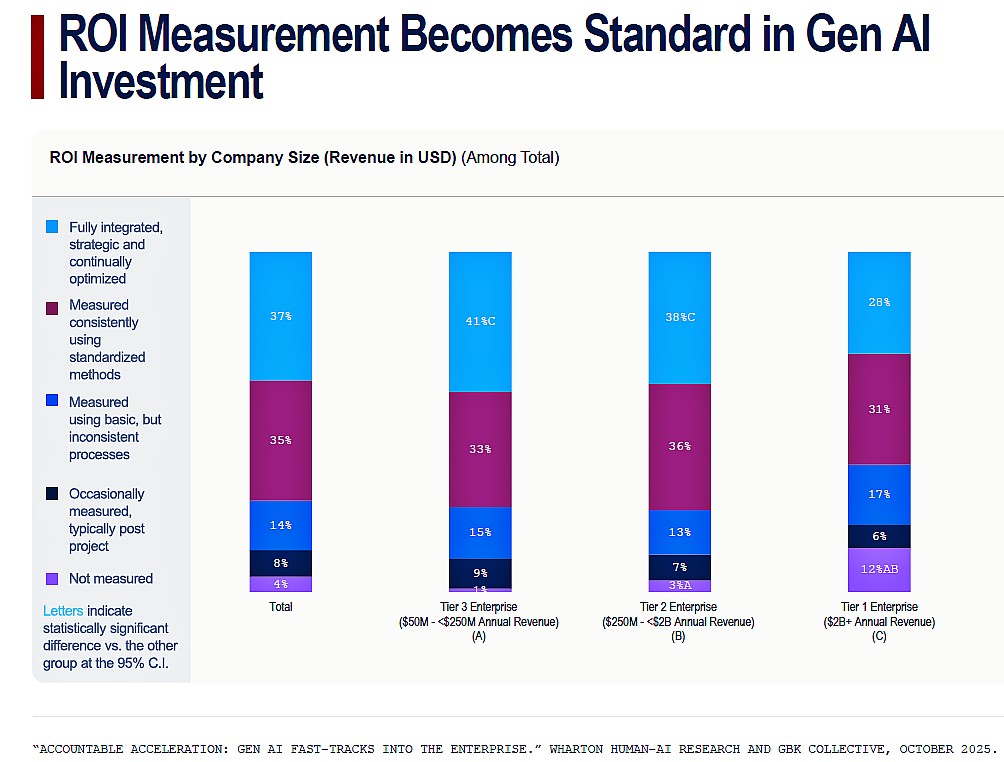
- Accountability is now the lens. While experimentation, excitement, and FOMO (fear of missing out) may have driven significant early Gen AI investments discussed in previous studies, measuring returns is now becoming standard practice. Nearly three quarters (72 per cent) of business leaders report tracking structured, business-linked ROI metrics (profitability, throughput, workforce productivity), optimising not just for adoption but for measurable outcomes.
- Impact is rising and conviction is building. Leaders anticipate that Gen AI will have a strong impact on their industry in the coming years (70 per cent expect a major or revolutionary impact).
- Long-term optimism about Gen AI is increasingly strong. Most (88 per cent) expect increased spend in the next 12 months (+16pp YoY), and 62 per cent anticipate >10 per cent growth over the next two to five years.
- Budgets are pivoting from one-off pilots to performance-justified investments, and although budget reallocation is not currently the norm, some leaders are beginning to fund AI by cutting elsewhere (11 per cent, +7pp YoY), with reallocation most often cited from legacy IT and HR & Workforce programs.
ROI landscape
The shift from experimentation to evidence marks a turning point. After two years of “FOMO-funded” pilots, the Wharton-GBK data suggest that generative AI is now being held to the same standards as any other business investment.
“About three-fourths of enterprises integrate formal ROI measurement into their business,” the study notes. Measurement itself has become a maturity signal: companies that track value tend to create it.
What’s being measured, however, is not uniform. Finance and HR functions with deep roots in process metrics are leading the quantification charge. “HR (84 per cent) and Finance (80 per cent) report the highest ROI measurement,” according to the study, while Legal lags well behind. In these functions, productivity, performance, throughput and profitability are the currencies of AI impact.
The metrics are tangible: time saved, tasks automated, output increased, and costs reduced. The same logic applies across industries. In the report’s words, “operations, IT, general management, HR, and finance/accounting have a higher average number of specific ROI metrics reported, while legal lags behind in measurement.”
In short, the people who already know how to count are the ones counting best.
For CMOs and marketing leaders, the signal is clear: ROI from generative AI can only be measured when it’s defined in business language. In the finance function, that means throughput and margin. In HR, it’s time-to-hire or compliance speed. In marketing, the corollary might be campaign velocity, content efficiency, or incremental lift, but few are yet measuring those outcomes rigorously.
The study positions ROI tracking itself as the new baseline for maturity: “Enterprises are no longer content with usage metrics alone, ROI measurement is now standard practice.” For years, adoption was a badge of innovation. Now, performance is the currency of credibility.
That pivot has elevated the CFO. Generative AI has moved from the CIO’s playground to the CFO’s dashboard, and marketers may soon find themselves explaining creative productivity in terms of measurable returns.
Who’s winning?
The headline number is unequivocal. “Many enterprises are already seeing tangible benefits in productivity and performance. Most already report positive ROI (74 per cent), particularly smaller players who move faster to integrate Gen AI into workflows,” the Wharton-GBK study finds.
Those smaller firms, classified as Tier 2 and Tier 3 in the study, are the surprise champions of the AI economy. “Tier 2 and Tier 3 enterprises report above-average consistent/fully-integrated measurements. Among functions, HR (84 per cent) and finance (80 per cent) report the highest ROI measurement,” the researchers note. Agility beats scale.
By contrast, the biggest firms, weighed down by layers of systems and committees, are still navigating complexity. “Tier 1 enterprises, despite larger budgets, are the most likely to say it’s still too early to tell, with about a quarter reporting that ROI can’t yet be determined. the study says.
The industry breakdown is equally telling. “Industries in the digital realm such as tech/telecom (88 per cent positive) and banking/finance and professional services (~83 per cent) are seeing more positive returns. Those more anchored in the world of real things, such as retail (54 per cent) and Manufacturing (75 per cent) industries are still able to prove significant value.
Put bluntly: data-rich, intangible industries are monetising faster.
According Ribeiro, "The study’s respondents are primarily from tech, telecom, and banking. Having done a lot of work in these sectors, I can say they naturally predisposed to early AI adoption. This means the broader 'mainstream' AI narrative might not fully apply to slower-moving industries like retail or manufacturing."
Still, across every sector, the tone the report finds is unmistakably more grounded. ROI measurement has become part of operational DNA. For most, the returns are real, if uneven.
Gimlet-eyed bosses
The further up the corporate ladder you go, the rosier the view of AI’s payback. Senior executives (VP and above) are far more optimistic about returns, with almost half (45 per cent) reporting significantly positive ROI. Their mid-managers are more cautious, with only 27 percent saying the same, according to the report.
Ribeiro noted the bias uncovered by the study. "First, there’s a clear leadership optimism effect: senior executives (VP level and above) consistently hold more optimistic views on GenAI’s progress, potential, and ROI than mid-managers. This 'vision bias' often contrasts with the practical challenges faced on the ground in driving adoption and change, rallying and galvanising people."
That optimism gap matters. Leadership enthusiasm can mask operational friction such as missing integrations, inconsistent data, or unmeasured rework. If AI’s biggest beneficiaries are the ones measuring least precisely, then “positive ROI” may be as much about perception as precision.
Still, for three-quarters of enterprises to report measurable upside within 18 months of mainstream adoption is no small feat. The digital transformation of the 2010s took a decade to reach that kind of consensus. GenAI appears to have achieved it in two.
The complexity challenge
For the laggards, the problem is not belief but plumbing. Wharton’s researchers are blunt: “Tier 1 enterprises, despite bigger budgets, more often report ‘neutral/too early’ outcomes (34 per cent) as they work through scale and complexity.”
The same pattern plays out in physical industries. “Retail (54 per cent) and manufacturing (75 per cent) are still proving value,” the report notes. Here, return on investment is hostage to the messiness of real-world operations such as fragmented data, legacy systems, compliance bottlenecks, and frontline adoption. The machines may be intelligent, but the organisations are not yet interoperable.
“Too early to tell,” cited by 25 per cent of Tier 1 firms, isn’t an admission of failure. Rather it is viewed as an acknowledgment of the learning curve. Measuring ROI at enterprise scale requires not just model accuracy but change management, telemetry, and disciplined accounting.
The study suggests a tension between speed and scale: smaller firms race ahead, but larger enterprises must build the scaffolding that allows sustained, compliant use. Their challenge is institutionalisation, not innovation.
There’s also the question of attribution. Generative AI rarely operates in isolation; it amplifies other tools and processes. In such cases, what’s the baseline? If a bank’s customer service times drop by 30 per cent, how much of that belongs to the AI summariser versus process redesign or staff retraining? The study does not resolve that question but it does make clear that enterprises are grappling with it.
ROI measurement, in that sense, is not a static accounting exercise. It’s a moving target that reveals the organisational capacity to link technology with outcomes. As the researchers put it, “Tier 2 and Tier 3 enterprises lead the way in positive ROI, showing that along with measuring ROI, the investments in Gen AI are paying off.”
This correlation between measurement discipline and payoff echoes lessons from earlier digital revolutions: you can’t manage what you don’t measure. The firms that built clear measurement architectures for digital advertising or CRM a decade ago are now the ones translating those muscles into GenAI governance.
From excitement to accountability
The Wharton-GBK study offers no hype, no hero narratives, and no grand promises of disruption. It delivers something rarer: evidence.
Across sectors, 72 per cent of enterprises now formally measure ROI, and 74 per cent already report positive results. The pattern is consistent: smaller, nimbler firms convert faster; data-rich industries lead; and CFOs, not technologists, are emerging as the new AI champions.
It’s tempting to see that as the end of the beginning, the moment when generative AI stops being a curiosity and becomes another line item in the P&L. Yet the data also whisper caution. Large firms are still wrestling with scale. Training and change management remain uneven. Mid-managers are more sceptical than their bosses.
For CMOs and customer leaders, the lesson is not that AI guarantees returns, it’s that measurement guarantees progress. Generative AI’s economic story will be written not in press releases but in dashboards: throughput, time saved, conversion lift, cost avoided.
As the report puts it, “enterprises are no longer content with usage metrics alone.” Nor should marketers be. Accountability is the new innovation.
