
'Our problem is not each other, our problem is bigger than that': ITV, Sky and Channel 4 launch outcomes-based measurement in one year – can Australia's TV networks match it?
Six months ago some of Australia's major TV players and media buyers backed a push to build a real-time, outcomes based reporting system that would put TV and streaming on an even footing with global platforms. Adgile said it could build the system within 12 months. The UK's major commercial broadcasters have done just that, without letting politics derail intent, because they recognise the migration of ad dollars to platforms poses an extinction-level threat. The beta version of Lantern is now live – and it will soon link with Universal Ads, the cross-broadcaster self serve ad marketplace, which brings SME brand and crucially, performance budgets into play. It's a huge opportunity – and a template – for those willing to unite for the future of TV.
Simply put, Lantern is an outcomes-based measurement solution created by three of the UK’s major commercial TV companies – Sky, ITV and Channel 4.
In a short space of time – just a year after revealing a proof of concept – the broadcasters have collaborated to build, test and launch a beta version. This is exactly the kind of innovation broadcasters need to protect and grow their businesses, and to get back into the room with clients.
What impresses me most isn’t just that Lantern tackles outcomes, but the speed of its launch, the fact that broadcasters didn’t let politics derail it, and the sheer level of granularity in the data, feedback loops and outcomes it can now deliver to advertisers.
As Ian Daly, AV Investment honcho at the UK's largest independent media agency The7stars put it:
"It’s hard to overstate the significance of all three major broadcasters coming together to bring Lantern to life. Valuable outcome measurement in TV depends on transparent, consistent and robust datasets – something only the broadcasters themselves can deliver at scale."
And only if they can work together.
For me, there are three key benefits to Lantern:
Performance spend and SMEs. As TV rightly pursues performance budgets and the SME market, it needs to offer data and insights on par with, or better than, the platforms.
Client access. Broadcasters have long struggled to secure meetings with clients because they lacked the high-level insights platforms provide. Lantern provides exactly the sort of data that media managers and marketing teams can’t ignore.
Incremental sales. It’s the biggy. We’ve been stuck in an era, in my view, of targeting likely buyers and claiming attribution (when they would buy anyway). Proving advertising leads to incremental sales is the next big thing. This does that. And more.
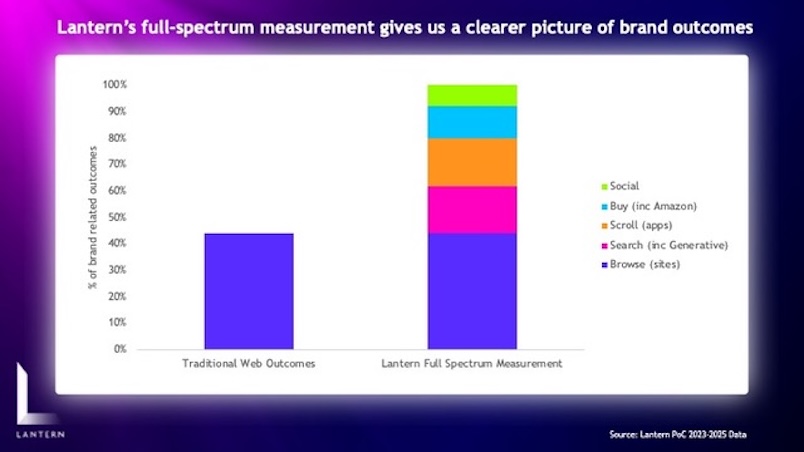
Lantern employs the use of a panel to access these insights. Ads rarely act in isolation; exposure may lead consumers to search, check social media, use generative AI, visit a website, etc. Lantern tracks these behaviours and what particularly impressed me was the breadth of impacts (search, social, AI, etc.) that is trackable. To give an idea of the level of insights, here's the full-spectrum (as they call it) of brand outcomes they are able to share with clients.
Slide taken from Thinkbox's event 23 September 2025
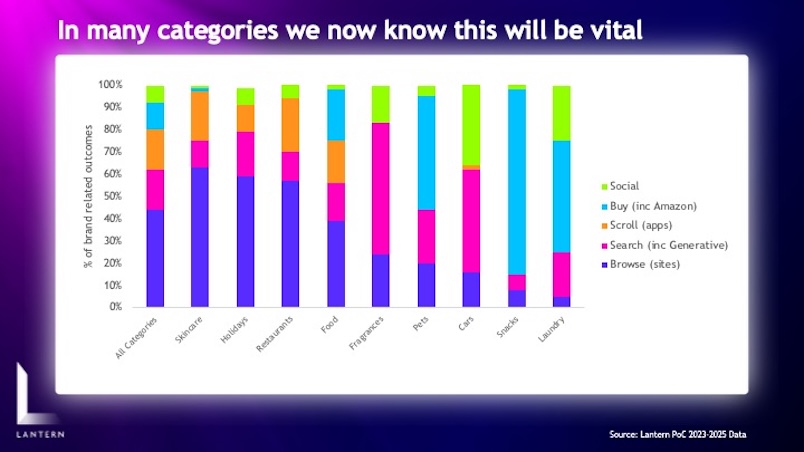
Since proof of concept, Lantern has been able to capture category behaviour, which will be invaluable for brands. Imagine being able to walk into a client meeting and show them whether they’re over- or under-performing in their category, then advise on the tactics to improve outcomes.
Slide taken from Thinkbox's event on 23 September 2025
Lantern can also be used to report against performance KPIs, which is essential. Not all brands or agencies will buy that way; audiences and GRPs remain fundamental. But the reality is many brand and media managers are incentivised on KPIs such as footfall, sales, website traffic, pricing power, repeat purchase, loyalty and so on.
This is one of the main reasons platforms are so successful. The TV industry may not like these KPIs, they’re often short-term, but that doesn’t matter to the buyer. Buyers are rewarded on these measures, and TV can now promise to deliver and measure against them. That’s huge in rebalancing spend. (And I say “rebalance” because clients are over-indexing in digital/platform spend precisely for this reason. I have data to support this; I don’t just make shit up.)
At the moment, the three broadcasters are funding Lantern together and aren’t charging clients for insights. This is something the industry must provide. Platforms already do, and if broadcasters want to win spend back, they don’t really have a choice. If clients can see TV’s impact on the same factors digital claims credit for, Lantern could play a vital role in protecting existing budgets, attracting new money and bringing spend back.
Since 2015, UK viewership is roughly flat once you combine broadcasters and streamers. Demographics aren’t that different either. Some groups are down, but not by much. And yet, advertiser spend on TV is flat or down.
Why? Measurement. Advertisers want instant outcomes and insights for quarterly business reviews. They need to justify where to put money in the next two or three months. Lantern helps meet that need.
Our problem is not each other. Our problem is bigger than that – and is external to all of us … It is not about a couple of share points between us and Channel 4. Why bother, if the medium is tanking? That is the thing we need to focus on.
In my discussion with ITV's Sameer Modha and Channel 4's Henry Vernon (see the full video below) it was fascinating to hear how Lantern was built – ultimately because commercial rivals have recognised they have little viable alternative. ITV's Modha was succinct:
“Through the different industry forums that we have – Barb, Thinkbox in particular – we all talk about the challenges we have, and the challenges are shared challenges. Our problem is not each other. Our problem is bigger than that – and is external to all of us.
“So you very quickly get to a point where you say ‘what matters is doing the right thing for TV as a medium’.
“If you were to say the platforms are ripping everybody off and taking money for old rope, I don’t think that is quite true. Equally, is it the case that the share of media money today reflects the share of value creation? No. But [that is] because we have always been about the long-term – ‘TV will give you your reward in two years’ time’. Well, in two years’ time, that marketing manager is no longer in their job, and the CEO is not going to take an IOU.
“It needs to show up where people are now. And it is just the medium – it is not about a couple of share points between us and Channel 4. Why bother, if the medium is tanking? That is the thing we need to focus on.”
Nail on head.
Pooled inventory, self-serve marketplace next
To tackle legal challenges and move to the next stage of development, broadcasters have agreed to pool inventory so impression data is held centrally. Again, it’s one of the main benefits of such a tight collaboration as I’m sure this move will improve flexibility to do other things in the future.
Lantern also ties in with Universal Ads (launched by Freewheel with all commercial broadcasters) to target SMEs. This market accounts for circa 80 per cent of Meta’s revenue and depends on data to justify spend. SMEs are less sophisticated advertisers, so they’ll lean heavily on this kind of measurement.
TV cannot grow by squeezing more from the same top advertisers. Those budgets will shift around, but won’t return to the levels it once was. Growth has to come from new sources. The SME market is desperate for alternatives to platforms. Brands who rely on performance data for spend are enormous. (Sky put the addressable “performance spend” market for TV at £1.5bn in the UK). Mid-sized “felt” brands that have maxed out on digital and want to grow are another huge opportunity. Lantern gives TV a real shot at winning, or at least attacking them all.
