Behaviour change has a messaging problem.
For decades, the approach has been to tell people what’s right, show them the risks, and hope they comply. But people rarely change their behaviour because they are told to. If that worked, every Australian would floss nightly, stretch before exercising and own a reusable coffee cup that wasn’t serving exclusively as a receipt storage device in the car. Instead, people change when behaviour becomes emotionally rewarding, socially visible or psychologically irresistible.
For marketers, that requires a shift in mindset: Behaviour change is driven by designing experiences that work with human psychology, not against it.
Before we begin, I should point out this is not the work of a behavioural psychology expert, nor do I possess a doctorate framed above a standing desk beside an aggressively minimalist Scandinavian desk lamp. These are simply field notes from a strategist, who was part of the team behind some of Leo Australia's most impactful behaviour change campaigns, where I repeatedly discovered that humans really don’t like being told how to behave.
Which is why some of the most interesting behaviour change ideas in Australia recently didn’t come from government departments or public policy papers. They came from brands.
Both the AAMI Driving Test and Suncorp Haven were built around a deceptively simple truth, if you want to change behaviour, you need to work with human nature, not against it.
Take road safety.
For decades, the approach has been graphic crashes, grim voiceovers and fatal statistics. Yet, road fatalities continue to rise, risky driving has become normalised, and 90 per cent of drivers still believe they are above average behind the wheel.
Which is mathematically impossible. That’s like 90 per cent of people believing they could outcook Gordon Ramsay because they own an air fryer.
The issue wasn’t recklessness. It was overconfidence.
Traditional campaigns targeted bad drivers. The problem was the majority thought the message was not about them. The speed demon weaving through traffic, sure. But not Joe from Silverdale who occasionally texts at the lights while holding a sausage roll.
Instead of framing road safety as something Australians had to comply with, we reframed it as something to compete for.
And this is where it gets wonderfully Rory Sutherland-shaped.
Because competition is behavioural catnip. Humans will enthusiastically do absurd things the moment you add points, rankings or bragging rights. People voluntarily run marathons. Buy Pelotons. Compare sleep scores as though REM cycles are an Olympic event.
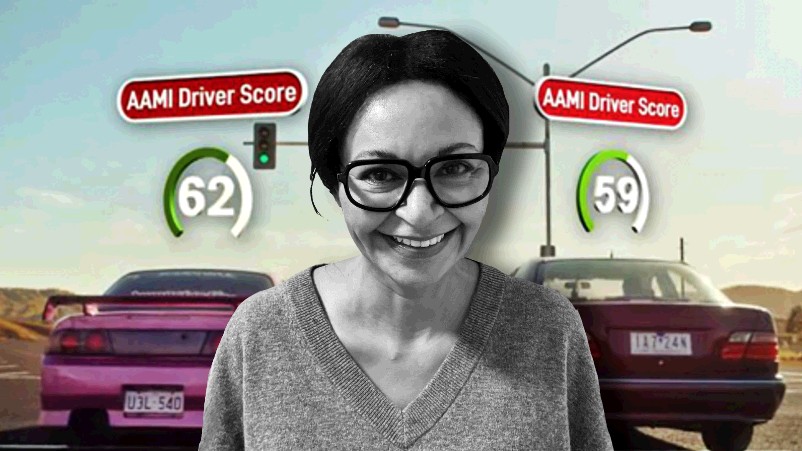
The AAMI Driving Test tapped into Australia’s deeply competitive spirit, turning safe driving into a national sport. Using real-time mobile telematics, every trip became a live, personalised driving score based on speed, braking, cornering, acceleration and phone use.
Leaderboards appeared. Rivalries emerged. Boomers competed against Zoomers. Dog people battled cat people. Australians suddenly wanted to prove they were safer drivers than everyone else.
Giving people skin in the game is what shifted the dial. Mim Haysom, CMO & EGM of Brand and Customer Experience at Suncorp shares this sentiment. “We were seeing increased investment in safety campaigns that used scare tactics, but it was ineffectual because accidents kept increasing. The kind of engagement you get from turning it into a competition is so much more powerful. Our job is not to preach to people, our job is to democratise data and show people how they can help themselves if they want to.”
But the real unlock sat underneath the competition. The campaign gave people feedback loops.
Behavioural science repeatedly shows humans struggle to improve things they can’t see. Driving habits are mostly invisible. People assume they brake smoothly, corner safely and avoid distraction because there’s no evidence to tell them otherwise.
The app turned invisible behaviour, visible. Suddenly drivers could see where they lost points, compare themselves against others and improve incrementally.
Road safety stopped feeling like compliance and started feeling like mastery, motivating high-risk drivers to actively improve their behaviour and lift their driving scores by an average of at least 37%, with drivers who initially scored below 50 out of 100 showing the most significant improvement. Improvements were observed across all road safety behaviours such as braking, accelerating, cornering and phone use, showing the breadth of behaviour change achieved.
Attitudinally, there was also a shift – with 61 per cent agreeing they were motivated to drive safely as a result of reward and recognition delivered via the campaign.