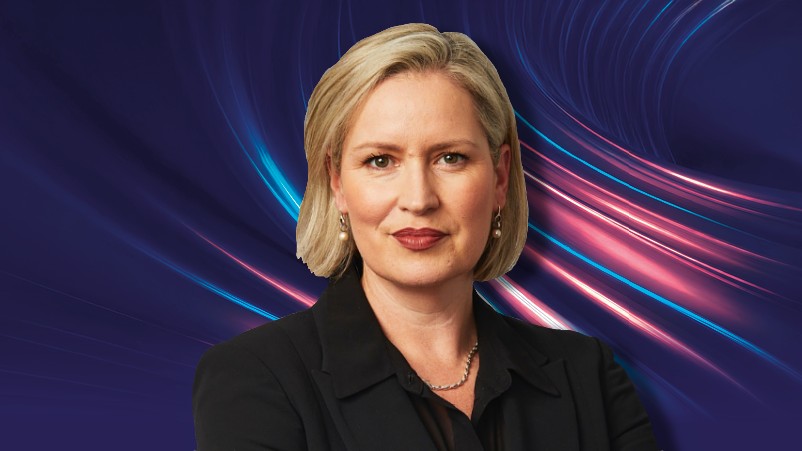



CMOs of the Year 2026 #15: Rebecca Darley
This go-getting believes her CMO superpower is to bring bravery to the job and take the big bets, “matched with the vulnerability and curiosity to always keep learning”. “Life and careers are too short to die wondering,” the group CMO says. Here's how she's redefining the brand and commercial playbook.
At TPG, Rebecca Darley is matching the art with the science at Australia’s $5bn number two telco and across its portfolio of brands including Vodafone, TPG, iiNet, Felix Mobile, Lebara and Kogan mobile.
Which is why, even as she was releasing tranche one of her breakthrough Vodafone campaign work at the time of submission, Darley says the turnaround job at hand at TPG is not just about beautiful advertising campaigns.
“It’s about understanding business – the underlying drivers in a highly commoditised, deeply penetrated and increasingly fragmented category – and knowing which marketing levers to pull to deliver growth,” she explains. “In my first meeting with my CEO, Inaki Berroeta, my conversation opener was that if he wanted to shift the dial one or two points I’m not the person. However, if he wants to drive wholesale change, let’s do it.”
And that’s what Darley’s CMO Awards submission is full of, one year into the turnaround agenda. “A marketing turnaround, and indeed a business turnaround, takes more than one year. However, I hope my entry is testament to my core belief that marketing is a strategic business driver,” she says. “It’s been a year of taking an organisation on a journey through sheer grit, determination and lot of patience.
“But I believe there are two types of marketers – those who follow the playbook and those who write the playbook. I am the latter.”
Innovative marketing
Darley’s arrival at TPG coincided with Vodafone’s networking sharing deal to double its regional coverage. So she built a campaign around the line of ‘doubling the network’. In a nod to Vodafone’s challenger brand status, the bold PR-led campaign called for an end to the major competitor’s ‘bush tax’ by virtue of “monopolistic over-charging regional areas”.
“For a business which had experienced stagnant growth for a number of years, the growth targets were enormous, the trust in marketing was low and of course the budget wasn’t near enough,” says Darley, noting Vodafone is outspent 2:1 by Optus and 3.5:1 by Telstra.
The result is Vodafone outstripping the category across all brand, commercial and performance metrics in FY25, with brand consideration +23 per cent up against a target +10 per cent, a+65 per cent lift in network perception, and net new customer growth taken from the top two competitors of 4 per cent. Customer churn is also down by 10 per cent. Importantly, FY25 EDITDA has increased +18.4 per cent, mobile service revenue growth by +2 per cent, and ARPU +8 per cent.
It’s paved the way for what’s to come, says Darley. In March, Vodafone debuted its “fresh confident, competitive and credible challenger” narrative, with a second tranche planned in May.
“We’re rebuilding trust in the least trusted category, translating Vodafone’s perceived negatives into customer-centric truths,” comments Darley. “We’re honest about our network coverage. We don’t build network towers in the desert and charge customers for it. We offer the big telco experience without the stuff you don’t need and its cheaper. We boldly ask Aussies why they’re paying more? To help tell this story, we’ve enlisted the ballsy female, American comedian Ali Wong – she’s honest, bold and straight talking. Just like the Vodafone brand.
“It’s a plucky strategy, however, the simple fact is that we’re a #3 where growth comes from switching. Our honesty and pragmatism will no doubt polarise however, this is a brand that can no longer sit quietly backstage.”
Discerning decision making
Before any of this, Darley looked to get underneath the hood on the unit economics of the business. “Why? Firstly, I’m a commercial marketer with a firm belief that the modern CMO must understand and quantify their contribution to revenue,” she says. “Secondly, TPG Telecom operates six brands from a finite marketing budget and FTE envelope.
“Put simply, my role is to make select and strategic investment choices to maximise short and long term revenue return from every single dollar invested in marketing.”
Working alongside the CFO, Darley saw unit economics provided a clear and indisputable fact-base outlining which products/brands maximise revenue for every dollar spent. Alongside this, she’s built a full-funnel Market Mix Model (MMM) to determine optimal brand/product marketing investment as well as consider the ‘halo’ impacts across the Group’s portfolio.
“The output was a strategic shift in marketing investment. The change was large-scale and it meant brands/products which historically received a disproportionate marketing share were reduced, whilst those that had been under-invested were increased,” says Darley. “In addition, the work highlighted optimisation trade-offs in channel and mix, shifting away from lower-performing allocations and focusing investment where ROI is strongest. Armed with this combined insight, it also informed marketing resource reallocations, matching investment decisions with workforce to ensure effort mirrored demand.
“The CFO loved it.”
It’s early days, but already Darley points to +15 per cent increase in total TPG Group ROAS (Return On Advertising Spend) and lifts in gross margin as a sign of things being on the right track. In new connections, there’s been a +4 per cent rise in new subscribers (228,000), and average revenue per user is up 2.4 per cent.
“Beyond the results, the cultural impact cannot be under-estimated; leaning into my leadership principles of resilience, humility and calculated risk-taking to drive better outcomes for the business and its shareholders,” adds Darley.
Upon joining TPG I wanted to understand the unit economics of the business. Why? Firstly, I’m a commercial marketer with a firm belief that the modern CMO must understand and quantify their contribution to revenue. Secondly, TPG Telecom operates six brands from a finite marketing budget and FTE envelope. Put simply, my role is to make select and strategic investment choices to maximise short and long term revenue return from every single dollar invested in marketing.
Data-driven decision making
Select and strategic trade-offs in marketing spend are being made to deliver revenue growth, Darley continues. However, she sought to answer a higher-order question to make sure the decisions were the right ones: How does TPG’s move away from ‘target everyone with every brand’ towards distinct acquisition audiences and propositions, giving each brand its own white space?
Enter the Group Brand Strategy. An aggregated set of data is providing the strategic inputs from commercial (the unit economics work developed with Finance); customer (a total market segmentation developed with our external research agency); and competitor (including category-wide research to understand relative brand heartlands).
It’s crystallised the brand playbooks and helped to better realign propositions and products.
“There is a depth of strategy and commerciality that underpins the highly visible creative output. In a complex, multi-brand, multi-product telco business, and it’s about select and strategic choices,” argues Darley. “In other words, it’s as much about what you choose not to do as what you choose to do.”
More broadly, Darley points to harnessing rich data and insights into a ‘secret sauce’ optimising the marketing levers to maximise short and long term growth, “in a highly commoditised, deeply penetrated and increasingly fragmented telco category.”
Commercial acumen
While growth is the ultimate ambition of marketers, Darley knows growth is only one part of what the TPG turnaround involves. With a flat YoY marketing budget and stagnant FTE costs, effective cost base management during a period of such rapid change has been a large contributor to the commercial success.
Among the initiatives here have been renegotiating and consolidating external partner contracts to deliver cost efficiencies ranging from 5 per cent to 15 per cent. She’s also been in-housing creative services and media and leveraging AI capabilities for speed, scale and efficiency. In addition, offshored ad technology and ad operations teams have delivered circa-25 per cent cost saving and reducing customer acquisition costs (CAC) by 8 per cent.
There’s also been realignment of internal teams, reducing spans and layers, and shifting from generalist skillsets to subject matter experts.
“Because at the end of the day businesses want to make money. It’s about more net cash falling to the bottom line,” comments Darley. “Not a traditional marketing term I hear you say? Well it should be! More marketers must understand and quantify net return if we’re to be taken seriously.”
Business & Leadership impact
Darley’s ambition on the team was equally palpable: Build an end-to-end brand/customer segment-led, fully scaled marketing team within the first year. And all without business interruption and within existing budget.
Supporting the brand/customer teams, she’s built three centres of excellence (CoE) – marketing strategy and insights, media and creative. The CoE’s are supported by agency partners including Howatson & Co.
“Within this universe, I’ve re-built the underlying data, martech and adtech capabilities shifting from marketing generalists to highly-qualified specialists, located both on and off-shore,” she explains. “We’re now well on our way towards building shared vision and common language.”
Other initiatives have included putting the entire team through Mark Ritson’s MiniMBA – and extending the program to include Finance, Product & Sales colleagues to build the shared understanding. Quarterly Exec Series inviting CMOs from industry to share leadership insights and perspectives to expand thinking and challenge status quo, plus Monthly Lunch and Learn have been key too.
Darley has taken this further with a Marketing-wide Development Plan in 2026, incorporating internal/external mentoring. Getting the team rhythm right has been another component, and she’s working to foster ‘one-team’ identity through regular engagements.
“Operationally, process improvements, celebrating failure and explicitly linking ways of working to wellbeing and performance foster curiosity, a growth mindset and psychological safety,” she adds.