


CMOs of the Year 2026 #5: Joanna Robinson
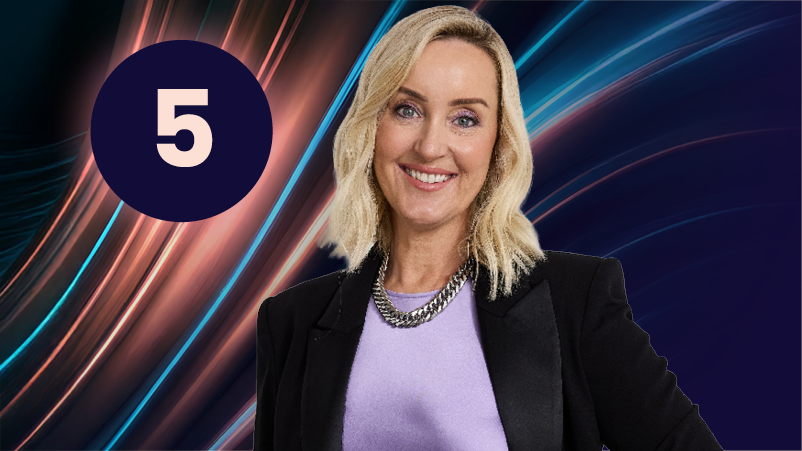
For this year's #5 CMO of the Year, the biggest misconception about her role is also the most persistent. “There are a lot of assumptions that my role is just about how the brand looks and feels,” she says. "But in reality, my role is deeply involved in applying tech and AI to enhance customer experience, using customer data and innovation to drive growth, driving hard commercial outcomes with our brand partners and staying laser focused on delivering commercial impact." Here's how she's making the most of her big M marketing approach.
Yes, the team strives to create stunning campaigns – and yes, Robinson herself admits to buying a lot of clothes.
“But in reality, my role is deeply involved in applying tech and AI to enhance customer experience, using customer data and innovation to drive growth, driving hard commercial outcomes with our brand partners and staying laser-focused on delivering commercial impact,” she says.
It’s that commercial focus that has defined Robinson’s tenure at The Iconic.
Over the past two years, she has led a fundamental shift away from short-term, promotion-led growth towards a more disciplined, relationship-led model, one that has helped deliver the company’s first net profit in its 15-year history.
Innovative marketing
In an industry obsessed with "the next big idea," the true breakthrough at The Iconic was a return to fundamental marketing discipline.
“Historically, our digital model was optimised for speed - fuelled by aggressive promotions that eroded margins and trained customers to prioritise price. My mission was to pivot toward relationship-led retail, moving away from short-term demand to build a sustainable commercial foundation at a deliberate pace,” Robinson says.
Over the past two years, Robinson evolved marketing from a functional silo into a core commercial engine by establishing the ‘Got You Looking’ (GYL) masterbrand platform. This pioneered a ‘brand-formance’ model architected to build long-term equity while delivering immediate outcomes, a strategy validated by an Effie award, being named Power Retail’s #1 Most-Loved Retailer, and twice winning the All Star Award for Top Online-Only Retailer.
The impact has been significant. In FY25, The Iconic achieved its first net profit, supported by a 71 per cent increase in EBITDA to $45.7 million on an $893 million revenue base. At the same time, the business delivered a 70 per cent lift in unprompted awareness and a 17-point increase in brand preference.
The strategy also unlocked new growth through partnerships, with the Retail Media Network evolving into a higher-margin revenue stream delivering 38 per cent year-on-year growth.
Trust. It underpins everything from consideration and conversion, to loyalty and advocacy and without it, even the smartest marketing can only get you so far. In a world that is constantly scrolling and overwhelmed with choice, it is one of the most powerful advantages that you can have as a brand.
Effective marketing strategy
A key part of Robinson’s impact has been repositioning marketing from a functional silo into a core commercial driver.
“When I joined The Iconic, our Retail Media Network/Partnerships function operated primarily as a tactical support unit rather than a strategic commercial driver. Historically, the business had focused on endemic brand relationships through a lens of simple supply, missing a significant opportunity to leverage our deep audience data and creative capabilities for non-endemic partners,” she says.
As a result, Robinson led a wholesale partnership commercial model reset, establishing a structured, high-growth engine that delivers mutual value for both The Iconic and its global and local brand partners.
“This reinvigoration required a fundamental shift in our internal ways of working, moving from transactional deals to a packaged partnership proposition. Under my leadership, we introduced a new commission model and built a full-service offering that spans retail media, first-party audience insights, bespoke creative execution, and large-scale physical activations.”
A flagship example of this new capability in action was its 2025 ‘Outrun Your Delivery’ campaign with Nike, where the company turned its 3-hour delivery USP into a competitive consumer experience, and the ‘DeliveRobe’ collaboration with Uber One during Australian Fashion Week.
“These were not just marketing moments; they were proof points of a new, agile operational process that allows us to scale partner impact while maintaining brand integrity.”
The commercial turnaround following this reset has been significant. By shifting the team’s focus to a unified brand and commercial strategy, the Partnerships business delivered 38 per cent year-on-year revenue growth while also improving margins, a rare combination of expansion and efficiency.
This realignment unlocked new revenue streams, particularly from non-endemic partners, broadening the commercial model beyond its traditional base.
More broadly, it contributed to a pivotal milestone for the organisation, supporting its return to profitability for the first time in more than a decade.
“Ultimately, this transformation has proven that when marketing leadership treats partnerships as a commercial product rather than a functional task, it can generate significant, repeatable shareholder value,” says Robinson.
Discerning decision making
Perhaps the most defining decision Robinson made was to challenge the business’s reliance on discount-led growth.
For years, performance marketing had operated as a highly effective engine, driving acquisition and conversion through promotions. But over time, it created what Robinson describes as a dependency – one that constrained long-term value.
The decision was to reallocate money from the marketing budget into building a new loyalty infrastructure: The Iconic Front Row (TIFR), its first official loyalty program.
This was not without risk. The organisation had been optimised for short-term demand, and any shift away from that model required careful balance to avoid disrupting performance.
“I had to ensure we did not ‘break the engine’ of our performance marketing or ‘steal’ from our vital brand budget. By reframing loyalty as an experience and truly listening to and recognising our customers through access, exclusive moments, and curated benefits - we transformed loyalty from a tactical tool into a strategic platform designed to increase lifetime value.”
By repositioning loyalty as an experience - built around access, exclusivity and recognition - Robinson transformed it into a strategic growth platform.
The early results are compelling: Since soft-launching in October 2025, TIFR has shown promising early ‘green shoots,’ indicating the program’s power as a growth engine, and helping deliver its first net profit in 15 years.
“By putting brand equity and customer experience first, we have positioned The Iconic for sustainable, loyalty-led growth.”
Customer & market smarts
For Robinson, the shift to relationship-led retail is grounded in a deeper understanding of customer behaviour.
“Trust. It underpins everything from consideration and conversion, to loyalty and advocacy and without it, even the smartest marketing can only get you so far,” she says. “In a world that is constantly scrolling and overwhelmed with choice, it is one of the most powerful advantages that you can have as a brand.”
To build that trust, The Iconic needed to move beyond transactional data to understand the motivations behind customer decisions.
The launch of The Inner Circle, a customer research forum, has been central to that shift. More than 30,000 active customers opted in within the first 24 hours, creating a continuous insight engine that informs everything from product and loyalty design to user experience.
This insight has been translated into tangible improvements across the business, including enhancements to search functionality, app experience, and loyalty design.
A focus on findability, for example, led to improvements in multi-modal search, delivering a 28 per cent increase in click-through rate, a 12 per cent lift in conversion, and an 8.3 per cent revenue increase over a four-month period.
In early 2026, Robinson also launched a refreshed app homepage explicitly shaped by feedback from over 1000 Inner Circle members.
“The update introduced a content-rich experience with a personalised ‘For You’ tab, integrating loyalty status and order tracking with tailored product discovery based on favourites and shopping history,” she says. “By turning listening into a system and personalisation into a partnership, we have transformed customer insight from a report on a desk into a driver of customer experience.”
Data-driven decision making
Robinson’s approach to data is not just about measurement, it’s about turning insight into operational change. A clear example is the overhaul of The Iconic’s delivery and returns ecosystem.
“We identified a critical gap: while we were rich in transactional data, we lacked the qualitative insight to understand why specific friction points were impacting Customer Lifetime Value (CLV),” she says.
“By analysing pulses from our 30,000-member Inner Circle panel, we discovered that delivery speed was no longer a "nice to have" but a primary driver of conversion; our data showed a 3-10 per cent shift in conversion for every additional day of delivery time shown at checkout. In response, we drove a cross-functional initiative with our logistics and tech teams to optimise our supply chain.”
This insight triggered a cross-functional transformation. Delivery times in Melbourne were reduced by more than 50 per cent, New Zealand delivery performance improved by 15 per cent, and next-day delivery was introduced in metro areas.
At the same time, improvements to returns tracking addressed customer concerns around ‘return anxiety’, resulting in a 6 per cent week-on-week reduction in return-related enquiries.
“The demonstrable business impact of these decisions is clear: this infrastructure was a core contributor to The Iconic delivering its first net profit in 15 years,” she says. “By turning listening into a system and data into operational discipline, we have proven that marketing leadership can directly dictate P&L success.”
Business & Leadership impact
Robinson’s influence extends well beyond marketing. Her “Big M” philosophy positions marketing as a driver of enterprise strategy, shaping decisions across sustainability, technology, and commercial operations.
One example is RE-Iconic, the company’s circular fashion platform. Working closely with the commercial team, Robinson helped position circularity as a commercial growth opportunity rather than a brand exercise, supported by customer insight showing that 92 per cent of customers would engage with the service.
She has also played a central role in advancing The Iconic’s technology roadmap, from enhancing search and discovery to rebuilding the customer service chatbot, Tilly, into an AI-first agent, improving automation rates and delivering cost savings.
Notably, this impact is supported by a deliberate focus on culture.
Robinson has built a marketing function designed to be bold, responsive and adaptive, grounded in psychological safety and a “kindness first” mindset that encourages collaboration and experimentation across teams. That focus has helped break down silos and strengthen cross-functional alignment, lifting engagement and enabling faster, more effective execution.
“This focus has been commercially transformative, lifting team engagement by +20 percentage points and breaking down silos to drive cross-functional collaboration,” she says.
“Flexibility and inclusion are the bedrock of this culture. As a working parent, I model the balance of career and family; a commitment reflected by our Senior Leadership Team, the majority of whom are working parents.”
It is this combination of strategic influence and people-first leadership that has helped translate transformation into tangible business outcomes, reinforcing marketing’s role not just in shaping direction, but in delivering sustained performance.
“This culture was the engine behind The Iconic’s first net profit in 15 years and our record $45.7 million Adj.EBITDA in FY25,” Robinson adds.