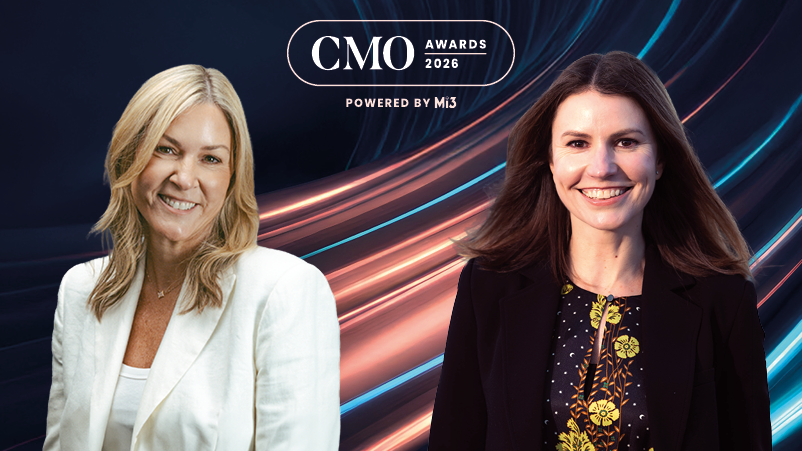



CMOs of the Year 2026 #6: Nicole Bardsley

It’s the marketing leader’s imperative to keep showing brand and creativity can drive both immediate commercial outcomes and create durable competitive advantage over time, says this dynamic marketer. Two years into her role, she's now delivering the goods. From fighting to convince stakeholders that mobility needed a long-term brand platform – and sticking to the plan even when budgets were cut – to backing bolder bets that can spike attention, here’s her playbook for connecting insights to strategy that ensures impact.
Nicole Bardsley is well aware there’s a misconception that all she does is make ads with celebrities. “The truth is a huge part of my role is shaping growth, helping the business make sharper commercial decisions about our brand and advocating for what our customers actually need,” she says. “But yes, I did also get to shake hands with Shania Twain.”
Bardsley believes her superpower is clarity in connecting insights to strategy. “It’s about finding the human truth in a problem and turning it into something that can move the business,” she says. “I’m at my best when I can connect customer insight and creativity and rally teams behind a strategy that can deliver commercial impact.”
That’s key if marketing is to drive long-term growth inside Uber. “We need to keep showing that brand and creativity can drive both immediate commercial outcomes and create durable competitive advantage over time,” she says.
Innovative marketing
Take Uber Mobility’s first long-term, brand platform, ‘Can’t Do That If You’re Driving’, which Bardsley has been instrumental in realising. Uber had growth through product launches and short term tactics. Then came the transformation of Uber Eats into a culturally connected force, driving outsized business growth and category position. But within mobility, brand was seen as optional, she explains.
“A huge leadership job needed to be done to convince business stakeholders of the importance of brand in driving category growth,” says Bardsley. “I also needed to advocate for a deliberate strategic pivot: Start focusing on the real competitor – private cars, which account for 85 per cent of all mobility trips in Australia. If we wanted meaningful growth, we had to bring a challenger mindset and shift behaviour at scale. My leadership was successful at driving buy-in.”
Through extensive research, she uncovered a powerful tension: Australians love driving, but life is often better as a passenger. From that insight, Uber Mobility’s first long-term brand platform, ‘Can’t Do That If You’re Driving’ was born.
“This was a structural shift in how we show up, reframing Uber from a functional A-to-B utility, into a liberating moment of freedom,” says Bardsley.
To make it unmissable and to break the inertia of driving, Uber paired observational musical comedian, Tom Cardy with global icon, Shania Twain. “This unexpected, multi-generational duo transformed our insight into an infectious pop anthem and a true cultural moment,” per Bardsley.
The platform extended beyond paid media into in-app gaming experiences – only playable when a consumer isn’t driving – and personalised CRM incentives. The impact was clear, with uplifts in intention to use Uber, app sessions, first trips and millions of organic views. It’s a repositioning of Uber Mobility for long-term growth, “proving that brand can drive penetration”, adds Bardsley.
The Attention Spike playbook has become a foundational tool for driving cultural relevance and earned media globally - turning creative experimentation and play into a scalable capability which has inspired extraordinary award-winning activations in all Uber’s star markets.
Effective marketing strategy
Another strong marketing case Bardsley puts forward is the work done to reinvigorate the art of non-traditional ‘attention spike’ campaigns.
“Uber's DNA is rooted in non-traditional marketing, but after a decade of successful big-budget celebrity campaigns we had inadvertently lost some of the magic,” she comments. “The success of the Uber Carshare Valtteri Bottas campaign had revived a desire, but it had also exposed a critical organisational tension: Internal confusion and agency ‘swirl’ resulted due to the lack of codified principles for non-traditional campaigns. We had the desire for earned media, but lacked the structural capability, principles and processes to scale it.”
With experience across brands such as Virgin Mobile and Cashrewards before her arrival at Uber, Bardsley identified the opportunity to build a repeatable system and challenged the team to create the ‘Attention Spike’ playbook. The guide has proven so effective, it’s since scaled globally. And it fed into capitalising on standout cultural moments in 2025 for real-world impact.
An example is chasing Andy Murray during Channel 9’s broadcast of the AO, generating the highest brand attention of any sponsor and an all-time high in buzz. The campaign went on to inspire Jim Courier, delivering even bigger results. Another example Bardsley points to is enlisting actor Chris McDonald to position Uber One as an exclusive club, without the exclusivity. Delivering Democracy Sausages on Election Day was recognised as one of the top ads of 2025.
“Each of these delivered outsized impact by leveraging the power of social engagement and PR buzz. Together generating more than 500 earned media articles and millions of social engagements,” says Bardsley. “The Attention Spike playbook has become a foundational tool for driving cultural relevance and earned media globally - turning creative experimentation and play into a scalable capability which has inspired extraordinary award-winning activations in all Uber’s star markets.”
Discerning decision making
In Bardsley’s book, marketers are commercial leaders with a pragmatic growth mindset. Which means they know when they have to fight for what is going to get them the long-term gains, not just short-term spikes.
That meant building a rigorous business case for brand marketing in Uber Mobility, then refocusing and sticking to the game plan midway through development when regional and local P&L pressures resulted in the marketing budget being cut.
“I developed an MVP go-to-market strategy centred on a robust measurement framework designed to prove the commercial impact of brand marketing,” she says. Work involved partnering with ops, strategic planning and data science to design a market-level experiment measuring the incremental demand impact of the brand campaign. This ran alongside brand tracking, creative testing and a bespoke survey to measure shifts in consideration and intent to use Uber.
To achieve statistically robust results with 95 per cent confidence, a large portion of Australia, including Melbourne, Brisbane, Adelaide and Perth, needed to sit in the control group.
“It meant these markets would remain dark with no investment,” says Bardsley. “This was a significant trade-off that prioritised measurement over reach during the busiest quarter for Uber Mobility.”
Results validated the strategy and as noted above, ‘Can’t Do That If You’re Driving’ delivered a statistically significant uplift on multiple fronts.
Customer & Market smarts
With a vision to raise the bar across all aspects of the marketing function, Bardsley has also tasked every team member with an OKR focused on rethinking processes, how the brand shows up in culture and most importantly, how it understands customers. This kicked off with a Marketing Academy, Uber’s internal marketing capability program, focused on customer centricity, training the team to identify consumer insights and write impactful marketing briefs.
Several insight gaps were also identified as being key to understanding the consumer benefit of online food and grocery delivery for the key growth segment of young parent families. There was equally a need to understand the barriers for engaging lapsed and sporadic users.
This led to a multi-stream research program, including a two-phased qualitative approach to identify category entry points. The ANZ team also led an immersive ethnography approach across APAC to uncover the universal emotional role of Uber Eats in people’s lives.
“The research highlighted the need to demonstrate how Uber Eats is relevant and makes their day easier to drive category consideration,” says Bardsley.
It’s since led to development of a grocery campaign targeted at young parent families: ‘Top Up Shop’. Creative highlights the universal pain of popping to shops with young children through humorous and relatable scenarios. The campaign evoked an emotional response, delivering the highest behaviour change and creative scores seen to date across the region, well above IPSOS norms. Most importantly, the campaign drove a +4pt increase in grocery consideration and increase in grocery orders during the campaign period.
Data-driven decision making
Using data and research to challenge assumptions definitely plays into Bardsley’s approach. “The best moments have been when the research told us something surprising, and that unlocked braver creative work or a smarter growth decision,” she says.
Such data-driven decision making was brought to bear on ensuring an enduring legacy for Uber Eats through the creation of a differentiated and structural growth lever.
“Despite year-on-year growth, brand health research revealed a critical obstacle: Uber Eats was perceived as a luxury,” explains Bardsley. “Price was the biggest barrier preventing people from using the category, especially amongst sporadic users, and the cost-of-living crisis was only making this worse. Running multiple seasonal discounts had failed to shift value perceptions.”
So Bardsley got to work developing a new holistic approach to value, designed to complement the salience superpower of ‘Get Almost Almost Anything’. This runs in partnership with operations and merchant sales teams. Founded on the Aussie cultural insight that “the highest compliment you can give a good thing is swearing about it”, ‘Ding Dong Deals’ was born.
“For the first time, the restaurants and grocery business units are collaborating on a whole business value proposition and a multi-layered framework showcases hero and headline merchant offers,” says Bardsley. “The business impact has been outstanding with incremental trips incremental gross bookings measured via a controlled test and 100 per cent positive uplift for perceptions of good value via brand lift studies.”
The campaign is now in its third iteration, with each phase driving higher incremental bookings, trip uplifts and higher merchant participation. ‘Ding Dong Deals’ is now being adapted to run in Mexico with other markets to follow.
Commercial acumen
Off the back of these efforts, the Uber Eats ANZ business delivered growth in 2025, alongside record highs for top-of-mind awareness and preference. Bardsley attributes this to a comprehensive and highly effective marketing strategy, coupled with strong partnership and collaboration between marketing and operations and “a relentless energy to keep raising the bar”.
“When I joined two years ago, I inherited an incredible team and a strong brand, but I saw an opportunity to build on these foundations to continue driving year-on-year growth,” she comments. “I set about diagnosing future growth pathways and kicking off new activity to deliver a full funnel approach, unlocking an incremental brand funding to support growth driving initiatives.”
Other ways Bardsley has put her stamp on marketing is by introducing a cross-functional growth forum to remove roadblocks and provide clear decision making and direction. She’s also tasking the team with creating a marketing and media playbook that focuses investment around fewer, bigger, better campaigns and drives best practice.
For instance, taking brand saliency derived through the ‘Get Almost Almost Anything campaign’ one step further and enlisting the iconic Cher, delivered all-time highs in brand attention and linkage, well above IPSOS norms, demonstrating the benefits of compound creativity in action. Meanwhile, identifying the opportunity to address affordability perceptions and introducing the innovative ‘Ding Dong Deals’ value platform has been a major contributor to incremental growth and reactivating users.
“We’re taking smart risks by supporting new global product initiatives such as Dine Out on Uber Eats to continue to expand the category,” she adds.
Business & Leadership impact
And the work extends into reputation too. Uber has faced a number of reputation challenges over the past 13 years. Recognising that reputation drives business outcomes and is fundamental for brands who offer innovation, Bardsley has played a key role in shaping and championing Uber’s reputation strategy throughout the business in collaboration with partners in communications, policy, legal and operations.
One flagship event contributing to this is the annual Uber Red Cross Clothing Drive (RCCD), which sees Uber offer a free pick up of unwanted quality clothing then resold in Red Cross shops across ANZ to fund Red Cross humanitarian initiatives. The 2025 RCCD was the biggest Clothing Drive to date and the first that was activated across both the Uber and Uber Eats brands.
“Putting on this event every year is a huge undertaking that extends well beyond the marketing and comms teams and requires collaboration across the business and the coordination of over 100 Uber team volunteers. I not only led the team to deliver a cut through earned campaign delivering 710 media articles and 8.2m social views but I’m also on the ground on the day as volunteer team lead,” Bardsley says.
The 2025 Drive set new benchmarks with 188kg donated across ANZ (+41% YOY) and 47 per cent quality yield – the highest ever. Uber has also seen a 3.3pt lift in brand favourability and uplifts across both the Uber and Uber Eats Reptrak with the Uber Eats brand reputation score the highest it’s been since tracking began in 2017.
It’s with a calm, considered, thoughtful style Bardsley looks to exhibit executive presence and earn stakeholder respect. And overall satisfaction and work engagement reflects the impact of her approach to cultural resetting.
Building a culture of individual growth has been a core foundation. Every team member has a ‘drive your growth’ plan which that’s revisited twice a year in addition to quarterly impact check ins.
“Twice a year we get together for an offsite (often in my backyard) to discuss where we can improve, develop action plans and set the vision for how we want to show up as a team,” says Bardsley. “We’ve spent time understanding our strengths and sharing our user guides with each other, to optimise ways of working and drive understanding of individual styles and preferences.
“And most importantly, we have a lot of fun. We’re only a small team of 10 but we embrace our agency village as part of the extended team to support us. And together we get the privilege to work on some pretty epic career defining marketing that delivers tangible business impact.”