
Editorial Series

CMO Awards 25

An Mi3 editorial series brought to you by

CMOs of the Year #18: Catherine Anderson

Optimistic, curious, everywhere: Those are the three words Catherine Anderson, CMO of Origin chooses to describe her approach to marketing leadership.

And they all manifest in knowing the power of saying no as a marketing leader to an excellent or what might be construed as a ‘bold’ idea. Why? Because she believes it “allows for something just so slightly more excellent to exist”. 

The experienced marketing leader, who spent more than seven years with green energy company, Powershop, including nearly four years as its chief customer officer, joined Origin in 2022 as GM of strategic initiatives. She was then appointed GM of marketing in late 2022, followed by CMO in November last year.

Effective marketing strategy

Over the last year, the energy provider’s marketing function under Anderson’s stewardship has been overhauling three key components of its media approach: Media strategy and buying, data platforms and ways of working.

“Our intent was to optimise our marketing acquisition programs with highly personalised offers and stronger customer experiences, ultimately to deliver better cost to acquire outcomes,” explains Anderson.

Success was bolstered by the introduction of AI utilisation, marketing mix modelling and intelligent real-time bidding strategies, while also in-housing digital advertising capabilities.

In the first phase, media mix modelling was adopted to analyse and learn from channel performance. Secondly, by adding in an AI-driven scenario builder, product marketing teams are able to leverage baseline insights gained by the model and now perform ‘what-if’ analysis to optimise channel mix and investment that maximise marketing outcomes.

“In a year where we were rewriting our brand strategy and creative, this work was important to complement that and support our product teams with commercial gains,” Anderson says. It has paid off, with channel contribution increasing, and growing returns on product marketing funnel investments.

All this while completing a large structural change project within marketing focused on cultural transformation. Knowing how important it is for marketing to be able to work in the face of ambiguity, Anderson is keen to ensure as much adaptability in her Origin energy marketing team as possible, and has brought in more adaptive ways of working to help.

“With marketing offering a more centralised service, we have rolled out simple, adaptive work styles that take some guidance from Agile, but are quite fluid and responsive – that’s important in an organisation with multiple working styles,” she says. “We have worked through many all-team workshops, met hurdles and points of friction by addressing them using a Feature – Advantage – Benefit [FAB] model to onboard teams.”

From utilising fortnightly sprints as a common language, to rolling out new technologies such as Asana and Confluence, marketing has spent considerable time designing workflows, quarterly planning adherence, accountability constructs and training so it’s able to have tough prioritisation conversations and deliver commercially.

As she stepped into the first month trialling all new tools and processes at the time of CMO Awards submission, Anderson is quietly optimistic about how it’s come together.

“Through our changes, we have been able to reduce our costs by a double-digit percentage, with no negative impact to our stakeholders or business targets and an increase in team engagement,” she says.

Discerning decision making

Achieving marketing excellence undeniably means knowing what you’re about – then connecting it to what value you can bring to your unique organisation. In this vein, part of Anderon’s transition of marketing has been about introducing the ‘70-20-10 Budget Challenge’. This initiative asked teams to firstly focus 70 per cent of budget on standard work to meet business targets, then put 20 per cent to initiatives that enhanced the core, such as exploring new channels or investing in research to make the BAU work harder. The last 10 per cent was pooled into an ‘initiatives’ fund any marketing staff member could pitch for – whether it was for things they thought might fail, or had just never been tried before.

“As a new starter in marketing at Origin, I was using this 70-20-10 challenge to show I was comfortable with certain risk levels, trialling new things and team autonomy,” explains Anderson.

Efficiency and cultural benefits came with it. With a renewed focus on core budgets, marketing achieved its sales targets. But this was balanced with energy for innovation and learning. Having that pure innovation fund allowed the marketing team to fund a new customer segmentation tool and attempt its first ever all-in product and brand presence at a large electric energy event.

“However, it was smaller initiatives directly benefiting customers that stood-out, such as creating our own Origin door-snakes to send to customers to help stop drafts at home – 40 per cent of heating can be lost through drafts – and supporting community initiatives in natural disaster-impacted areas,” says Anderson.

With marketing offering a more centralised service, we have rolled out simple, adaptive work styles that take some guidance from Agile, but are quite fluid and responsive – that’s important in an organisation with multiple working styles,” she says. “We have worked through many all-team workshops, met hurdles and points of friction by addressing them using a Feature – Advantage – Benefit [FAB] model to onboard teams.

Catherine Anderson, CMO, Origin

Business influence

All of this has been achieved even as Origin made public market commitments to reduce cost from the business in FY25 including a $200 - $250 million cash cost reduction from its FY18 baseline by FY24, according to strategy documents. Personalisation and segmentation, along with targeting additional customer value, were also part of the plan.

Marketing was a contributor to this effort, helping expand utilisation and functionality of marketing communications platform to find journeys and opportunities that reduced administrative load and activity and delivered productivity gains.

“By continuously testing and refining our processes, we’ve built an experimental culture that challenges assumptions and validates hypotheses before implementation and have helped to share broader business agendas,” Anderson says. “This approach has not only improved our marketing outcomes but has also informed decision-making across tech, UX, and commercial teams, ensuring our initiatives deliver measurable business impact.”

Customer-first thinking

Representing customers and leading customer-centric programs at Origin is critical for Anderson and her team. Among the core programs are the AI trial to undertake customer sentiment analysis. The second component of customer centricity is running retail business all-ins for call listening sessions. Teams from all across the retail business are able to work in real time to solve pain points they hear from customers.

Strong connectivity into the Origin Exchange Customer Insight community is the third pillar. Origin taps into its strong community for feedback and insights at any time, from product features to feedback on advertising or energy efficiency tips people are using each day.

Data-driven decision making

Another area of improvement for Anderson’s team has been around leveraging this wealth of customer data insights. In FY24, seeing a gap in actionable customer insights, the marketing team built and introduced the business to a values-based (attitudinal and behaviours) segmentation tool using a mix of first-party and useful external data sources such as energy usage and location.

As part of the rollout, it was important to have a case study ready to prove the value of the new segmentation tool, so Anderson and the team focus on Origin’s Electric Vehicle products.

“The opportunity Origin had was to create simple, tailor-made energy products that help to shift energy usage to cheaper times of the day for our customers,” Anderson explains. Drilling down to find additional insights, personas for specific segments were further developed. These were mapped to media buying to allow stronger targeting.

As a result of the deeper customer analysis, stronger media targeting and customised CVPs, Anderson’s team achieved its sales targets a week ahead of schedule, then overachieved against the baseline of previous launches, all while trimming marketing and sales OPEX.

People leadership

Alongside the changes to marketing’s ways of working, Anderson believes in ongoing development for teams and aims to balance training on emerging skills alongside key marketing outcomes and needed innovations.

“The World Economic Forum reports that skills such as resilience, creative thinking, influence and AI are rising in importance over the next five years and as such, our training program will follow this for our marketers,” she comments. For example, teams were trained by psychologists on resilience frameworks and their implementation last year. The year prior, Origin ran communication improvement programs to lift influential storytelling, big ideas development and improve ability to give feedback – all with the aim of helping teams be more influential.

“In 2025, our focus will be on AI and Big Data, personalisation and creativity. Running concurrently to our yearly themes, our curated ‘marketing academy’ runs all year with hand-picked sessions focusing on marketing training needs from partners,” says Anderson.  

But it’s not all hardcore marketing skills that are in Anderson’s sights. She quotes the Chinese proverb: ‘Learning is a treasure that will follow its owner everywhere’. “I look to maintain flexibility in our training agenda, preferring not to choose one supplier or fixed program for marketers. Marketers are also encouraged to take on external training and experiences un-related to marketing, such as Finance for Non-Finance Managers, new leader training or cultural immersion programs with the Origin Foundation,” adds Anderson.

“To foster learning-orientation, teams are asked to present back to the group following any events, conferences or training they undertake. Additionally, we believe career growth can be gained inside our organisation, with some marketers undertaking week-long secondments to other teams.”

A series of incremental but significant steps have enabled this CMO to optimise marketing acquisition programs, adopt AI tools, rewrite the brand strategy and creative playbook and lift marketing’s contribution to the business, all while keeping a lid on costs.

CMO Awards 25

CMO Awards 25

CMO AWARDS SPECIAL REPORT
The journey to business growth: How CMOs are rethinking customer engagement
  • Six of our CMO Awards 2025 and CMO50 2022 alumni share how they are rejuvenating their customer journey approaches using data and insight, fresh segmentation, personalisation, tech and AI.
  • In-depth look at the work done by marketing teams across Freedom Furniture, Suncorp, MYOB, IBM, Anytime Fitness and REA Group, to improve responsiveness to customer journeys across the lifecycle and throughout their organisations, driving better engagement and experiences.
  • Hear how marketers are striking a balance between customer preferences and changing behaviours, privacy and governance versus hyper-personalisation at different stages of customer journeys.
  • Supported by CMO Awards Platinum Partner, Adobe, and Gold Partners, News Australia and Publicis Groupe.
Six of our CMO Awards 2025 and CMO50 2022 alumni share how they are rejuvenating their customer journey approaches using data and insight, fresh segmentation, personalisation, tech and AI.
Special Report 2
CMO AWARDS SPECIAL REPORT
From Silos to Synergies: Unlocking the CMO-CIO Partnership
  • What it really takes to transform the CMO and CIO relationship from antagonism and misalignment to unity and common goals
  • In-depth case studies with marketing and technology chiefs at 5 leading Australian brands: Beyond Bank, IAG, Treasury Wine Estates, University of Tasmania and Virgin Australia.
  • 5 key drivers instrumental to forging successful partnership
  • Strategic ways CMOs and CIOs are tackling AI together
  • Supported by CMO Awards Platinum Partner, Adobe, and Gold Partners, News Australia and Publicis Groupe.
What it really takes to transform the CMO and CIO relationship from antagonism and misalignment to unity and common goals.
CMO Awards - Special Report 1

First-time CMO of the Year: Kristy Rutherford

When Kristy Rutherford stepped into the role of marketing director for Pernod Ricard ANZ in July 2023, the business was at a crossroads. Innovation was faltering, market share was slipping, and a siloed culture was stalling success. But where others saw a crisis, Rutherford saw opportunity. 

“Our team was overwhelmed with resource-heavy and inefficient work. This was driven by a culture built on silos - with separate reporting lines for Marketing, Trade marketing AU, NZ, digital, insights and media. We were also saying yes to every ‘opportunity’ and launching too many brands or campaigns without adequate plans to make them successful.” 

Her bold vision, “Do LESS to unleash our power and impact MORE”, has since redefined how Pernod Ricard approaches marketing across Australia and New Zealand. 

“When I became CMO, I spearheaded a new initiative called 'More IMPACT'. I set a dynamic vision: “To become the #1 marketing team in Australia & New Zealand, by doing less and impacting more”. The goal was to unleash the power already in our organisation by making decisions based on the impact they would have, not what everyone was used to doing, and through this transform our culture.”  

A standout example of its ‘More IMPACT’ approach was the powerful three-way partnership between St Hugo Wine, Daniel Ricciardo, and Dan Murphy’s.

“St Hugo has been releasing co-created wine with the F1 superstar since 2021. But in 2024/25, my team approached this differently using ‘MORE IMPACT.’ 

“Working seamlessly between the marketing, trade and sales teams, we pitched to Dan Murphy’s [the #1 wine retailer in Australia] to execute the ‘Greatest wine takeover in History’. They went for it – and we achieved never-before-seen integration between three brands. Dan Murphy’s re-named their stores ‘Dan Ricciardo’s’, and swapped Daniel’s face onto their iconic logo. 

“We had people flocking to stores to take photos, taste St Hugo, and then flood social media. We then surpassed this in 2025 by launching a new Rosé and re-naming the store ‘Dan Murphé’, then executing a social-first campaign featuring Daniel that garnered 6.6 million views, and +3,400 comments. We achieved 230 pieces of PR coverage representing 18.5 million in reach. Win-win-win.” 

Certainly, achieving the vision of ‘doing less and impacting more’ and achieving cultural change required re-imagining almost every process and inspiring people to think differently about decision-making, Rutherford admits. 

To bring the vision to life, she led the Marketing Leadership Team (MLT) in developing a strategic framework called ‘IMPACT More in ’24’. 

She introduced 10 core principles to drive sharper decision-making and cultural change across the business. These included challenging legacy thinking with ideas like the ‘Death of the 360 Wheel’ – focusing on fewer, high-impact initiatives instead of overloaded plans – and ‘One Great Is Better Than 50 Boring’, which encouraged standout content over high-volume, always-on activity. 

“To ensure the vision and principles embedded into the work, I then lead a monthly meeting called ‘More IMPACT’. The MLT presented inspiring topics relating to creativity and the 10 principles, and the team presented their work, demonstrating to their peers how they had employed the principles to create greater impact.   

Through a relentless focus on impact (over volume) we transformed into a culture focused on growth.   

This initiative has been transformative. We are now winning share in all four business segments. And we are delivering our most strategic and impactful work ever, even on legacy brands – a significant example is G.H.Mumm. We have been the champagne partner of the Melbourne Cup for fifteen years. 

In 2024 we managed to increase social/digital reach (a key indicator of growth) by +28% to 10.3 million assisted by the addition of a Vogue media partnership, better (& less) content creation and greater focus on facilitating User Generated Content.” 

Discerning decision making

Rutherford doesn’t believe that ‘doing less’ means playing it safe. In fact, her leadership is marked by knowing when to break the rules and go big.

At the heart of More IMPACT is the art of making strategic trade-offs. It’s not about doing less for the sake of it, it’s about doing less of what doesn’t matter and more of what truly moves the needle. As one of our guiding principles puts it: “Don’t be afraid to go ALL IN.” Sometimes the right call is to double down, back big ideas, and invest in work that actually gets noticed.

That mindset came to life with The Glenlivet. The brand had all the ingredients to win –strong margins, heritage, and a fresh global positioning (‘Live Original’) – and it was slated to be a major commercial focus. The problem? US-led comms hindered by the conservative tone of that market.

“But we are a more open society,” she says. “And the growth opportunity was too big for us to miss due to a lack of assets.” 

So, she made the call to brief a local agency, Emotive, for a bold, social-first campaign that spoke to Australian sensibilities. The result? Obey the Rules, Miss all the Fun – a punchy, progressive idea fronted by Oscar-winner Anna Paquin, designed to challenge whisky’s traditional rules. With lines like “Best enjoyed however the $#! you want”* and “Whisky doesn’t care what’s between your legs,” the campaign resonated powerfully with a new generation of drinkers.

It paid off. The Glenlivet surged – and more than doubled the category – and the campaign has now run for over three years.

“I am a huge advocate for maximising working dollars by using global assets on 90 per cent of occasions. However, you need to know when to step away from rules, be brave, and invest in creative. This experience has given me more confidence to be bolder in future decisions and drive this mindset with my team,” says Rutherford.

I am a huge advocate for maximising working dollars by using global assets on 90 per cent of occasions. However, you need to know when to step away from rules, be brave, and invest in creative. This experience has given me more confidence to be bolder in future decisions and drive this mindset with my team.

Kristy Rutherford, marketing director ANZ, Pernod Ricard

Business influence 

Rutherford will be the first to tell you: “Never waste a good crisis – or a good restructure.”

That mindset defined her first major act as CMO: Leading an initiative as a member of the Executive Leadership Team (ELT). The task was clear but challenging: Reshape the marketing function for a more agile, fit-for-purpose future. But where others might have seen constraints, Rutherford saw a rare opportunity to rewire not just her department, but the wider business.

“I saw this as an incredible opportunity. I had the ability to shape the business and make us more efficient and agile, and it also gifted me a platform to establish myself as a new leader with a new agenda and accelerate the shifts that I was aiming to make to the team’s thinking,” she says. 

Her impact extended beyond marketing. “I influenced changes to cross-functional structures to make decision-making more agile and release tensions across teams. 

That change wasn’t just operational; it was cultural. It allowed two key principles of the company’s ‘IMPACT More in ‘24’ strategy to take root: “Create NZ plans as though you live there” – thanks to tighter trans-Tasman integration – and “Set budgets based on objective”, now possible with consolidated budget ownership.

Inside the marketing team, Rutherford removed unnecessary layers and redefined every role to be broader and more accountable. This eliminated the kind of “busywork” that can creep into under-optimised teams, and instead instilled a laser focus on work that truly moved the business forward. The changes were supported by the introduction of a unifying vision, ‘More IMPACT’, which helped her team rally around a clear purpose even as they adjusted to a leaner structure.

“Within marketing, I also removed layers and made every role bigger and more important. This reversed the behaviour of people filling their time with work whether it would have a business impact or not. Any reduction in headcount can be tough to adjust to, however I facilitated this transition by combining it with the launch of ‘More IMPACT’, demonstrating how the new vision and principles could make us more productive and successful, even though we had less people.” 

The results speak volumes. Despite the headcount reduction, productivity rose. So did morale. Just three months after the restructure, engagement scores had soared. 

“I’m most proud of that,” Rutherford says, proving that having people laser-focused on impact can drive business results. 

Data-driven decision making 

When asked, “Data or creative first?” Rutherford doesn’t hesitate: “Creative 100 per cent – the human brain responds to magic more than logic.” 

That said, she’s clear-eyed about the power of data. Behind the scenes, data-driven segmentation is enabling the business to punch well above its weight, ensuring every creative move is backed by precision targeting and insight.

“We don’t have the marketing budgets of the largest players, therefore if we can’t win at ‘Share of Investment’ we need to punch above our weight in ‘Share of Impact’ and ‘Share of Intelligence’.” 

As a result, she initiated a Usage & Attitudes study in 2024 on the Alcoholic Beverages sector. 

“The data segmented the market into ‘need states and occasions’ and determined the biggest growth opportunities over the next five years. This data has proven extremely powerful. It has given us one consistent data source that we are using across the business - from prioritisation and setting our three-year business strategy, to engaging external customers, and writing insights for our ‘Better Briefs’.” 

This highlights that one of the most powerful shifts under Rutherford’s leadership has been the move from brand-by-brand execution to a more strategic, data-led portfolio approach. By grouping brands based on shared consumer targets and need states, the business unlocked new levels of efficiency and creativity.

A standout example is its partnership with the ASB Classic, New Zealand’s premier international tennis tournament. Rather than investing in a single-brand activation, Rutherford led the negotiation and strategy behind a partnership that brought three brands – G.H.Mumm Champagne, Stoneleigh wine, and Altos tequila – under one integrated platform.

“These brands shared common target consumers, yet sat in different need states and could successfully activate against different occasions within the one platform. G.H.Mumm’s role [Discern needstate] was elevation celebration +  owning VIP spaces. Stoneleigh’s role [Bond & Connect] was enabling friends to connect and enjoy the tennis together. Altos [Release] got the Margarita’s flowing and brought fun vibes in the higher-energy section of the precinct.” 

She says it went beyond the event itself. “We leveraged the partnership to drive sales. One trade marketing budget, driving three brands instead of one, all powered by data and analytics.” 

Commercial delivery

Rutherford had an ambition to gain share from the big players while growing the category. 

It was a bold goal, given Jameson was the newcomer in a ready-to-drink (RTD) segment dominated by veterans like ‘Jack’ (Daniels), ‘Jim’ (Beam), and ‘Woody’ (Woodstock), each with a ~20-year head start. 

But rather than being daunted by the gap, Rutherford saw opportunity in focus, simplification, and smart, high-impact execution.

“We had spent years launching disjointed innovation that resulted in nine different products in market, with only 2 >80 per cent distribution. We needed to simplify to become more sophisticated.” 

Rutherford developed a new strategy, centred on doing three things extremely well for More IMPACT including: Simplified and differentiation brand architecture; building awareness through one platform (AFL); and leveraging its power as a culturally magnetic brand. 

Under the strategy, she streamlined the Jameson RTD range by de-listing five SKUs and focusing its efforts behind the top four, which represented 79 per cent of the opportunity. To secure shelf space, she introduced 4-packs, offering a lower RRP during the cost-of-living crunch while increasing margin per can. 

“This differentiated us and allowed us to sell at a lower RRP (but higher price/can) than competitors, which was appealing to retailers during the cost-of-living crisis. Boom – we were in.” 

At the same time, to build awareness and trial of the RTD, we went all-in on the AFL with a broadcast sponsorship and an MCG commercial partnership, allowing the team to sell and activate at games. The team also leaned into Jameson’s cultural cachet by getting branded merch onto the right people, turning fans into walking advocates and amplifying the brand’s presence on the street.

People leadership 

Rutherford knew that for ‘More IMPACT’ to be more than a slogan, it had to be lived and felt across the team, and be sustained by learning, capability building, and a sense of shared belief. 

“‘More IMPACT’ could only take hold and drive cultural change if it was sustained by a learning and development program that supported everyone across the marketing function to engage in, and truly believe, that they could do less and have more impact,” she says. 

That meant creating space for inspiration, skill-building, and connection. Alongside the Marketing Leadership Team (MLT), she launched a structured program to fuel both mindset and mastery.

At the heart of it was Uncorked, a yearly offsite designed to bring the outside in, with thought-provoking speakers and training that introduced fresh perspectives and energy. She also redefined how the team approached creative work, engaging the “magnificent” Pieter-Paul and Matt from Better Briefs to run workshops on how to craft truly effective briefs. “This completely revolutionised the quality of our briefs, and improved relationships and outputs from all of our agencies -– I couldn’t recommend them highly enough,” Rutherford says.

Another bold move was putting every marketer through the Mark Ritson Mini MBA. Rather than approve ad-hoc enrolments, she saw greater value in taking the team through it together. 

“We didn’t have the budget to do it all at once, but I asked my MLT, ‘What would have more impact on morale: Doing the course, or more dinners and drinks this year?’ Everyone said the course.” She funded it by trimming the travel and entertainment budget, embodying the very mindset she was instilling – focus on what matters most.

Through clarity, conviction and the belief that less really can be more, she’s turned a marketing team under pressure into a business unit that’s now winning share in every segment.

In a world that often celebrates doing more, I’ve learned that true marketing impact comes from clarity, focus, and love – for the craft, for the team, and for the story we’re here to tell. 

“Or, as I like to say, the three words that define my style as a CMO: Drive. Impact. Love,” adds Rutherford. 

When this first-time CMO stepped into the role of marketing director for ANZ across this alcoholic giant in July 2023, the business was at a crossroads. Innovation was faltering, market share was slipping, and a siloed culture was stalling success. But she wasn’t daunted: Through crisis, this marketing chief saw opportunity.

CMO Awards 25

CMO Awards 25

CMO AWARDS SPECIAL REPORT
The journey to business growth: How CMOs are rethinking customer engagement
  • Six of our CMO Awards 2025 and CMO50 2022 alumni share how they are rejuvenating their customer journey approaches using data and insight, fresh segmentation, personalisation, tech and AI.
  • In-depth look at the work done by marketing teams across Freedom Furniture, Suncorp, MYOB, IBM, Anytime Fitness and REA Group, to improve responsiveness to customer journeys across the lifecycle and throughout their organisations, driving better engagement and experiences.
  • Hear how marketers are striking a balance between customer preferences and changing behaviours, privacy and governance versus hyper-personalisation at different stages of customer journeys.
  • Supported by CMO Awards Platinum Partner, Adobe, and Gold Partners, News Australia and Publicis Groupe.
Six of our CMO Awards 2025 and CMO50 2022 alumni share how they are rejuvenating their customer journey approaches using data and insight, fresh segmentation, personalisation, tech and AI.
Special Report 2
CMO AWARDS SPECIAL REPORT
From Silos to Synergies: Unlocking the CMO-CIO Partnership
  • What it really takes to transform the CMO and CIO relationship from antagonism and misalignment to unity and common goals
  • In-depth case studies with marketing and technology chiefs at 5 leading Australian brands: Beyond Bank, IAG, Treasury Wine Estates, University of Tasmania and Virgin Australia.
  • 5 key drivers instrumental to forging successful partnership
  • Strategic ways CMOs and CIOs are tackling AI together
  • Supported by CMO Awards Platinum Partner, Adobe, and Gold Partners, News Australia and Publicis Groupe.
What it really takes to transform the CMO and CIO relationship from antagonism and misalignment to unity and common goals.
CMO Awards - Special Report 1

Best Growth Initiative of the Year winner: The Arnott’s Group

The debut of the Arnott’s gluten-free range of products has become the most incremental launch for The Arnott’s Group to date. In the three years since the FMCG first put its toe into gluten-free waters with an MVP play, its fast-scaling GF range has delivered $78 million in retail scan sales, $42m in the last 12 months alone. 

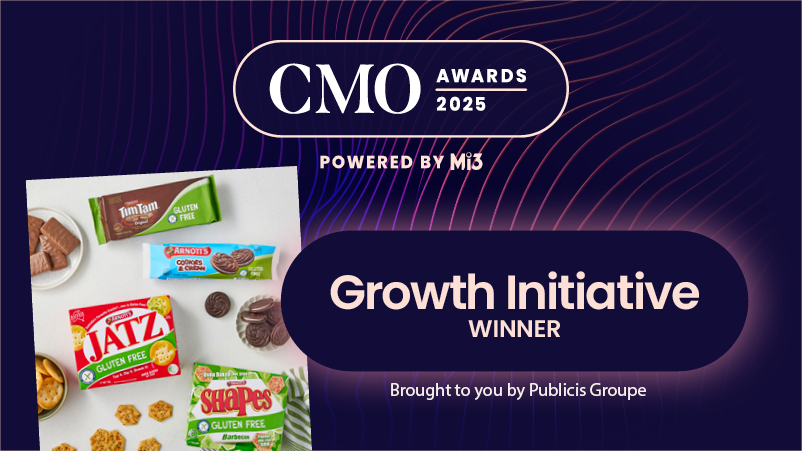
So it was a no-brainer for this year’s judges to hand The Arnott’s Group the trophy for the inaugural Best Growth Initiative of the Year Award, brought to you by Publicis Groupe, at the first-ever CMO Awards. Judges noted the articulation of the insights behind the approach, detail on how growth has been defined and unlocked, whole-of-company alignment and investment, classic principles of marketing in play, and the go-to-market work itself, as a compelling, standout growth story.

The background

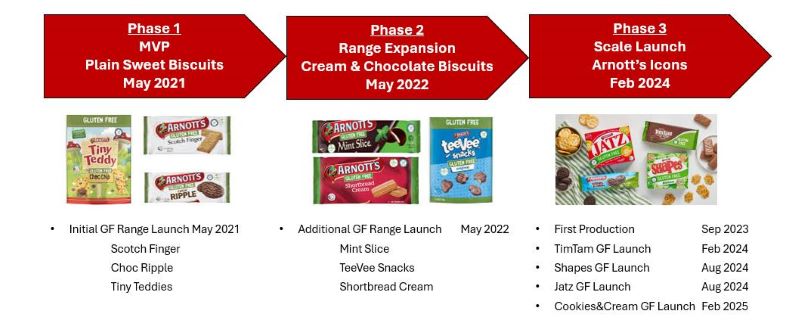
The Arnott’s team says its Gluten Free range has been an overnight success – albeit three years in the making. Having first delivered an initial MVP in 2021, and subsequent range expansion in 2022, it was the launch of the Arnott’s Gluten Free Icon Range of Tim Tams, Shapes, Jatz and now Cookies & Cream in the last 12 months that has been the gamechanger and ultimate growth unlock.

Today, gluten-free biscuits make up approximately 10 per cent of the total biscuit market, with an impressive annual growth rate of 40 per cent. Remarkably, Arnott’s has driven 82 per cent of this growth in the past year alone. Nearly 50 per cent of sales revenue growth on GF products realised in the last 12 months off the back of launching classic favourites done GF like Tim Tams.

“We’re almost at our five-year goals, two years ahead of schedule,” says The Arnott’s Group CMO, Jenni Dill. “Perhaps the most exciting part of Arnott’s Gluten Free growth initiative is that we’re just getting started. We have big ambitions and aggressive growth plans over the next five years, including more incredible new gluten-free products, more international expansion and even better sales results.”

Such substantial growth doesn’t come from nowhere. Over the past four years, The Arnott’s Group has been on a transformational journey, making its marketing one of the most effective and efficient in Australia. Dill says this was driven by relentless focus on what matters most, crystallised into four strategic priorities:

  1. Grow the core
  2. Build a Scale BFY [better for you] biscuits business
  3. Grow premium Indulgence
  4. Driving step-changed consumer impact through PR, social and digital

Going into gluten free is part of the group’s ‘better for you biscuits business’ strategic pillar. To get the ball rolling, Arnott’s kicked off in 2021, plotting a three-phase approach over five years to deliver growth.

“The launch of Gluten Free marks a significant expansion into the rapidly growing market of gluten avoiding consumers and required new ways of working to truly unlock the growth potential,” says Dill.

A set of ambitious five-year goals were set: Drive incremental revenue for Arnott’s, achieving $50m in retail scan sales; deliver incrementality of sales over 50 per cent; deliver share leadership in gluten-free biscuits; and delight consumers with a gluten-free range that tastes just as good as the gluten versions.

Building the capability to deliver gluten free

Launching and scaling the Gluten Free range required a dramatically different approach for Arnott’s. The first step was launching Minimum Viable Product (MVP) to prove concept, then scale when ready. Arnott’s ventured into the gluten-free market with a small, strategic range of products designed to test the market potential, introducing simple yet beloved biscuits like Scotch Finger, Choc Ripple and Tiny Teddy.

“The success of this initial launch paved the way for an expanded lineup in 2022, featuring cream-filled and chocolate-coated favourites such as TeeVee Snacks, Shortbread Cream, and Mint Slice,” explains Dill. “By November 2022, with strong early sales and positive consumer sentiment, we committed to a $30m investment in a state-of-the-art gluten-free bakery within our existing bakery in Adelaide.”

In just 10 months, the first gluten-free Tim Tam at the new gluten-free bakery came off the baking belt, something that would typically take 24-36 months from capex approval.

Operational transformation was driven by a dedicated cross-functional team that worked hand-in-glove to deliver. The new, walled off, gluten-free bakery introduced stringent operational practices, including segregated uniforms, lunchrooms and staff, as the main bakery surrounding it continued to produce gluten-containing products.

“In the past 12 months, our investment in our own gluten-free bakery has enabled us to launch our true icons; gluten-free versions of Tim Tams, Shapes, Jatz and Cookies & Cream that taste just as good as the original versions. These launches drove a step-change in gluten-free growth, for both Arnott’s and the biscuit category,” says Dill.

Operations needed to adhere to un-matched baking expertise and highly regulated gluten-free claims. Australia boasts some of the world's strictest standards for gluten-free products, with local regulations capping gluten detection at an incredibly low 5 parts per million (no detectable gluten). In contrast, the US, the UK, and the EU permit up to 20 parts per million in products when making a gluten-free claim.

“This stringent regulation often deters global brands from entering Australia’s gluten-free snacking market even if they have gluten-free offers overseas,” comments Dill.

Arnotts plan

Today, 112 packets of gluten-free Tim Tams are made in the 3800sqm Marlestone factory per minute, adding up to 2 million kilograms of gluten-free biscuits made by Arnott’s in total per year. The consumer repeat rate for these products exceeds 51 per cent, far surpassing industry benchmarks.

Complementing the product investment was a broad launch strategy, turbo-charged with in-house amplification to reach the gluten-free target.

“We leveraged the Masterbrand model for broad reach of the gluten-free launch announcement while also investing in hyper-targeted, highly engaging messages to the gluten-avoiding audience,” says Dill.

This included a 15-second dedicated Gluten Free TVC edits for Scotch Finger, Tim Tam, Shapes to announce the launches. Arnott’s also partnered with the Coeliac Australia, the peak body for gluten-free consumers, with on-pack certification, advertising and editorial in the Coeliac magazine, product giveaways and sampling and leverage its social following.

Creating excitement across the gluten-free community through social and PR also delivered record owned and earned impact, including more than 250 million earned impressions with a media value equivalent of close to $20 million. Arnott’s additionally chalked up 300+ pieces of coverage from mainstream media outlets including the Daily Mail, Triple M, KIIS, The Project, Nova, and News.com.au.

We’re almost at our five-year goals, two years ahead of schedule. Perhaps the most exciting part of Arnott’s Gluten Free growth initiative is that we’re just getting started.

Jenni Dill, CMO, The Arnott's Group

Cross-functional and executive-level alignment

According to the Arnott’s team, launching the Gluten Free range was more than just a marketing initiative; it was a transformative business endeavour that required true cross-functional collaboration to deliver success.

First up was executive sponsorship. “Even with compelling commercial case, this growth initiative still represented significant risk, high levels of capital investment, and the worlds’ strictest gluten-free operational standards,” continues Dill. “Despite this, we worked hard to align and secure c-suite and board backing – and more importantly, the funding for $30m in capital investment to build a gluten-free bakery inside an existing gluten bakery.”

Cross-functional collaboration meanwhile, saw teams from marketing, R&D, finance, sales, engineering and supply chain united to develop the world-class new products to satisfy consumer demand. Part of the unique structure of the Arnott’s business teams is the inclusion of members from these functions as a way of overcoming barriers and unlocking growth, comments Dill.

Retailer partnerships were another vital part of the picture. The team built a compelling growth story to achieve strong buy-in from major grocers, aligning launch dates, incremental range and space, further driving the scale and incrementally of results.

Collaborating with Publicis Groupe and Analytic Partners, Arnott’s then crafted an evidence-backed campaign that maximised reach, sales results and incrementality. In addition, it leveraged in-house social and PR capability to drive an always-on content strategy across owned and earned channels, maximising reach across a broader audience and engagement among gluten-avoiders.

“This comprehensive approach not only launched a successful product range but also set a new standard for business-wide transformation for high speed, high complexity, high stakes initiatives,” adds Dill.

Commercial impact

Having delivered an initial MVP launch through a co-manufacturing deal in 2021, the launch of an in-house made Arnott’s Gluten Free Icon Range of Tim Tams, Shapes, Jatz and now Cookies & Cream in the last 12 months has been the gamechanger and led to the follow results:


Results Summary

Last 12 Months

Arnott’s GF Retail Sales

$42m

Arnott’s GF YOY Sales Growth

+135%

Arnott’s GF Market Share

40%

Arnott’s Share of Growth

82%


Notably, Gluten Free sales are 71 per cent incremental to Arnott’s, the FMCG’s most incremental launch to date. It’s even growing abroad: Gluten Free Tim Tam launched in the UK in February 2025, delivering similar units per store sales to Australia after just three weeks.

“Perhaps the most exciting part of Arnott’s Gluten Free growth initiative is that we’re just getting started. We have big ambitions and aggressive growth plans over the next five years, including more incredible new gluten-free products, more international expansion and even better sales results,” says Dill. “Watch this space!”

It was a no-brainer for this year’s judges to hand The Arnott’s Group the trophy for the inaugural Best Growth Initiative of the Year Award, brought to you by Publicis Groupe, at the first-ever CMO Awards for its gluten-free product range efforts. Judges noted the articulation of the insights behind the approach, detail on how growth has been defined and unlocked, whole-of-company alignment and investment, classic principles of marketing in play, and the go-to-market work itself, as a compelling, standout growth story.


CMO Awards 25

CMO Awards 25

CMO AWARDS SPECIAL REPORT
The journey to business growth: How CMOs are rethinking customer engagement
  • Six of our CMO Awards 2025 and CMO50 2022 alumni share how they are rejuvenating their customer journey approaches using data and insight, fresh segmentation, personalisation, tech and AI.
  • In-depth look at the work done by marketing teams across Freedom Furniture, Suncorp, MYOB, IBM, Anytime Fitness and REA Group, to improve responsiveness to customer journeys across the lifecycle and throughout their organisations, driving better engagement and experiences.
  • Hear how marketers are striking a balance between customer preferences and changing behaviours, privacy and governance versus hyper-personalisation at different stages of customer journeys.
  • Supported by CMO Awards Platinum Partner, Adobe, and Gold Partners, News Australia and Publicis Groupe.
Six of our CMO Awards 2025 and CMO50 2022 alumni share how they are rejuvenating their customer journey approaches using data and insight, fresh segmentation, personalisation, tech and AI.
Special Report 2
CMO AWARDS SPECIAL REPORT
From Silos to Synergies: Unlocking the CMO-CIO Partnership
  • What it really takes to transform the CMO and CIO relationship from antagonism and misalignment to unity and common goals
  • In-depth case studies with marketing and technology chiefs at 5 leading Australian brands: Beyond Bank, IAG, Treasury Wine Estates, University of Tasmania and Virgin Australia.
  • 5 key drivers instrumental to forging successful partnership
  • Strategic ways CMOs and CIOs are tackling AI together
  • Supported by CMO Awards Platinum Partner, Adobe, and Gold Partners, News Australia and Publicis Groupe.
What it really takes to transform the CMO and CIO relationship from antagonism and misalignment to unity and common goals.
CMO Awards - Special Report 1
Search Mi3 Articles